Tag Archives: Western Conference

Looking at the NBA’s 2015 non-conference schedule

Last week’s release of the NBA’s 2014-15 season schedule marks the return of the non-conference posts. Maybe we’ll find something that gives one conference a scheduling edge over the other in their non-conference matchups. For the East, that would be nice.

As a reminder, 450 non-conference games are played each season, basically taking the number of teams (30) divided by those in each conference (15). The matchups last season were historic in several ways, one being that the West outscored the East by 4.09 points per game, the highest ever point differential in the last 17 seasons, according to NBA.com. The 2014 West nearly finished with the highest winning percentage in non-conference play, but fell just short of the mark set in 2004 at 63.33 percent.

Below is a breakdown of point differential, wins and losses, and win percentage in non-conference play since 1998. You can find the same chart in the last East vs. West post last season. All stats are from NBA.com:

It’s probably obvious, but the 450 non-conference games next season are not scheduled at a consistent frequency over the season nor do they all take place within designated weeks. Below is a chart of how many of these games take place in each of the 25 weeks.

2015 non-conf games

19 of those 25 have anywhere from 14-29 non-conference games and the ones that fall below that range are opening week, the week just before and after the all-star break, and the last three weeks of the season. On the other end, weeks 5&6 (11/24-12/7), 13&14 (1/19-2/1), and 20&21 (3/9-3/22) combine to take up over a third of the non-conference games. Those two-week stretches feature 50, 51, and 56 games, respectively.

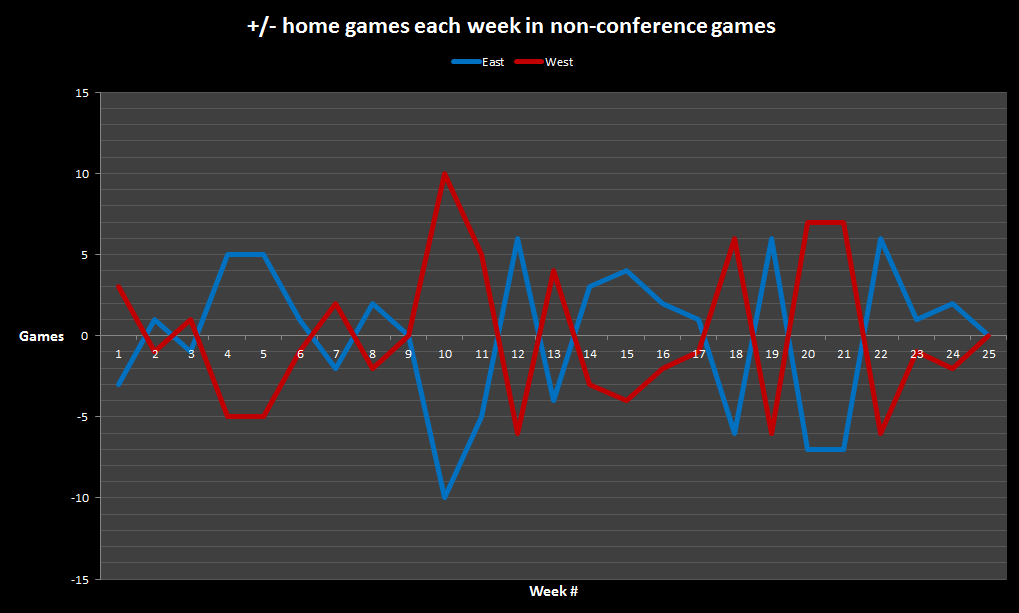
And though each team has 15 home and road non-conference games, they don’t happen equally either. Below is a chart looking at how many more home games each conference plays versus the other each week. For example, on the first week (10/28-11/2) the West has five home non-conference games versus two for the East, which amounts to +3 in the chart.
2015 non-conf home and road games

The East will have more home games early on, but it will catch up to them as we head into 2015 when the West will have 30 of the 45 games from 12/30 to 1/11 at home. From 1/26 to 2/22, the East will have 10 more home games than the West, but then the West hits another home-heavy stretch from 3/9 to 3/22.

Rest is also a factor in quite a few non-conference games. 238 (52.9 percent) of the 450 matchups will feature teams playing on equal days of rest, with 191 featuring both the West and East team on a one-day breather. Below is a chart of the total games on equal rest and those that feature rest advantages:

2015 non-conference rest


The advantage of playing games on more rest than an opponent goes to the East, 108 to the West’s 104, but the West holds arguably the most important rest advantage: Games with rest vs squads on back-to-backs, 69 games to 65 but also a 60 to 49 edge in games at home vs squads on a back-to-back. An advantage for the East is having six more games where they’ll have more rest vs opponents coming off a one-day break, best when an opponent is in the middle of a stretch of four games in five nights or three in four.

Of course, not all back-to-backs are equal. A back-to-back combo of Philadelphia and Boston is less intimidating than 2/3 of the Texas Triangle. Then again, the Knicks went 2-1 through the Spurs, Rockets, and Mavericks. Injuries and mid-season trades also happen, though the latter not nearly as often as in the past.

Predictions for teams and conferences is pointless to me, but I still see a top-5 point differential for the West with the reason as simple as the West remaining lo-o-o-oaded. That prediction isn’t as bold as saying the West will record their best ever winning percentage versus the East, but like last year a ton would have to go wrong for that to have a chance of happening. For the sake of a great season and competitive balance, hopefully Derrick Rose and the Bulls stay healthy, Toronto picks up where they left off since trading Rudy Gay, Chris Bosh returns to a strong #1 option, Cleveland has a hell of a year with LeBron James, Kevin Love, and Kyrie Irving, and the middle of the East wins a few more games than last season.

But we’re still over two months away from the regular season, which I struggle to accept. First hopeful thing comes first: Hopefully this off-season doesn’t last forever.

East vs. West Week 25: Final standings with offense-defense splits

The East vs. West series started thanks to the West’s usual dominance over the East this season, but also thanks to a post by Basketball-Reference detailing the historical disparity in the conferences over the years. This is the final post this season.

A bit late thanks to a fever that doesn’t seem to be letting up anytime soon and looking into a few projects going forward, but below is the final week-by-week non-conference breakdown. Followed by that are the final point differential tables and also some splits for how teams performed versus each conference and on the road or at home. There are some pretty glaring differences in each.

But below is the breakdown first:

The last game featured Detroit Detroiting to Oklahoma City, falling in the final minute to a Thunder squad looking to clinch the second seed out West.

Onto point differentials with the first sheet comparing this season’s margin of victory with others and the second sheet looking at month-by-month splits of this year.

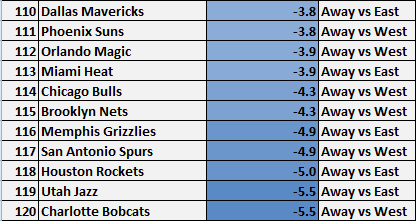
Lastly, thanks to some boredom but also hoping to add something to the last of these posts, below are some home-road east-west splits for offensive efficiency, defensive efficiency, and net rating. Since I still can’t figure out how to let readers sort through columns (it might be available on the newest version of Google Sheets, but still no luck embedding those to here), I color-coated rankings:

Something of a TL;DR section for the tables above, starting with offensive efficiency and ending with net rating:

    • Sample sizes are somewhat small for each. There are 15 non-conference home and road games and 26 games each for teams in the same one, but especially for squads in the same division. It makes for some big swings when comparing splits, especially for a team that goes through a roller coaster of a regular season like, for example, a trip to the West coast while dealing with injuries or turmoil then hit its stride after hosting some games.
    • There’s a noticeable drop-off when comparing arguably the easiest games (at home versus a team out East) and arguably the most difficult (on the road versus a West squad). Comparing the former to the latter, New Orleans has the biggest decline in scoring, scoring 10.2 points/100 possessions less. Detroit, Milwaukee, and Cleveland have upticks, oddly enough.
    • When comparing those splits to a team’s overall offensive efficiency, here are the biggest increases and decreases: :
    • Uptick/Downtick compared to overall efficiency (offense)
      UpticksplitO downticksplitO
    • Like scoring for teams hosting East opponents compared to on the road against the West, the difference in allowing points per 100 possessions is pretty large. Again comparing the former to the latter, every team allowed more points on the road against West teams with Cleveland at the largest with +14.1 points.
    • For nearly the entire season, the Spurs were the only team to allow less than 100 points when on the road against the West, a spectacular feat when they rested their trio (and more) for a decent chunk of those games. That accomplishment disappeared after their games at Oklahoma City, Minnesota, Dallas, and Houston.
    • Below are the largest upticks and downticks in defensive efficiency when compared to a team’s overall numbers. Captain Obvious maybe, but here’s a reminder that downticks in defensive efficiency are good when regarding the screenshots below:
    • Uptick/Downtick compared to overall efficiency (defense)
      upticksplitDDownticksplitD
    • The last sheet, regarding net rating, features some more startling numbers. Indiana somehow has a negative net on the road against East teams while Minnesota, among others, has a quite a change when comparing games at home versus the East to any other split.
    • There’s also a 20 point/100 possession difference for New Orleans when comparing games at home versus the East and on the road against the West. It’s the highest difference when comparing those two splits. Indiana (16.1), Houston (13.7), Chicago (13.5), and Minnesota (13.0) round out the top five.
    • The Spurs and Clippers are among the more consistent teams when comparing each category.
    • Overall, this all confirms the obvious: Teams often performed much better against the East than the West and even more when adding home-road splits, though the sample sizes for each are somewhat small.

This was a fun series to fool around with each week, and it was nice to see these posts recently assist two of my favorite writers and tweeters, Zachary Bennett and Matt D’Anna, in looking at how to retool divisions and conferences, or even get rid of them. That probably did more for me than it did for them since it looks like this blog has a few extra readers daily, and it was nice to know there was at least some usefulness in these posts. Good stuff. I definitely celebrated with a ham sandwich. It was fantastic.

But that’s it for this series, at least until next season when I could see the West pulling off a top-5 point differential. There are some likely rising teams out East like Washington, Toronto, and Chicago in a way, among others, but the West has as many if not more teams that should improve like Phoenix, New Orleans, and possibly the Lakers and ones that should stay legitimate in Oklahoma City, Houston, and the Clippers. Of course, there’s a whole off-season to play out and the East could balance itself somewhat with teams rising from the lottery to 40-win territory, but for now I’m siding with yet another loaded Western Conference.

East vs. West Week 24: Eh???

Updated week-by-week breakdown with an added column: point differential for the West through each week.

The one game left is Detroit taking on Oklahoma City on Wednesday, guaranteed (probably) to be fun for no longer than one half.

With Oklahoma City’s loss at Indiana yesterday, though, the West is out of contention for their highest winning percentage ever. Sad times since I beat that possibility into the ground over the last two months. Regardless, there’s always point differential to look at:

Lastly, updated month-by-month point differential:

I’ll look into posting something far more interesting after the regular season concludes. We’re so close to those amazing first round matchups out West andacoupleoutEastbutwhatever. Three more days!

East vs. West Week 23: Counting down to the last of the 450 games

Another week, another updated week-by-week breakdown:

The most exciting non-conference game of the week had to go to Minnesota traveling to Miami and winning in double overtime, much of it thanks to Kevin Love’s ridiculous shot making and Ricky Rubio carving up a hyper Heat defense. LeBron James and Chris Bosh weren’t too bad for the Heat, though, among other players. Dwyane Wade didn’t play because of a lingering hamstring injury.

Houston also lost their last two non-conference games, falling to the Nets and Raptors. Aside from all but guaranteeing the Rockets the fourth seed in the West, it also meant that San Antonio clinches the best record against the East at 24-6 while the Lakers and Kings are tied for the worst at 12-18 each. Neither hold a candle to Milwaukee’s 3-27 record in non-conference play, however, and the Bucks, 76ers, Magic, Celtics, and Pistons are collectively 100 games under .500 against the West, a combined record of 24-124 with the 76ers and Pistons finishing up the season with Memphis and Oklahoma City, respectively.

Maybe that’ll lead to an uptick in the West’s point differential, which I also updated from last week’s post. It hardly changed, but probably worth noting where it ranks in non-conference play since 1997 anyway:

Lastly, here’s the 212,749,834,9a8,943,f92th reminder about the West’s possible record-breaking winning percentage: They’d have to finish their last five games 4-1 to tie 2004’s 63.3 winning percentage and win all five to break it.

Below are those final non-conference games this season:

The last three games look very winnable for the West while the first two are something of a toss-up. Maybe they’ll split? Miami and Minnesota will be playing the tail-end of back-to-backs, however, with the first games against Brooklyn and San Antonio, respectively. Not the easiest two consecutive games for either team, especially when Minnesota has been without Nikola Pekovic, Kevin Martin, and about half the roster recently.

East vs. West Week 22: Comparing the West’s dominance with point differential

With another week of non-conference play in  the books, it was the same soup just reheated for the West as they went 12-7, a win rate similar to the season overall.

Every one of their playoff teams now has 20 wins against the East, something I brought up in previous posts about never being done before. Four teams out West are still in contention for the best non-conference record, but Milwaukee clinched the worst at 3-27. Two of those wins come from a sweep of the Los Angeles Lakers. Also worth noting is half the league finishing up non-conference play for the season. Gone are the West’s chances to build winning streaks against the middle and bottom of the East, which could mean movement in lottery balls.

Below is the updated week-by-week breakdown. I also included point differential for each week which I’ll then expand on by looking at how it stacks up against every other season since 1997. That’s as far back as NBA.com goes and, as far as I can tell, Basketball-Reference doesn’t yet have those splits to sort through. 1997 is a decent stopping point, though, because of expansion the season prior.

The West’s margin of victory month-by-month can be found here, for anyone curious.

Winning percentage shouldn’t be the only measuring stick for how dominant the West has been against the East. In fact, 2014 currently tops 2004 – the season with the West’s highest non-conference win rate ever – in average margin of victory:

That record-breaking point differential isn’t going to change much since there are only 11 non-conference games left. Neither are the complaints that Minnesota and one of Phoenix, Dallas, Memphis, and Golden State will miss the playoffs all while Atlanta is limping to the finish line.

I’ll have another blog post today regarding home/road, east/west splits. It’s actually something I kind of, sort of looked at six weeks ago but this time will be much more simple, hopefully less complicated and hopefully less ridiculous.

Edit: Maybe not, since Google Sheets doesn’t seem to be working for me.

All stats are according to NBA.com.