Category Archives: 2014 NBA Season

Houston’s twin’s towers: A permanent breakup or temporary?

200px-Houston_Rockets.svg

Playing Dwight Howard and Omer Asik together seemed hopeless from the get-go.

You could say Kevin McHale’s change in the lineup last night was a one-time adjustment, meant to match up with a smaller, hectic 76ers lineup that started Thaddeus Young at power forward, but the results of playing the two centers at once justify scrapping the ‘Twin Tower’ idea altogether. In 92 minutes, the Rockets were minus-35 in point-differential when Howard and Asik were on the floor, scoring at a rate that would’ve ranked far and away dead last in the league. Defensively, they flirted with the bottom ten in efficiency, that side of the court being where the two centers would be effective.

But not when they’re paired together.  

Enter Terrence Jones, the second-year forward who started in Asik’s place in last night’s overtime-loss. He had 10 points, 11 rebounds, three blocks, and two threes in 37 minutes. Pick and choose which of those statistics is most surprising, whether it’s the threes he helped stretch the floor with, the rebounding that was very good for the playing time he was given, or even just the fact that he played 37 minutes even if the game went to overtime.

Or maybe Asik all but joining ‘Club Trillion’ in only four minutes of play stuck out more than whatever Jones did. It’s too early to peg just how many minutes he will receive if he continues coming off the bench, though he only played 10-15 minutes when he was a backup for the Chicago Bulls.  Who knows what McHale has in store for Asik and the Houston’s rotation going forward. 

Jones playing 37 minutes was also surprising, as mentioned earlier, but he made them count. 30 of them were with Howard, resulting in Houston being plus-eight in point-differential in that timeframe. The starting lineup with Jones and Howard was even better as they logged 25 minutes as a unit and were plus-11. Defensively, they had about the same efficiency as any lineup featuring Asik and Howard together, but the offense was so much better. It also helps when Jeremy Lin makes, say, nine three pointers, though his defense continues to be a question mark going forward.

It was obviously only one game (I feel like I’ll have to type ‘SMALL SAMPLE SIZE ALERT’ in every post for another month) and the absence of James Harden and Michael Carter-Williams, the triple-double of Tony Wroten, and the 36-point outburst of James Anderson were just a few reasons to take last night’s results with a whole saltshaker. 

But Houston’s experiment with playing Terrence Jones at power forward was a necessary one, in my couch potato opinion, regardless of the opposition. Tonight, the Rockets match up with the Knicks, another team featuring a small ball starting lineup. Let’s see what McHale does next.

All stats are from NBA.com.

Looking at the corner 3, where the Utah Jazz are shooting nine percent

Shotchart_1384330671093

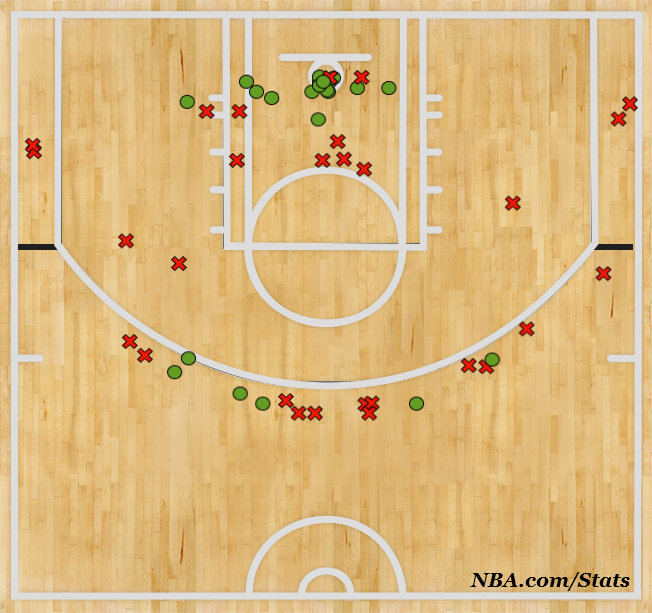
Utah’s shot chart. So much blood.

It might be overkill to look at the Utah Jazz’s struggles when I wrote about Toronto’s shooting yesterday. That, and Zach Lowe touched on the cramped spacing for Utah at the end of his latest column. But I’ll also look at a few more things about the corner three, including which team was once so good from that special area that it was silly.

But to start, as you can see in the Jazz’s shot chart, there are a lot of areas where the Jazz are struggling to convert offense from. None of it is worse than the corner three though, where they’ve shot a whopping 9.1 percent (3 for 33). It’s obviously a small sample size and a few other teams have been brutal from the area that usually produces the most efficient shot outside of a layup, but it’s difficult imagining the Jazz not being one of the five worst shooting teams from that area by season’s end. Who’s going to make those shots? Can Richard Jefferson catch fire for like one game? Where’s Brandon Rush? It might be up to Gordon Hayward, who was at least 45 percent from the right corner last year.

Again, it’s only been eight games, but hopefully they don’t break the record for worst shooting ever from the corners. That record belongs to Grant Hill, Jerry Stackhouse and the 1998 Detroit Pistons who shot a record-worst 25.2 percent, according to NBA.com. To stay above that mark, Utah, if they keep taking the same amount of shots from the corner as they previously have, will have to make at least 28 percent from here on out.

Hopefully that’s manageable, and it should be. No team has made less than 30 percent of their corner threes since the Jazz of 2007. If it’s not, then starting 0-8 may only be the beginning of a long, frustrating season in Salt Lake City. (At least there’s college basketball to look forward to.)

It’s weird though. Utah used to traditionally be at or near the bottom in corner threes attempted but were very good at making them. And since they were good at making them (they shot 50.7 percent in 1999, which is nowhere near the best and soon you’ll see who is) then why didn’t they shoot more? Why didn’t every team shoot more from the corner? No team neglected corner threes as much as Portland did in 1997 though, according to NBA.com, setting the record for the least corner threes attempted in a season with 86. Last year, 12 teams surpassed that many attempts before December.

But in 1997, another record involving corner threes was set–and this one is way better! The Charlotte Hornets, featuring Dell Curry and Glen Rice in his career year, set the record for the most accurate shooting from the corners by making 108 of their 175 attempts for a blistering 61.7 percent. Most teams today don’t even shoot that well around the rim. (Edit: Glen Rice was 45 for 68 from the corner three — 66.2 percent) 

There are a ton of good shooters from the corner today but picturing a team breaking that mark, combined with the total number of shots taken there? That would surely be a team for the ages. Hopefully the Utah Jazz don’t end up on the opposite end of that discussion.

Overreaction of Week 1: Josh Smith’s shot selection

overreaction

This post was initially devoted to all sorts of weird happenings over the first week of the NBA’s season. Michael Carter-Williams and the 76ers tanked so hard they ran over every team with their tank (until the Warriors ran them out of their own building), Boston was in pole position for the 2014 Draft as a result of the 76ers’ (and Suns’) unexpected starts, there were struggles from Derrick Rose and John Wall, and Milwaukee’s bench (21.5 points per game per-48-minutes) was the third-stingiest in the league and gave the incredibly average Bucks some hope for the postseason again.

But screw it. Of all the storylines to discuss, I wanted to write about what could possibly be this decade’s Rasheed Wallace in Detroit: Josh Smith. We’ll take a look at his offense through three measly games.

Last season, Smith took 363 shots (!) between ten feet and the arc which were good for just 30.5 percent. He also made only 29.9 percent of the 221 threes he hoisted. Overall, he was only a 30 percent shooter when he took jump shots. That’s just not acceptable for anyone, let alone a player where well over half of his field goal attempts were came from them.

What’s actually most frustrating though is how good he was around the rim at 77.1 percent, yet only about a third of his shots came from that area. His PER of 17.7 was his lowest since 2009, his three-point attempt rate of .170 was the highest of his career, and he recorded -0.3 offensive win shares. (All the stats listed so far are according to Basketball-Reference.)

It triggers the same reaction I had about Wallace, who’s now on the sidelines for the Pistons: Just get in the paint! Wallace was a much better three-point shooter than Smith has ever been, but the Pistons of the mid-2000s could’ve used more of a paint presence alongside the barrage of mid-range jumpers they were known for taking (but at least they made a respectable percentage of them).

Fast forward to this season as Smith enters the first year of his four-year, $54 million contract with the Detroit Pistons. The paint, where Smith is so good yet often neglects, is even more crowded with Andre Drummond and Greg Monroe starting alongside Smith, who’s now playing small forward. 25.6 of Smith’s 40 minutes per game have been spent with Drummond and Monroe with respectable results so far. Detroit’s outscored their opponents by 1.4 points per 100 possessions when all three are on the court.

But Smith’s shot selection has been controversial as usual. He’s averaging 7.3 three-point attempts per game — including an 11-attempt outing in a three-point loss at Memphis — and making only two on average. That’s good for 27.3 percent and he’s shooting only 20 percent on jump shots overall. Smith’s more than doubled his three-point rate from 2013, with 44 percent of his shots coming from beyond the arc. If anything, the frequency of his three-pointers could turn into a drinking game.

As a result, his free throw rate has been sliced by more than half. Smith’s typically been below average from the line, shooting a career-worst 51.3 percent last season, so there could be a correlation between that percentage and the decline in free throw attempts overall. But it could also be the result of a feeling out process now that Smith is playing with two frontcourt players who also work around the painted area.

There’s good news, though. Check out his shot chart through three games:

Shotchart_1383690868809

He hasn’t hugged the dead zones (at least so far) like in previous seasons. Only five of his first 50 shots have come between ten feet and the arc while eight have been attempted from five to nine feet where Smith has also typically struggled (and continues to do so, making just two shots from that area so far).

The rest of his shots (15) have come within five feet where Smith’s been terrific, making 13 of them for an 86.7 percent mark. It would be nice to see more of his shots taken there—as well as his three-point rate dropping back to a less-ridiculous level for his skill set—but Smith would be viewed differently so far if a couple more of those threes dropped.

If anything, his shot chart actually looks promising even if all the X’s from the arc say otherwise. If he’s going to chuck the long-range jumpers — and there’s barely a difference in accuracy between his 18-footers and three-pointers — wouldn’t you rather have Smith chuck from behind the arc? If both go in at a 30 percent clip, it’s an extra 0.3 points per attempt when Smith shoots from three. Whether that cures the headaches of fans of Detroit though is anyone’s guess.

There’s plenty of time to bring Smith’s game to the paint more frequently—and whether Pistons head coach Mo Cheeks wants it there—and for his jump shot to be a little less brick-worthy. Here’s the most Josh Smith three pointer of them all, by the way, unfortunately happening in the preseason:

We’ll see if his offense improves as the season goes on or if dedicating a post to his shot selection, with a tiny, tiny sample size, was just a waste.

Tweets of NBA arenas before their home openers

Since a few games start much later than others, I’ll continue updating throughout the night. If they don’t load at first, just refresh the page and it should work out. Anyway, enjoy.

Cleveland Cavaliers

https://twitter.com/ZPisani/status/395675316137385984

Dallas Mavericks

Where Dirk Nowitzki, Monta Ellis and Monta Ball will happen.

Detroit Pistons

The Josh Smith era begins:

https://twitter.com/Sean_Walker_/status/395687351902420992

Golden State Warriors

Houston Rockets

http://twitter.com/RelativitySport/status/395668181726945280

Minnesota Timberwolves

New Orleans Pelicans

If only the seats were color coordinated to create an Anthony Davis unibrow.

https://twitter.com/KelsWingert/status/395667801592963072

New York Knicks

Google translated to: the night Knicks fans turn on Andrea Bargnani. Probably.

Philadelphia 76ers

Congrats to Allen Iverson.

Phoenix Suns

Maybe Robert Sarver will have better luck filling courtside seats this season.

http://twitter.com/JasonRowleySuns/status/395666324166156288

Sacramento Kings

San Antonio Spurs

https://twitter.com/amelie_nicolett/status/395699762038448128

Toronto Raptors

https://twitter.com/boi1danet/status/395660780818800641

Utah Jazz

https://twitter.com/BPbees/status/395590900841074688

Enes Kanter may have took one step onto the court and shattered it.

2014: The season of comebacks

Maybe it’s because this will be my first basketball season without worrying about school, but the 2013 offseason was the slowest that I can remember, even topping (or in this case, bottoming?) the 2011 lockout.

The preseason, now what I call the weird season after watching Andray Blatche hoist six threes against the Celtics, didn’t help my NBA withdrawals either. There was this gem, however:

But just when it was tempting to resort to swallowing Halloween candy whole to cure my boredom, the NBA season arrived. There are the usual storylines coming into 2014: the off-season acquisitions we have to wait and see on whether they work out or not, the youthful players we hope evolve into franchise cornerstones, lottery-bound teams last season looking to get back into contention, and so much more.

If I had to pick a working title for this season right now though, it would be “The Season of Comebacks”, starring Derrick Rose, Kobe Bryant and Rajon Rondo, among others, who are returning after suffering devastating injuries a season or two ago. We’ll get to see one of those comebacks tonight in Rose, and what a bang he should start the season off with.

But the returns of Kobe and Rondo are still up in the air thanks to another unique element playing into this season: the 2014 NBA Draft. We may witness as much terrible basketball, thanks to tankapalooza, as much as we will witness great play with so many teams having a fighter’s chance at making this season’s Finals.

Whatever the dream matchup for the 2014 Finals may be, it’ll be quite a challenge to outperform what was a battle for the ages between the Spurs and Heat. It feels like that happened forever ago, yet somehow only four months have passed since its conclusion. I just remember wanting more after Game 7 but, after looking back at all that took place, feeling satisfied at the same time. It was like an ending to a great, season-long story.

How will we remember 2014? It’s time for its story to begin.