Potential playoff upsets with SRS

Six of the eight first round matchups are extending to at least six games for the first time since the best-of-seven format started in 2003. To me, none of those series have felt like a slogfest either. We might even see a few upsets, starting tonight with both the eighth-seeded Hawks and seventh-seeded Grizzlies hosting Game 6’s with 3-2 leads.

Looking at where each of those teams were seeded, those would be huge wins for Atlanta and Memphis if they can pull them off, but if we look at how they match up in regular season SRS with Indiana and Oklahoma City, respectively, sealing their first round series tonight (or in a Game 7) would be arguably even more impressive.

SRS, or shortened for Simple Rating System, combines margin of victory and strength of schedule. As you’ll see below, it has its drawbacks since it doesn’t exactly value records that help determine seeding, but it’s easily understandable and often does enough to show how good teams were for 82 games. For more of an explanation, check this out, but it might also help to say that the best SRS in league history, according to Basketball-Reference, comes from the 1971 Milwaukee Bucks at 11.91, narrowly beating out the 11.80 from the ’96 Chicago Bulls. The worst goes to the 1993 Dallas Mavericks at -14.68 while the average SRS is 0, though no team has ever actually achieved that exact rating.

To go back to the playoffs, from 2003 to 2013, the team with the higher SRS in their first round series has advanced 79.6 percent of the time, or about the same rate as teams with the higher seed at 78.4 percent. Teams with both the higher SRS and the higher seed (75 occurrences) won 84 percent of their matchups. (Edit: Washington, with an SRS .72 points less than Chicago, advanced Tuesday night and Portland, .62 points less than Houston, can advance tomorrow.)

The higher the difference in SRS with home court, the higher the likelihood a team will win a series, which makes it all the more interesting that Atlanta (SRS: -0.88) and Memphis (2.18) can each clinch tonight. Each of theirs are at least four points lower than Indiana (3.63) and Oklahoma City (6.66) and are in two of five matchups this postseason with that large of a difference or more.

Below are the others with Hawks-Pacers and Grizzlies-Thunder included:

I’ve been fiddling with the SRS of every matchup since 1984, when the league went to their current playoff format 30 years ago. The scenario this season’s Hawks, Grizzlies, and the other three teams are in – an SRS at least four points worse than their opponent and without home court advantage – has often made for a heck of an uphill battle.

Below is a round-by-round look at how teams, ones in those same situations as this year’s previously listed five teams, have performed over the last 30 seasons:

The Charlotte Bobcats will join the list of those that couldn’t overcome their disadvantages, but Atlanta and Memphis have two outs while Brooklyn and Dallas can still extend their season with victories at home tomorrow night.

As for the table above (for the series wins, click here) the only win in the second round came last postseason when Memphis (3.69) beat the Russell Westbrook-less Oklahoma City Thunder (9.15). Another weird one came in 2001 when the Los Angeles Lakers (3.13) had an SRS 4.18 points lower than San Antonio in the Conference Finals. Going by SRS, those Lakers were an underdog in every round except for the NBA Finals, when they were 0.11 points higher than the 76ers. They ended up having the most dominant postseason run of all time, according to Neil Paine but most likely tons of others, too.

2013 featured two upsets meeting this post’s requirements, though 1995 has the most ever with three. This postseason definitely has a chance of matching either 2013 or 1995, but they could also surpass them both with four or more. With all that’s happened the last two weeks, would it really be that surprising if that happened?

Also (!!), I haven’t posted lately because of a high fever at first, but I then made my debut at the Washington Post‘s Fancy Stats. If the Hawks’ three-point shooting has stood out to you, check out my post on how they’ve taken more threes than free throws and how unique their starting five is.

Any other thoughts are welcome.

East vs. West Week 25: Final standings with offense-defense splits

The East vs. West series started thanks to the West’s usual dominance over the East this season, but also thanks to a post by Basketball-Reference detailing the historical disparity in the conferences over the years. This is the final post this season.

A bit late thanks to a fever that doesn’t seem to be letting up anytime soon and looking into a few projects going forward, but below is the final week-by-week non-conference breakdown. Followed by that are the final point differential tables and also some splits for how teams performed versus each conference and on the road or at home. There are some pretty glaring differences in each.

But below is the breakdown first:

The last game featured Detroit Detroiting to Oklahoma City, falling in the final minute to a Thunder squad looking to clinch the second seed out West.

Onto point differentials with the first sheet comparing this season’s margin of victory with others and the second sheet looking at month-by-month splits of this year.

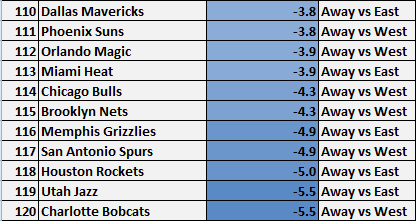
Lastly, thanks to some boredom but also hoping to add something to the last of these posts, below are some home-road east-west splits for offensive efficiency, defensive efficiency, and net rating. Since I still can’t figure out how to let readers sort through columns (it might be available on the newest version of Google Sheets, but still no luck embedding those to here), I color-coated rankings:

Something of a TL;DR section for the tables above, starting with offensive efficiency and ending with net rating:

    • Sample sizes are somewhat small for each. There are 15 non-conference home and road games and 26 games each for teams in the same one, but especially for squads in the same division. It makes for some big swings when comparing splits, especially for a team that goes through a roller coaster of a regular season like, for example, a trip to the West coast while dealing with injuries or turmoil then hit its stride after hosting some games.
    • There’s a noticeable drop-off when comparing arguably the easiest games (at home versus a team out East) and arguably the most difficult (on the road versus a West squad). Comparing the former to the latter, New Orleans has the biggest decline in scoring, scoring 10.2 points/100 possessions less. Detroit, Milwaukee, and Cleveland have upticks, oddly enough.
    • When comparing those splits to a team’s overall offensive efficiency, here are the biggest increases and decreases: :
    • Uptick/Downtick compared to overall efficiency (offense)
      UpticksplitO downticksplitO
    • Like scoring for teams hosting East opponents compared to on the road against the West, the difference in allowing points per 100 possessions is pretty large. Again comparing the former to the latter, every team allowed more points on the road against West teams with Cleveland at the largest with +14.1 points.
    • For nearly the entire season, the Spurs were the only team to allow less than 100 points when on the road against the West, a spectacular feat when they rested their trio (and more) for a decent chunk of those games. That accomplishment disappeared after their games at Oklahoma City, Minnesota, Dallas, and Houston.
    • Below are the largest upticks and downticks in defensive efficiency when compared to a team’s overall numbers. Captain Obvious maybe, but here’s a reminder that downticks in defensive efficiency are good when regarding the screenshots below:
    • Uptick/Downtick compared to overall efficiency (defense)
      upticksplitDDownticksplitD
    • The last sheet, regarding net rating, features some more startling numbers. Indiana somehow has a negative net on the road against East teams while Minnesota, among others, has a quite a change when comparing games at home versus the East to any other split.
    • There’s also a 20 point/100 possession difference for New Orleans when comparing games at home versus the East and on the road against the West. It’s the highest difference when comparing those two splits. Indiana (16.1), Houston (13.7), Chicago (13.5), and Minnesota (13.0) round out the top five.
    • The Spurs and Clippers are among the more consistent teams when comparing each category.
    • Overall, this all confirms the obvious: Teams often performed much better against the East than the West and even more when adding home-road splits, though the sample sizes for each are somewhat small.

This was a fun series to fool around with each week, and it was nice to see these posts recently assist two of my favorite writers and tweeters, Zachary Bennett and Matt D’Anna, in looking at how to retool divisions and conferences, or even get rid of them. That probably did more for me than it did for them since it looks like this blog has a few extra readers daily, and it was nice to know there was at least some usefulness in these posts. Good stuff. I definitely celebrated with a ham sandwich. It was fantastic.

But that’s it for this series, at least until next season when I could see the West pulling off a top-5 point differential. There are some likely rising teams out East like Washington, Toronto, and Chicago in a way, among others, but the West has as many if not more teams that should improve like Phoenix, New Orleans, and possibly the Lakers and ones that should stay legitimate in Oklahoma City, Houston, and the Clippers. Of course, there’s a whole off-season to play out and the East could balance itself somewhat with teams rising from the lottery to 40-win territory, but for now I’m siding with yet another loaded Western Conference.

Game-by-game shot locations for each team

About two months ago, I wrote a few things about the Knicks and their excessive shooting from the perimeter. Part of what was looked at were game-by-game shot locations for teams from NBA.com, but ever since writing that post there wasn’t a whole lot of usefulness with a season’s worth of shot location logging when it came to presenting it.

With the season concluding last night, however, I decided to release the entire document in this post. Along with that, I made three tables to highlight some of the best and worst performances by teams from each of the five spots on the floor: restricted area, paint non-restricted area, mid-range, corner three, and the above the break three. Unfortunately, I never tracked free throws. Maybe next season.

The three separate tables include the top 10 games with the most and least field goals made from each spot, most and least field goals attempted, and the hottest and coldest performances from each shot location. (Scroll a little further down in each table for the least/coldest shooting games.) For some categories with ties, I included a few extra games just because.

Some teams will dominate certain categories, for better or for worse, like how some may expect Houston to make a joke of the least mid-range field goals attempted. For every table I’ll also include some notes, something like a tl;dr section.

Anyway, the first table is the most/least field goals made from each location. You can toggle through each location with links to them at the bottom of each table. Again, for the entire document, this link should do the trick along with sheets detailing percentage of attempts outside the paint and percentage of attempts in high-efficiency spots versus dead zones.

Restricted Area: Not surprisingly, the Los Angeles Lakers got fried around the rim while the opposite can be said for the Pacers. All of the latter’s appearances in the least attempts around the rim came before the all-star break, but it shows just how suffocating they’ve been when clicking 100 percent.

Paint Non-RA: A good mix of teams and opponents for the most makes. Another not-so-surprising stat is how many games played out where a team was scoreless from this location: well over 40.

Mid-Range: The teams that shoot a ton from this location (Portland, New York, Orlando) make the list for most field goals made, Portland being at the top thanks to a 26-for-49 outing against non other than a team like Indiana. Houston and Detroit, the former neglecting this location while the other can’t space the floor all that well, fill up over half the slots for the least field goals made.

Corner 3: A mix of teams and opponents for both categories. A lot of struggling defenses gave up the most threes from the corner, however. Washington is the only team to make 10 in one game with Milwaukee being the casualty.

Above the break 3: Another variety of teams. Minnesota, one of the most frustrating teams from beyond the arc (in my opinion), actually makes the top 10 twice. More of the typical struggling teams from the perimeter crack the bottom 10: Memphis, Philadelphia, Detroit, Utah. Memphis is the only team to make no above the break threes in a game. Their opponent? Chicago.

Onto most and least field goals attempted:

Restricted Area: Detroit, a team that feasts around the rim, naturally is featured here. Philadelphia and Houston unsurprisingly crack the top 10 as well. The results for the bottom 10 may or may not be expected as well. Teams like Brooklyn, Boston, and New York make that list. Sacramento has the lowest attempts with 8. Crazy. That’s 45 less attempts than the leading Detroit.

Paint-Non RA: A mix of good defenses allowing the most attempts and bad ones allowing the least from this location. The Kings are a surprise in the top 10, however, making the list as an opponent three times. Some good and struggling offenses make the bottom 10 in attempts with Miami and New York each making it twice and Chicago once.

Mid-Range: Houston makes a joke of the bottom 10 attempts in a game. There’s a wider variety in the top 10 but Portland, Boston, and Washington unsurprisingly are featured. Indiana and Chicago account for half the opponents in that top 10.

Corner 3: Some brutal defenses make up the opponents in the top 10 with a mix of solid offenses as the ones teeing off from the corners. The opposite can be said for the bottom 10. Yeesh. 14 times has a team attempted no threes from the corner. Some good defenses and ones that struggle but do take away the corner (Portland) are the opponents during those games.

Above the break 3: A bunch of games that went into overtime make up the top along with a lot of solid teams and…Philadelphia. At the bottom, New Orleans and Memphis make up 2/3 of it with the latter shooting the least amount of threes from above the break with 3. Sigh.

Lastly, hottest and coldest shooting:

Restricted Area: Oklahoma City makes the top 10 multiple times, but Miami is absent despite their trio of LeBron James, Dwyane Wade, and Chris Bosh all feasting from that location. A few of the struggling offenses make up the bottom, as usual. No team missed 75 percent of their attempts, however, so there’s that.

Paint Non-RA: Tons of scoreless outings from this spot on the floor with the hottest shooting coming from less than 10 attempts. Dallas, Chicago, and New York are the only ones to shoot perfectly.

Mid-Range: Quite a few brutal nights, with New York’s Knicksy performance at Milwaukee probably being the worst. Brooklyn, with all the decent shooting they have, holds the worst park percentage-wise, however, at 19 percent on 4-for-21 shooting. Ouchies!

Corner 3: Lots of perfection here with New York’s KNICKSY game at Milwaukee topping all others. The worst outings come against a mix of both good and bad defenses. Not surprising, though, with how only a handful attempts or so available each game.

Above the Break 3: Indiana and Chicago each allowed a couple of the best shooting nights, though against respectable teams in the Suns and Clippers, respectively. There have sadly been 13 scoreless games from this location with the usual struggling teams from the arc being featured. Utah holds the worst performance at 0-for-14 against Dallas from just over a week ago.

But that’s it! A brief summary of each location. To explore the entire document and some other sheets I fooled around with from earlier posts, click here. Unfortunately, as someone not too experienced with Google Sheets, I can’t figure out a way to sort through columns. Any help would be appreciated since it’d be nice to let others sort their way through the document.

Other than that, enjoy the break until the playoffs.

As a reminder, all stats are according to NBA.com.

East vs. West Week 24: Eh???

Updated week-by-week breakdown with an added column: point differential for the West through each week.

The one game left is Detroit taking on Oklahoma City on Wednesday, guaranteed (probably) to be fun for no longer than one half.

With Oklahoma City’s loss at Indiana yesterday, though, the West is out of contention for their highest winning percentage ever. Sad times since I beat that possibility into the ground over the last two months. Regardless, there’s always point differential to look at:

Lastly, updated month-by-month point differential:

I’ll look into posting something far more interesting after the regular season concludes. We’re so close to those amazing first round matchups out West andacoupleoutEastbutwhatever. Three more days!

Adding to the unlikeliness of Corey Brewer’s 51 points

Shortly after Corey Brewer’s 51-point outing against the Houston Rockets, Ryan Feldman at ESPN Stats & Info published a post about if the Timberwolves wing is the most unlikely 50-point scorer ever.

Here are some cool tidbits from that column that I suggest giving a read:

What do Michael Jordan, Allen Iverson, Rick Barry and Corey Brewer have in common?

They’re the only players in NBA history with at least 50 points and six steals in a game (steals became official in 1973-74).

More:

Brewer is the sixth player in NBA history to score at least 50 points in a game without having previously scored 30 points in a game.

And lastly:

Brewer, in his seventh NBA season, is the most experienced player ever to score 50 points without having previously scored 30.

The only other players to score 50 before ever scoring 30 among players with at least two full seasons of NBA experience were Delk (fifth season in 2000-01) and Willie Burton (1994-95 season with the Philadelphia 76ers was his fifth season).

I’d like to add onto those interesting stats, though, after looking through 50-point scorers dating back to the 1978 season. It seems like that’s the first year Basketball-Reference started adding usage rating, among other statistics to their player pages. Here’s what I found:

For seasons when a player has scored 50 points in one game, Brewer’s usage rating is comfortably in last place. Below are the bottom 10 out of 150:

In the last 10 games prior to his explosion versus Houston, Brewer was using 18 percent of the team’s possessions while on the floor. Adding his career night (32.6 usage) hikes that recent uptick to 20.

Brewer also holds the second-worst PER (bottom 10 here) of the 50-point club, one that increased .5 points overnight. He also squeaks into the bottom 20 percent when it comes to offensive rebound percentage, something that could aid in scoring. He’s also on the list of the 25 worst three-point shooting seasons ever, at least for players taking over 200 attempts, and a below-average free throw shooter at 72 percent. The Timberwolves were also without one-half of their “outlet mall” in Kevin Love while Brewer often makes up the receiving end of the fast break points.

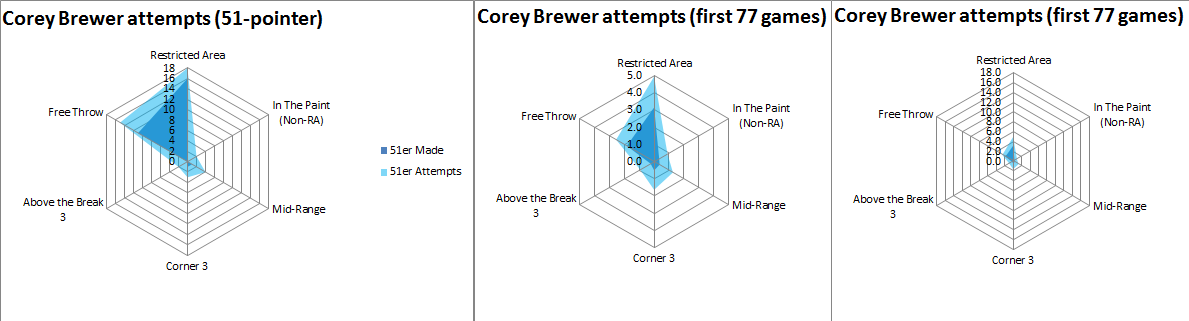
None of these obstacles got in the way of Brewer, who scored 32 points in the restricted area alone while going 2-of-6 from three-point range. As for three throws, he was 73 percent but off 15 attempts, good for 11 points from the stripe.

It’s safe to say he’s one of the more unlikely 50-point scorers and hopefully those stats contribute to the discussion. Just for fun, I wanted to compare his shooting that game to his averages in his first 77 outings so I fiddled around with a variety of graphs I’ve recently used for the highest scorers and teams, among other related posts.

Below are his attempted and made shots per game. The last graph is Brewer’s first 77 games with the same axis used for his 51-point outing:

Brewer attempts together

Click to enlarge.

Lastly, points per location:

brewer points

Click to enlarge.

Edit: Percentage of points by location and shooting percentages can be found in those links. I just couldn’t help myself when it came to including yet another batch of those charts in a post. I should probably turn it down a notch.

As someone in Minnesota, though, this has been quite an entertaining last month or so of the season despite the Timberwolves either basically out of playoff contention or officially eliminated. They travel to Sacramento on Sunday where they’ll play former-teammate Derrick Williams, who always seems to show up to play them, but how Brewer will bounce back from 51 points (I still can’t believe it) will obviously be exciting as well. Given how he plays, it’s possible those were the happiest 51 points ever.

All stats are according to Basketball-Reference.com, save for the shooting charts. Those are according to NBA.com’s numbers.