Why Kyrie Irving and Dion Waiters remind me of a backcourt duo from the 90s

Erik Drost | Flickr

Erik Drost | Flickr

Lately I’ve been getting my cavalier on, both with a more-lazy-than-usual weekend and a couple of my latest posts featuring the rebuilding, possibly playoff-contending franchise out in Cleveland. It wasn’t my intention to continue discussing them through this week, but the young backcourt of Kyrie Irving and Dion Waiters felt worth looking at.

Irving and Waiters arrived in Cleveland through the 2011 and 2012 NBA Drafts, respectively. The former went first overall and the latter sparked a lot of discussion about going fourth, drafted when Cleveland also could’ve used a small forward or center for the future. Nevertheless, Cleveland locked up their backcourt.

But the Cavaliers continue to struggle, 11 games under .500 as they approach the halfway point in the season. (They were 9-28 through 37 games a year ago.) Waiters is no longer in the starting lineup (not a terrible thing, to be fair), and he’s had a few words about his difficulties playing with both Irving and Tristan Thompson. He’s floated around in trade rumors since last summer, and it’d be no surprise if he’s playing for a new franchise by the end of his rookie contract.

It all reminds me of a backcourt duo from over 15 years ago, back in the mid-90s when the Philadelphia 76ers retooled their backcourt with the third and first picks of the 1995 and ’96 drafts, respectively. Jeff Malone and Dana Barros were out and replaced with Jerry Stackhouse and Allen Iverson.

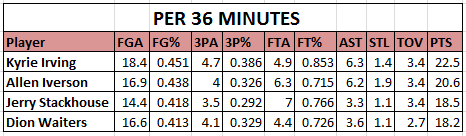
Since ‘Stack’ was drafted before Iverson, it’s a little hard to make statistical comparisons between the Sixers’ ’96 and ’97 backcourt and Cleveland’s the last two seasons, which was built with the point guard first. Here’s my best shot though, with the help of Basketball-Reference. As always, you can click to enlarge each screen shot:

per game wsai

per 36 wsai

adv wsai

There’s a lot to discuss from there. (If I missed something you’d like to include, feel free to use the comment section.)

First, I’m not comparing Waiters to Stackhouse or Irving to Iverson, though Cleveland could build around their point guard much like Philadelphia did with theirs. I’m grouping them together mainly because of their unique situations: two young, ball-dominant guards on the same team. Already mentioned was Waiter’s issues with Irving and Thompson, but Stackhouse had his own reported problems with Iverson that you can find here and here from the SI Vault. Bad things happen when backcourt duos consist of each wanting to score. Speaking of that…

Another reason I compared the two duos was because of their usage rates. Iverson and Stackhouse were the only starting backcourt in 1997 to each use up over 25 percent of their team’s possessions, according to Basketball-Reference. The same went for Waiters and Irving in 2013. Backcourt combos with similar high usage rates can succeed as long as they complement each other well, like Ray Allen and Sam Cassell for the 2001 Milwaukee Bucks and Tony Parker and Manu Ginobili for the 2010 Spurs. More often than not, however, guards with similar usage rates feature one starter and another as a spark off the bench, like how the Spurs have often used Ginobili.

That wasn’t the case for the ’97 Sixers or the 2013 Cavaliers, though, and neither team won all that many games as a result. That’s not to say those four players were solely responsible for so many losses, but a team isn’t going far with two players taking over a combined 30 field goal attempts per game while recording effective field goal percentages (EFG%, when accounting for threes worth more than twos) below league-average, which usually ends up between 47.5 and 50 percent. In particular, Iverson and Stackhouse couldn’t spread the floor, shooting around 30 percent from the arc and playing an average of nearly 40 minutes per game. Bad times all around.

Cleveland has since put Waiters in the role of a sixth man rather than pull the trigger on a trade. Philadelphia eventually scrapped their backcourt pairing and surrounded Iverson with players known more for their defense, starting when Stackhouse was sent to Detroit in December of ‘97 with Eric Montross and a 2nd round pick for Aaron McKie, Theo Ratliff, and a 2003 first-rounder. That first rounder, with the help of hindsight, was treated pretty unfairly. 25 months after trading Stackhouse, that pick would be sent to Houston for Mirsad Turkcan. (Turkcan didn’t do much at all in the NBA, but in fairness he ended up being a force of nature overseas. He was a nominee for the 2001-2010 Euroleague All-Decade team, but did not make the list.) In June of 2001, the first-round draft pick was then traded from Houston to Atlanta for Terrence Norris, then traded to Sacramento for Dan Dickau, and finally sent back to Detroit with Jon Barry for Mateen Cleaves. The draft pick ended up being Carlos Delfino, but treating a pick like that in the one of most loaded talent pools could’ve led to disastrous results.

But trading Stackhouse deserves a ton of credit when the Sixers’ front office had top-10 draft picks each year from 1992 and 1998, yet only kept two of them – Iverson and Larry Hughes – by 1999, when Philadelphia finally made the playoffs. They too logged usage rates of over 25 percent each, though Hughes came off the bench instead of starting. He was traded the following season for Toni Kukoc.

This all actually makes it a little more interesting that, despite the results from the Stackhouse-Iverson combo, Denver made the trade in 2007 to pair Iverson with Carmelo Anthony. Denver had a better supporting cast than Philadelphia in the mid-90s, and the Nuggets played 10 points better/100 possessions when Iverson was on the court in 2008 (according to Basketball-Reference), but it’s hard to expect two mediocre perimeter defenders and outside shooters like themselves to go deep in a loaded Western Conference.

In Cleveland, Irving remains relatively safe from trade rumors while Waiters, like Stackhouse, has been thrown around in plenty. The Cavaliers still have plenty of trade assets left over even after acquiring Luol Deng, so it wouldn’t be all that surprising if Waiters is eventually moved before his next contract. The value of rookie deals in today’s NBA is so different from when Stackhouse and Iverson entered the league, though. Both trading and keeping Waiters feel like gambles, but at least Cleveland still has time to decide which decision is better for their long-term future.


Kevin Durant’s efficient explosion since Christmas

Tonight’s matchup between Oklahoma City and Denver should be another one of those I-CAN’T-WAIT-TO-SEE-THESE-TEAMS-IN-THE-PLAYOFFS kind of games we regularly see out West. Denver’s offense is back to lighting it up, scoring over 110 points in their last three games, with 137 and 129 coming against the Lakers and Celtics, respectively.

The most recent stretch for the Thunder has been bitter-sweet, however. The bitter is from going 4-3 since Christmas, when Westbrook last played. There are losses at Utah and Brooklyn but they took care of a back-to-back between Minnesota and Boston. 

The sweet comes from Kevin Durant‘s explosion while Russell Westbrook works his way back to the court. Obviously winning is more important, but check out Durant’s stat lines before (28 games) and after (seven) Westbrook last played:

durant avgggggggg

Clicking on the image gives you a less blurry view. My apologies.

Durant’s also been both as efficient with his scoring and productive in other areas of the game since Christmas, at least offensively:

durant advanced

Arguably most impressive is Durant taking on a higher usage rate while turning it over only half the frequency as before. Some of that is attributed to taking more shots, but Durant’s also assisting a higher percentage of the time.

As far as being fed the ball, Durant’s field goals have been assisted only 32.1 percent of the time after Christmas compared to 59.0 before. The main feeders have been Jackson and Kendrick Perkins (!!!), according to NBA.com, each recording seven assists to Durant. In the 28 games before, they combined for 31 assists while Westbrook racked up 78.

Here’s the before and after of Durant’s shot chart and shot distribution:

shot chart before

Very few to no corner threes, but still attacking the paint!  (Click to enlarge)

shot dist after

More threes, but also more free throw attempts.

Defensively, the Thunder’s allowed five more points per 100 possessions with Durant on the floor but they’re nonetheless elite in either situation. What’s odd about that, though, is the starting lineup being so stingy on that end with Reggie Jackson compared to Westbrook. With Jackson, the Thunder’s allowed 16 less points per 100 possessions than with Westbrook and 25 points better overall, per NBA.com. That net rating with Jackson starting will be put to the test over the next 12 days as Oklahoma City plays the likes of Houston, Golden State, Portland, and San Antonio during that time (and playoff-contending Denver tonight). The other 12 games before the all-star break feature eight on the road.

By then, Westbrook should be nearing a return to the court. It’d be interesting to see him in the situation Durant’s currently in, and maybe sometime in early April that’ll happen if the league’s leading scorer needs a few games off. For now, though, we’ll have to settle for Durant’s remarkable production. Over his career, he’s averaged 30 points per game against Denver.

Let’s see if that gets a swift uptick tonight.

The trickle-down effects before and after the Luol Deng trade

Keith Allison | Flickr

Keith Allison | Flickr

I told myself I was going to sleep last night, but then the latest trade in the NBA shook up the Twitterverse. It’s already widely known what Cleveland and Chicago each got in their trade last night, but I’ll list the details anyway:

Chicago receives: Andrew Bynum (who has since been waived), Sacramento’s first round pick (top-12 protected this season and top-10 protected through 2017 then turns into a second-rounder), rights to swap 2015 first round picks with Cleveland (if the Cavs make the playoffs), and Portland’s second round picks in 2015 and 2016.

Cleveland receives: Luol Deng

There was immediate backlash about Cleveland sending three, possibly four draft picks for a small forward with an expiring contract, but general manager Chris Grant has a recent history of making savvy trades, ones often revolving around desperation from other front offices. Here’s a quick summary of those trades, including the pieces involved that were thrown into the Deng trade:

2011: Traded Mo Williams for Baron Davis and their 2011 No.1 pick, which landed Kyrie Irving. In June, Cleveland traded J.J. Hickson to the Kings for Omri Casspi and a first round pick.

That’s the Kings’ first-rounder that Chicago received, which looked more valuable back then than it does now. Sacramento has picked fifth and seventh in drafts since then, and they’d be fourth in the 2014 Draft if the lottery balls don’t alter their position in either direction. That doesn’t bring a lot of hope going forward, but Sacramento has both a new owner and another batch of young players that can hopefully rise up from the West’s cellar, or at least high enough to bag roughly 35 wins sometime before 2017. That’s definitely possible with a top-five pick this year, even with the absence of defense displayed by the squad and Rudy Gay‘s player option that makes a rebuilding team more expensive than it should be.

2012: After trading Sebastian Telfair and Delonte West for Ramon Sessions, Ryan Hollins, and a 2013 second-round pick, the Cavaliers shipped Sessions to Los Angeles for Luke Walton, Jason Kapono, and their 2012 first-round pick. The pick became Jared Cunningham, which was then traded with Jae Crowder and Bernard James to Dallas for Tyler Zeller. That didn’t turn out so well, but Cleveland nonetheless traded players with little value in their organization for assets.

2013: The Cavaliers traded Jon Leuer to Memphis in order to take on the salaries of Marreese Speights, Wayne Ellington, and Josh Selby. The biggest return in the trade, however, was Memphis’ 2015 first round pick. Protection is as follows, according to RealGM:

Memphis’ 1st round pick to Cleveland protected for selections 1-5 and 15-30 in 2015, 1-5 and 15-30 in 2016, 1-5 in 2017 or 1-5 in 2018 or unprotected in 2019 [Cleveland-Memphis, 1/22/2013]

The draft pick looks especially peachy for Cleveland from 2017 to 2019, when Marc Gasol and Mike Conley will either be approaching 30 years of age or into their low-30s if they stick with Memphis for that long. That’s a long time for Cleveland to wait for that draft pick, but it could be a great prize if Memphis goes through a rebuilding phase over those three years. Besides, if Cleveland gets that pick in 2015 or 2016 then it’s in the 6-14 range. It’s yet another high draft pick for a squad that’s had a ton of them lately.

That’s where Cleveland has gone wrong since The Decision, though. The trades Chris Grant made were fine, but they don’t make up for the draft blunders that have plagued the organization ever since selecting Tristan Thompson fourth overall in 2011. It’s led to a trickle-down effect, one that led to the trade last night when Cleveland finally found a (expensive) small forward to add to their core of Kyrie Irving, Dion Waiters, whatever improvements come from Tristan Thompson, and whatever that makes Anthony Bennett not so horrible.

But Deng will be one of the oldest 29-year-olds in the league when Cleveland has to decide on re-signing him or not. Deng’s played nearly four seasons under Tom Thibodeau, dog years compared to any other coach and he’s been in the league since he was 19. There’s also a fine line between giving a player with his mileage a three-year deal and one that’s four. $36 million for three years sounds a lot more desirable than $45 million for four, as the last of the latter contract could be albatross-like while the former becomes moveable fairly quickly. There’s also the good and bad that comes with an aging player like Deng who, as Zach Lowe of Grantland noted, doesn’t rely on jaw-dropping athleticism but can barely get separation on offense as is. Lowe also makes a good point on a possible four-year contract with Deng in that some of the money in the last season should be non-guaranteed.

Cleveland also has to address their expiring rookie deals, the soonest being Irving’s and Thompson’s. Waiters’ contract looms the following season, though he and Anderson Varejao have been trade chips for a while now and could be gone by February of 2015. The Cavaliers still have plenty of draft picks, one not mentioned already being Miami’s 2015 first-rounder, protected 1-10 through 2016 and unprotected in 2017. It becomes very nice if the Heat break up their core after this season and rebuild, though Miami rebuilding for more than one season seems like a long shot given their franchise history, geography, and if Pat Riley stays with the franchise.

For Chicago, they gave themselves an opportunity to land a top-10 pick, move Carlos Boozer for whatever they can get back in a trade (Chicago, always conscious about saving money despite being in a huge market, probably isn’t up for using the amnesty clause which would pay Boozer not to play for them), and open up playing time for Nikola Mirotic as soon as next season. Chicago’s not rebuilding as much as they are reloading, even if it means losing not just Deng but also Boozer by next fall.

While the haul for Deng was one of Chicago’s best financial ones possible, it isn’t exactly the greatest they could’ve received in terms of value on the court. Sacramento’s pick might be a coin flip on whether or not it ever falls out of its top-10 protection, swapping picks with Cleveland sounds nice until the best they could move up to is 15th overall (still valuable, though), and the second rounders from Portland suddenly look like they’ll be in the 50-60 range in 2015 and 2016.

Chicago might’ve also booted Charlotte from the playoffs with this trade, a big deal when the Bobcats owe them a draft pick with top-10 protection. At 15-20, the Bobcats currently have the NBA’s 12th-worst winning percentage but are seventh in the East. But with Cleveland having the pieces to make a playoff push and New York and Brooklyn resembling professional basketball teams again, both Charlotte and Chicago look like they’re headed for the lottery. That could be as much of a good thing as it is bad, though, as Charlotte’s protection on their pick they owe Chicago is only top-8 in 2015 and unprotected in 2016. It’s another potential ripple effect from a trade that has more long-term risk than short-term.

Overall, you can make a case for either side of the Luol Deng/Andrew Bynum trade being good or bad. Getting the best of their returns is dependent on what happens this summer. That’s when Chicago hopes to rebuild through the draft, all while Cleveland sacrificed their own draft position so they could land a premier wing to play alongside Irving both in the short-term and long-term.

Until then, another chapter in this trade that will occur sooner involves the careers of Carlos Boozer and Andrew Bynum. Each has the potential to swing the fortunes of a contender while Chicago and Cleveland dwell in opposite sides of “mediocrity”.

‘Twas the West’s 20 wins before Christmas

Richard Masoner | Flickr

Holiday spirit? (Richard Masoner | Flickr)

Quite a few teams have jumped out to unexpectedly hot starts before the Christmas games, arguably the most surprising being the Portland Trail Blazers. They have tall tasks coming up against the Clippers, Heat and Thunder, but for now they’re 23-5 and first in the West, just barely ahead of Oklahoma City and San Antonio.

For Portland to get to 20 wins before Christmas is quite an accomplishment and a sign of success across the entire regular season. From 2000 to 2013, 30 teams out West have reached 20 wins before December 25, which averages out to about 2.3 teams per season. 2014 surpassed that mark with four total.

Below is a table showing each team in the West’s 20-win club over the last 14 years:

20 wins before Christmas

Season Team W-L by 12/25 82-game record West rank Finish
1999-00 Los Angeles Lakers 22-5 67-15 1 Won Finals
Portland Trail Blazers 20-7 59-23 3 Lost Conf. Finals
2000-01 Utah Jazz 20-8 53-29 4 Lost First Round
Los Angeles Lakers 20-10 56-26 2 Won Finals
2001-02 San Antonio Spurs 20-5 58-24 2 Lost Conf. Semifinals
Sacramento Kings 20-9 61-21 1 Lost Conf. Finals
2002-03 Dallas Mavericks 23-4 60-22 3 Lost Conf. Finals
Sacramento Kings 22-8 59-23 2 Lost Conf. Semifinals
2003-04 Los Angeles Lakers 20-6 56-26 2 Lost Finals
Sacramento Kings 20-6 55-27 4 Lost Conf. Semifinals
San Antonio Spurs 20-10 57-25 3 Lost Conf. Semifinals
2004-05 Phoenix Suns 23-3 62-20 1 Lost Conf. Finals
San Antonio Spurs 21-6 59-23 2 Won Finals
2005-06 San Antonio Spurs 21-6 63-19 1 Lost Conf. Semifinals
Dallas Mavericks 20-7 60-22 4 Lost Finals
2006-07 San Antonio Spurs 21-7 58-24 3 Won Finals
Dallas Mavericks 20-7 67-15 1 Lost First Round
Utah Jazz 20-8 51-31 4 Lost Conf. Semifinals
2007-08
2008-09 Los Angeles Lakers 23-5 65-17 1 Won Finals
2009-10 Los Angeles Lakers 23-4 57-25 1 Won Finals
Dallas Mavericks 20-9 55-27 2 Lost First Round
Denver Nuggets 20-9 53-29 4 Lost First Round
2010-11 San Antonio Spurs 25-4 61-21 1 Lost First Round
Dallas Mavericks 23-5 57-25 3 Won Finals
Utah Jazz 21-9 39-43 11 Missed Playoffs
Los Angeles Lakers 21-8 57-25 2 Lost Conf. Semifinals
Oklahoma City Thunder 20-10 55-27 4 Lost Conf. Finals
2011-12
2012-13 Oklahoma City Thunder 21-5 60-22 1 Lost Conf. Semifinals
Los Angeles Clippers 21-6 56-26 4 Lost First Round
San Antonio Spurs 21-8 58-24 2 Lost Finals
2013-14 Portland Trail Blazers 23-5
Oklahoma City Thunder 22-5
San Antonio Spurs 22-6
Los Angeles Clippers 20-9
34 teams   57.8-24.2

So average regular season records those teams finish with are often quite good. Only one team finished with less than 50 wins and the average 82-game record is just under 58-24. It wouldn’t be all that surprising to see all four teams this year finish with 58 wins before the playoffs, fattening up in non-conference matchups in the process. No team with over nine losses by Christmas, however, has won over 58 or more games since Chris Webber and the 2002 Kings. The Clippers are probably out of luck, at least until they get J.J. Redick back.

Only one team missed the playoffs on that list: The Utah Jazz of 2011 who had a mess of a season. They’d lost Carlos Boozer the summer prior and replaced him with Al Jefferson, who is now in Charlotte. Utah now has Richard Jefferson and his expiring contract. Will Utah replace him next summer by drafting another Jefferson? The Jazz also ended the season without Jerry Sloan and Deron Williams while prolonging a total rebuild. None of the four 20-win teams this year match what Utah went through. Portland did have an active off-season, but to match Utah’s they’d have to ship LaMarcus Aldridge for, say, David Lee, then have Damian Lillard request a trade down the road. Hmm…

Some other notables from the 20-wins-before-Christmas Club:

  • Of the 29 20-wins-before-Christmas teams that made the playoffs, six lost in the first round.
  • 15 teams made at least the Conference Finals. It’s basically a lock that one of the four this year makes it unless we have a Houston-Golden State matchup. Not likely, but nonetheless possible.
  • 10 of the 13 seasons have featured a 20-wins-before-Christmas team represent the West in the NBA Finals.

Portland, Oklahoma City, San Antonio, and the Los Angeles Clippers are in a club that often entails success down the road, but a few stumbled despite a hot start. Let’s see which starts were more on the fluky side and ones that were the real deal.

Until then, happy holidays. I need to wrap my presents. Where’s the duct tape?

Eastern Conference ends six-week drought, finishes last week over .500 against the West

via Wikipedia

via Wikipedia

We all know the Eastern Conference has been weaker this season than it usually is. Every night, a few games out in the west coast will make us excited about a future playoff matchup like last night’s back-and-forth between the Clippers and Timberwolves. Meanwhile, it seems like the Bobcats and the Bucks are playing against each other every night out east. Please, let Indiana and Miami be at full strength come May!

It doesn’t help when the matchups in non-conference play have been historically lopsided this season, though last week finally provided some relief for the East. It was the first time since November 4 to November 10 that they went over .500 against the West. Here’s a week by week breakdown:

Week Weekly West wins-East wins West-East wins through listed week Winning % through listed week
October 29 to November 3 7-2  7-2 77.8%
November 4 to November 10 7-8 14-10 58.3%
November 11 to November 17 17-6 31-16 66.0%
November 18 to November 24 13-1 44-17 72.1%
November 25 to December 1 13-6 57-23 71.3%
December 2 to December 8 10-8 67-31 67.0%
December 9 to December 15 16-2 83-33 71.6
December 16 to December 22 8-10 91-43 67.9

As you can see, the West started laying the smackdown on Week 3. That’s pretty much when the jokes about the East started to surface. It only got worse as the West went 26-7 over the following two weeks against its “toothless Eastern cousin”, as netw3rk dubbed them. Last night, they needed Toronto to beat Kevin Durant and Oklahoma City AT OKLAHOMA CITY, WHERE THE THUNDER WERE UNDEFEATED, just to finish over .500 against the West. Somehow, Toronto came through.

Who knows what the All-Star Game will be like? Hopefully five years from now we won’t look back on a Jamaal Magloire or Mo Williams kind of all-star, but is Jordan Crawford that bad of a fit alongside LeBron James and Paul George

Maybe the conference won’t be so bad by mid-February. Up until last week, it couldn’t have been much worse. 

Weeks in this post were defined as Monday through Sunday, instead of Sunday through Saturday.