All sorts of weirdness in the NBA has gone down yet we’re only entering the third week of its season. Among other things, two of the most obviously tanking teams–Phoenix and Philadelphia—have actually started out above .500.
That may not last much longer for Philadelphia, who are 4-3. They host the Spurs tomorrow and follow that up with Houston on Wednesday. From there, it’s a three–games-in-four-days kind of road trip to Atlanta, New Orleans, and Dallas. Finishing 6-6 would be a very respectable outcome.
As for the 5-2 Suns, their schedule is quite soft until the end of November. For the rest of the month they play Sacramento, Portland, and Utah all twice while playing Charlotte and Orlando once. Brooklyn and Miami also linger in the schedule and it’s a road–heavy one overall (six games on the road and four at home), but it’s a 10-game stretch where winning five is not out of reach.
Anything more would be a nice bonus for a team that on paper would be lucky to win 25 games all season, but they’ve already generated nice buzz around the league such as this tweet from Marc Stein about head coach Jeff Hornacek:
Getting guys to buy in, I continue to say, is more crucial to modern coaching than X-and-O brilliance any day. Hornacek appears to have it
It’s tough to tell how long the Suns’ success will last, especially when we’re entering only week three of a five-month season, but who doesn’t enjoy a fairy tale? The rest of this month is set up to keep Phoenix’s going.
Eventually, the grind of the season will get to their youthful roster. For now, they have their moment in the spotlight.Let’s see how long it lasts.
If you have any interest in either fantasy basketball or the history of basketball (but preferably both), I suggest giving RotoMonster a look. It’s a simple, easy to navigate fantasy basketball archive that covers every NBA season from 1952 to now. There’s a ton worth discussing from there and maybe I’ll dedicate a series of posts to what I find, but for now I wanted to use it to write/brag about one of my favorite players ever, Shawn Marion.
In a weird place called reality, Marion might be the very cutoff separating great NBA careers from Hall of Fame-caliber ones. Among other accomplishments, he was good for 20 points and 10 rebounds on both the pre-D’Antoni AND D’Antoni-led Suns of the mid-2000s, all while being a third banana. (Amar’e Stoudemire and Steve Nash were the first two great bananas of those Suns squads, in my opinion.)
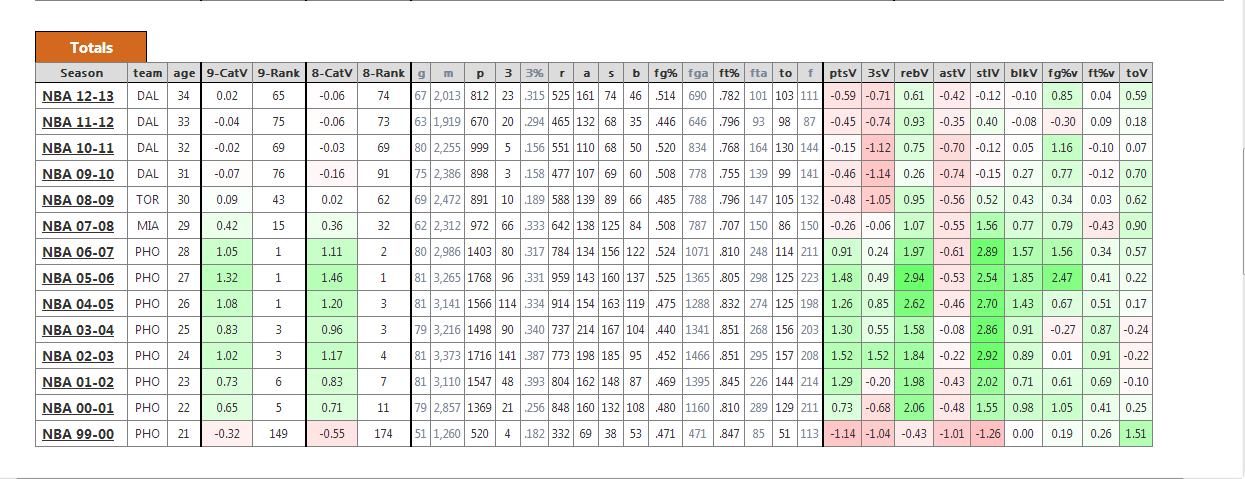
But if there’s one description for both the real-life Shawn Marion and his fantasy basketball version, it’s that they were both freaks of nature during their time with the Suns. He could do it all statistically with his average line from 2001 to 2007 being 19-10-2-2-1 with 48/34/83 splits, one chest-passed three, and 2.8 free throws per game. He wasn’t a turnover machine either, ranked outside the top 50 in that category. That made him more valuable in 9-category leagues than 8’s, the difference in the leagues being the inclusion of turnovers in the 9-cats.
Equally as important was Marion’s durability. From 2001 to 2007, he always played 79 to 81 games, making him one of the most valuable commodities in those seven seasons. He was at his greatest from 2005 to 2007, the best in 9-cats during the primes of Kevin Garnett, Dirk Nowitzki, and Kobe Bryant, among others.Here’s a screenshot of his fantasy basketball career (click to enlarge if you’d like):
For Marion’s entire fantasy basketball page, click here.
The absence of Amar’e Stoudemire in 2006 led to Marion’s greatest season statistically. Though it was only good enough to make third team All-NBA, it was his most convincing first place ranking in fantasy basketball and arguably the most convincing season of his career in terms of his real, on-court value. He bested the 9-cats over second-place Nowitzki and Elton Brandby nearly .40 points in overall value, the largest margin since 1990. Marion was the only player that season ranked in the top 20 in points, rebounds, steals, blocks, field goal percentage and minutes.
Freak. Of. Nature. Basketball-Reference had him listed at center that season. If fantasy basketball leagues gave him multiple positions, he was that much more valuable.
Stoudemire’s return in 2007 put a dent in Marion’s production, but he still placed first and second in 9-cats and 8-cats, respectively. Kobe bested him in the latter, thanks to turnovers not being accounted for. 2007 was a monster season for the Suns both in real and fantasy basketball. The core of Nash, Stoudemire, and Leandro Barbosa, along with Marion, made the top 15 in each kind of fantasy basketball league.
Per game wise, Marion was one of the best in 2008, ranking fourth in 9-cat leagues and sixth in 8-cats, but he only played 63 games. It was that season when the fantasy basketball torch was passed to Chris Paul, which was then passed to Kevin Durant in 2010. Marion has continued to be a nice addition to fantasy leagues, often ranked in the top 75 in each league since 2009.
Where real basketball is played, Marion’s Hall of Fame status is up for debate, though it might be a losing one. In fantasy basketball, however, there’s no doubt the Matrix was one of the greatest of his time.
There was just over three minutes left in the third quarter of a Monday night game between the Minnesota Timberwolves and the Cleveland Cavaliers. Minnesota was in the middle of an attempt to string together some sort of run to get within striking distance of a game they were losing by 18. The Cavaliers’ offense had become such a mess to where Tristan Thompson, with one second left on the shot clock, got the ball within a step of the three-point line.
He had to hoist the 22-foot jumper which ended up being an air ball, though partially blocked by Ricky Rubio. It was yet another empty possession from the Cavaliers; one of several disappointing ones that, if not for Kevin Love’s missed three-pointer at the end of regulation, could’ve cost them the game.
But that sloppy execution confirmed what was one of the more unusual stories of the NBA’s 2013 offseason: Thompson going from a left-handed shooter to using his right hand. He used the latter during that 22-foot miss.
Go back to the situation for Thompson. There was only a second left on the shot clock and no time for him to second-guess a shot well out of his range. Wouldn’t anyone else shoot with the hand they’ve used since they first played basketball?
I would imagine only Larry Bird and Andrew Bynum would consider going against that logic. Bird was one of the best shooters in the game, known for shooting with his off-hand more than a few times in the regular season just to keep himself entertained. As for Bynum, we’ve seen him do crazy things before, such as this three-pointer.
It seems plausible he’d take a similar shot with his off-hand as well.
But Thompson went with what used to be his off-hand—his right hand—which now I’m confident is his strong one from here on out. (Didn’t anyone else have their doubts?) Thompson himself showed he was confident enough to use it, despite the possibility of an opposing guard blocking his shot (which happened).
If only there was YouTube footage of this moment I’m sensationalizing. The only proof of it is in a play-by-play log of the game.
Overall, the results of Thompson’s right hand have been promising. He’s eight-for-20 with his jump shots, 40 percent, and an uptick from last year’s 36.3. His free throw percentage has seen a larger jump, up from 60.8 percent to 76.5 with about one more attempt per game.
Thompson’s PER may be five points lower than in 2013, but Cleveland’s been a jumbled mess offensively through four games. At least the promising young forward appears to be one of the few Cavaliers off to a good start.
This post was initially devoted to all sorts of weird happenings over the first week of the NBA’s season. Michael Carter-Williams and the 76ers tanked so hard they ran over every team with their tank (until the Warriors ran them out of their own building), Boston was in pole position for the 2014 Draft as a result of the 76ers’ (and Suns’) unexpected starts, there were struggles from Derrick Rose and John Wall, and Milwaukee’s bench (21.5 points per game per-48-minutes) was the third-stingiest in the league and gave the incredibly average Bucks some hope for the postseason again.
But screw it. Of all the storylines to discuss, I wanted to write about what could possibly be this decade’s Rasheed Wallace in Detroit: Josh Smith. We’ll take a look at his offense through three measly games.
Last season, Smith took 363 shots (!) between ten feet and the arc which were good for just 30.5 percent. He also made only 29.9 percent of the 221 threes he hoisted. Overall, he was only a 30 percent shooter when he took jump shots. That’s just not acceptable for anyone, let alone a player where well over half of his field goal attempts were came from them.
What’s actually most frustrating though is how good he was around the rim at 77.1 percent, yet only about a third of his shots came from that area. His PER of 17.7 was his lowest since 2009, his three-point attempt rate of .170 was the highest of his career, and he recorded -0.3 offensive win shares. (All the stats listed so far are according to Basketball-Reference.)
It triggers the same reaction I had about Wallace, who’s now on the sidelines for the Pistons: Just get in the paint! Wallace was a much better three-point shooter than Smith has ever been, but the Pistons of the mid-2000s could’ve used more of a paint presence alongside the barrage of mid-range jumpers they were known for taking (but at least they made a respectable percentage of them).
Fast forward to this season as Smith enters the first year of his four-year, $54 million contract with the Detroit Pistons. The paint, where Smith is so good yet often neglects, is even more crowded with Andre Drummond and Greg Monroe starting alongside Smith, who’s now playing small forward. 25.6 of Smith’s 40 minutes per game have been spent with Drummond and Monroe with respectable results so far. Detroit’s outscored their opponents by 1.4 points per 100 possessions when all three are on the court.
But Smith’s shot selection has been controversial as usual. He’s averaging 7.3 three-point attempts per game — including an 11-attempt outing in a three-point loss at Memphis — and making only two on average. That’s good for 27.3 percent and he’s shooting only 20 percent on jump shots overall.Smith’s more than doubled his three-point rate from 2013, with 44 percent of his shots coming from beyond the arc. If anything, the frequency of his three-pointers could turn into a drinking game.
As a result, his free throw rate has been sliced by more than half. Smith’s typically been below average from the line, shooting a career-worst 51.3 percent last season, so there could be a correlation between that percentage and the decline in free throw attempts overall. But it could also be the result of a feeling out process now that Smith is playing with two frontcourt players who also work around the painted area.
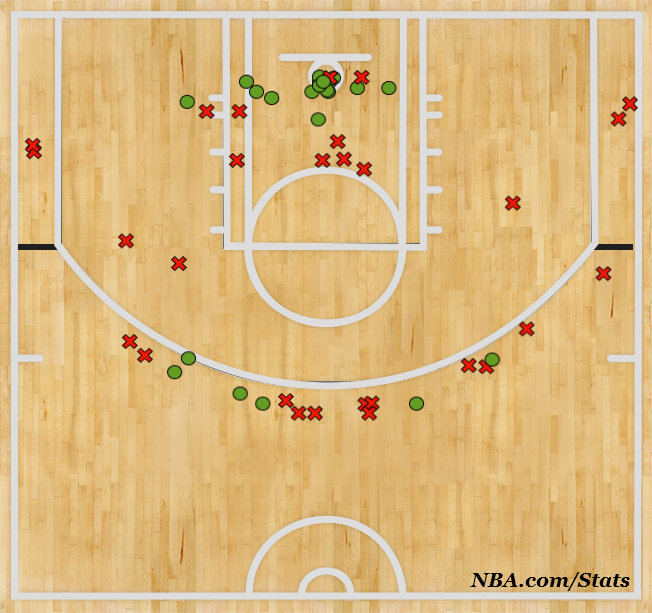
There’s good news, though. Check out his shot chart through three games:
He hasn’t hugged the dead zones (at least so far) like in previous seasons. Only five of his first 50 shots have come between ten feet and the arc while eight have been attempted from five to nine feet where Smith has also typically struggled (and continues to do so, making just two shots from that area so far).
The rest of his shots (15) have come within five feet where Smith’s been terrific, making 13 of them for an 86.7 percent mark. It would be nice to see more of his shots taken there—as well as his three-point rate dropping back to a less-ridiculous level for his skill set—but Smith would be viewed differently so far if a couple more of those threes dropped.
If anything, his shot chart actually looks promising even if all the X’s from the arc say otherwise. If he’s going to chuck the long-range jumpers — and there’s barely a difference in accuracy between his 18-footers and three-pointers — wouldn’t you rather have Smith chuck from behind the arc? If both go in at a 30 percent clip, it’s an extra 0.3 points per attempt when Smith shoots from three. Whether that cures the headaches of fans of Detroit though is anyone’s guess.
There’s plenty of time to bring Smith’s game to the paint more frequently—and whether Pistons head coach Mo Cheeks wants it there—and for his jump shot to be a little less brick-worthy. Here’s the most Josh Smith three pointer of them all, by the way, unfortunately happening in the preseason:
We’ll see if his offense improves as the season goes on or if dedicating a post to his shot selection, with a tiny, tiny sample size, was just a waste.
Kevin Love and Kevin Martin, two-fifths of the Minnesota Timberwolves’ starting lineup, scored 64 of the team’s 109 points in a nine-point victory at New York last night, giving the team a 3-0 start to the season. What was even more impressive from Martin and Love were the 64 points coming from only 31 field goal attempts, including Martin’s 30 points on only 12 shots party thanks to sinking all five of his three-point attempts.
Ricky Rubio, Corey Brewer, and Nikola Pekovic round out the rest of Minnesota’s starting lineup that’s blitzed the opposition in the first halves of each of their first three games, outscoring opposing lineups by 34.3 points per 100 possessions, according to NBA.com. For the most part, they were responsible last night for putting the Knicks in a 21-point hole after the first quarter.
When taking the last 24 minutes of the game into account though, the scoring of Minnesota’s starting unit takes a steep drop thanks to sloppiness we saw against the Knicks who, down 15 to start the fourth quarter, got within two with 4:48 left. That’s when the two Kevins carried the Wolves offense from there, scoring eight of the last nine points and 24 of the last 27. That two-man combination, along with the Love-Rubio duo, has all sorts of potential as a versatile one-two bunch to give defenders problems all season.
There’s one setI’ve noticed over the first three games though that’s especially intriguing when involving specifically Love and Martin. Love, a step above either elbow, will get the ball from Martin and have the opportunity to hand the ball back as Martin goes around him and to the baseline. Handing it off gives Martin a good look at a baseline jumper or Love can wait a little longer and allow him to post up, particularly against a smaller guard like last night when he was effective against Raymond Felton. This all happens with an entire side of the court initially spaced out for just those two to operate.
But Love can also fake the handoff to Martin and take a dribble behind the arc for a shot of his own. If that isn’t there –and if a pump faked three by Love somehow fails to draw a defender in the air– Pekovic will come sweeping across the lane, like in a few other plays that run through Love, for a post up near the rim.
The most notable Martin-Love variation of that play actually came last night when it nearly caused a turnover. Unfortunately for Spike Lee, it still led to two points:
Letting Love operate above either elbow has been a staple in the Wolves offense since Rick Adelman came to Minnesota. The last two seasons had Luke Ridnour, given his effectiveness withshots along the baseline, as the guy best for working off him (in my couch potato opinion). There’s also been variations to the play over the years such as a guard setting a pick on Love’s defender, allowing a cleaner look at a Love step-back three-point attempt, or Love setting a screen and allowing a Wolves guard to dribble into a mid-range jumper.
Let’s see how that all works with Martin now, who was due last night for some solid shooting after going 10-of-30 from the field in the first two games.
For Love (29.7 points, 14.7 rebounds, 13 free throw attempts per game), it looks like he’s back to his pre-2013 self, the one that made Second Team All-NBA as a 23-year-old. Having that version for an entire season should put Minnesota back in the playoffs.




 Chicken Noodle Hoop