Tag Archives: Eastern Conference

East vs. West Week 8: So close, and how this season stacks up with the last 44

Week 8 was another close call for the West, finishing .500 at 11-11 and continuing their possibly never-ending streak of finishing weeks at that mark or better. However, it was the first week the West recorded a negative point differential (only -0.18, but still). I think Atlanta’s victory over Houston was the most impressive Week 8 game for the East, but take a look at the scores for yourself and the non-conference summary below.
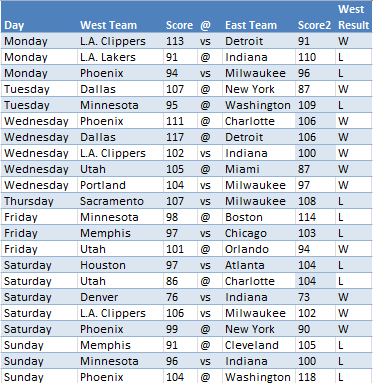
week8asa

Seems like the West is cooling off, and with about one-third of non-conference games already concluded, I looked at how this year’s stats measure up against those since 1971. I chose that year as the cutoff since conferences were called divisions before that, and it’s also the cutoff I used in posts like this one.

Stats I looked at were:

  • Point Differential: This is where 2014 separated itself from previous seasons.
  • West PPG/East PPG: This kind of adjusts for high and low scoring games. A 70-60 victory may or may not be more dominant than 130-120.
  • Win Percentage
  • Pythagorean Win Difference: The West’s real record is better than their Pyth one. How unusual is this?
  • Pythagorean Win% Difference

In the future, I’ll look at different stats instead of repeating myself over and over.

So the West currently holds a point differential of +4.06, just short of 2014’s mark but still more than good enough to make the top 10:
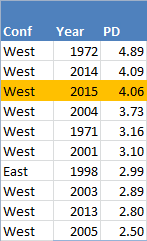
pd

Ew, vertical screenshots (there’s a lot of them in this post)

As noted in some other posts, 1972 just wasn’t fair. Milwaukee, with Kareem Abdul-Jabbar and Oscar Robertson, were new to the Western Conference and it kind of sort of had a huge impact on non-conference statistics. For 2015, there are still about two-thirds of the non-conference schedule to play out, so there’s plenty of room for the West to either pad their point differential or for the East to continue putting a dent into it like they have over the last two weeks.

Also, long live the 1998 East!

Adjusting for high and low-scoring seasons, I also divided the West points by East points and vice versa to find the 10 highest percentages:

pdperc

2014 and 2015 are more close to 1972 according to PD%, and 2015 is oh so close to the best of the last 15 seasons. Kind of crazy that seven seasons since 2000 make the top 10.

When it comes to win percentage, though, 2015 takes the cake. At least so far:

winpe

2014 was so close to topping the list before falling just short. I guess we’ll see if the 2015 West continues fizzling or comes back strong over the next four months (yes, there are still about four months to go).

When looking at how the West’s real win percentage stacks up against their Pythagorean one, 2015 isn’t too unique. According to point differential, the West has performed 1.8 wins better than expected, which is just above average when applying that amount for every ~150 games. From 1971 to 2014 (not including 1999), the average win difference is 4.8.

The difference in win percentage isn’t anything special either, and I’m not sure but maybe it’s a better measurement right now? The West’s real win% is 1.13 percent better than their Pythagorean one, and the average is about 1.33.

Below is look at the top 10 win% and win differences:

winperiffwestdiffsfsf

I suppose it’s worth diving into whether or not the West has had a cake non-conference schedule so far, or not, and has been either taking advantage of an easy schedule or performing strong against a, well, stronger-than-average non-conference schedule (edit: Easy schedule meaning rest advantages, etc.). Maybe in Week 9’s roundup I’ll look into that, and some other things. Maybe.

Below are the non-conference games this week, a smaller slate thanks to the holidays:

week9games

Enjoy the week! Maybe this is the one where the East goes over .500 for the first time. In the meantime, I’ll be ordering some holiday ham off Amazon.
East vs. West Week 4: Here we go again

In Week 2’s non-conference roundup, I noted that last year’s Western Conference began their dominance in weeks 3 through 7. They went 69-23 during that stretch.

Well…

With an 18-3 record and a +10.9 point differential versus the East, last week was arguably the West’s third most impressive since starting these posts. In weeks 3 and 7 last season, the West went 13-1 with a +13.14 point differential and 16-2 with a +10.00 point differential, respectively.

There could a case for last week to be ranked higher. The West went 18-for-21 despite 19 of the games featuring their team going off zero or one day of rest compared to 13 occurrences for the East, plus nine games where an East team had a rest advantage of one day or more. The East also had five more home games with a 13-8 edge.

The issue came, as you might’ve guessed, with talent. Using SRS as one measure, at the time of 15 of the 21 games, the West team had a higher mark, per Basketball-Reference. The West won 14 of those games, their only loss when Chicago defeated the Clippers without Derrick Rose and Pau Gasol. It was a hell of a victory for the Bulls and ended what was a struggle of a Monday for the East. The Lakers won in Atlanta the next day, the West went 5-1 on Wednesday, Sacramento and the Clippers took advantage of some missing players on Chicago and Miami’s squads in their TNT games, and the weekend was quite ugly. The West went 6-1 from Friday to Sunday and outscored opponents by a total of 100 points. Ew.

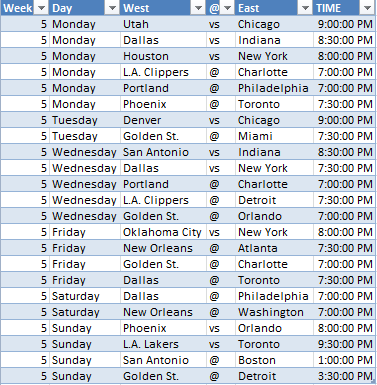
I’m not sure it gets that much better for the East. Check out what matchups take place in Week 5:

week5

The East has another five-game advantage at home, but as usual the West has some heavy hitters. Golden State and Dallas each play four non-conference games while the Clippers, New Orleans, Phoenix, Portland, and San Antonio play two each. For the East, most frequently on the menu-I-MEAN-SCHEDULE is Charlotte, New York, and Toronto. Chicago, Detroit, Indiana, Orlando, and Philadelphia combine for eight other games. For the most part, that’s not great.

Some other bad news for the East might be that Houston, without Dwight Howard, does not play another non-conference game for another month after Monday’s matchup versus New York. Minnesota, not doing too hot without Ricky Rubio, among others, is also on a bit of a non-conference break. They play their next non-conference game on December 3 (Week 6) before playing a bunch of East foes in Week 8. The East will avoid Memphis for a while, though, so at least they won’t match up against one juggernaut.

But a few more are looking to feast. Last season, much of the West took advantage of road trips out East and against those traveling on west coast trips. Let’s see if it also continues to be the case this season.

East vs. West Week 2: The East rebounds after shaky start

Through one week, it looked like non-conference play would get out of hand in the West’s favor. It even looked brutal halfway through Week 2 with the West going 14-3 through Wednesday. Cleveland lost twice on their road trip with playoff hopefuls Miami and Charlotte suffering losses as well, but the East bounced back over the last few days by finishing 5-2. Charlotte losing last night to the Lakers really hurt, but the East finished Week 2 with a somewhat respectable record of 7-10.

Below is the week-by-week breakdown:

How does this season stack up to last year after two weeks? The 2014 West was 14-10 through November 10 but caught fire during weeks 3 through 7, going 69-23 through that stretch with an overall record of 83-33. That’s right about when these weirdo posts started.

Back to the present, 19 non-conference games are scheduled this week. For the West, Oklahoma City and Utah are among the teams with the most games while the East will feature a lot of Brooklyn and Charlotte:

nonconfsecheu

Week 3 might be a pivotal set of games for the West since Week 4 and 5 feature a combined 10 more home games for the East. Then again, maybe it’s all fine when a team as bad as the Lakers can blow out the Hornets. Seriously, how and why did that happen…

Anyway, enjoy this week of basketball!

East vs. West Week 1: Strong start to the 2014-15 season for the West

One week of non-conference play is in the books, and the West finished 6-1 against the East. The only loss came on Saturday night when Minnesota lost a close one against a Derrick Rose and Taj Gibson-less Bulls squad. The West did score some key wins, though, like Memphis over Charlotte in a game that felt like 2004 (the dead ball era) all over again.

Below is a breakdown of the first week. It’s much like the ones I did last year but with some new additions relating to Pythagorean record. Like last year, this table will also be updated weekly:

Though a large number through seven games, point differential says the West ran slightly better than expected. That’s probably thanks to Minnesota holding on against the Pistons Thursday night after blowing a 19-point lead in the 3rd quarter.

Week 1 is the last of light non-conference weeks until the all-star break. There will be 17 non-conference games in Week 2 and it will pick up even more after that. The teams most often in the Week 2 matchups are Minnesota, Cleveland, and Miami with three games each. Below are some of the most important games:

Monday:

Oklahoma City @ Brooklyn
Houston @ Miami

Tuesday:

Oklahoma City @ Toronto
Cleveland @ Portland

Sunday:

Miami @ Dallas

It looks like the East has one extra home game in Week 2 than the West, and the five key games listed above feature three of them on East courts. The East will have actually have a nice home-court stretch through Week 5, playing seven more home games than the West by then.

So starting with Cleveland playing three non-conference games this week, this could either be a stretch where the East gains some ground or the beginning of an onslaught by the West.

Looking at the NBA’s 2015 non-conference schedule

Last week’s release of the NBA’s 2014-15 season schedule marks the return of the non-conference posts. Maybe we’ll find something that gives one conference a scheduling edge over the other in their non-conference matchups. For the East, that would be nice.

As a reminder, 450 non-conference games are played each season, basically taking the number of teams (30) divided by those in each conference (15). The matchups last season were historic in several ways, one being that the West outscored the East by 4.09 points per game, the highest ever point differential in the last 17 seasons, according to NBA.com. The 2014 West nearly finished with the highest winning percentage in non-conference play, but fell just short of the mark set in 2004 at 63.33 percent.

Below is a breakdown of point differential, wins and losses, and win percentage in non-conference play since 1998. You can find the same chart in the last East vs. West post last season. All stats are from NBA.com:

It’s probably obvious, but the 450 non-conference games next season are not scheduled at a consistent frequency over the season nor do they all take place within designated weeks. Below is a chart of how many of these games take place in each of the 25 weeks.

2015 non-conf games

19 of those 25 have anywhere from 14-29 non-conference games and the ones that fall below that range are opening week, the week just before and after the all-star break, and the last three weeks of the season. On the other end, weeks 5&6 (11/24-12/7), 13&14 (1/19-2/1), and 20&21 (3/9-3/22) combine to take up over a third of the non-conference games. Those two-week stretches feature 50, 51, and 56 games, respectively.

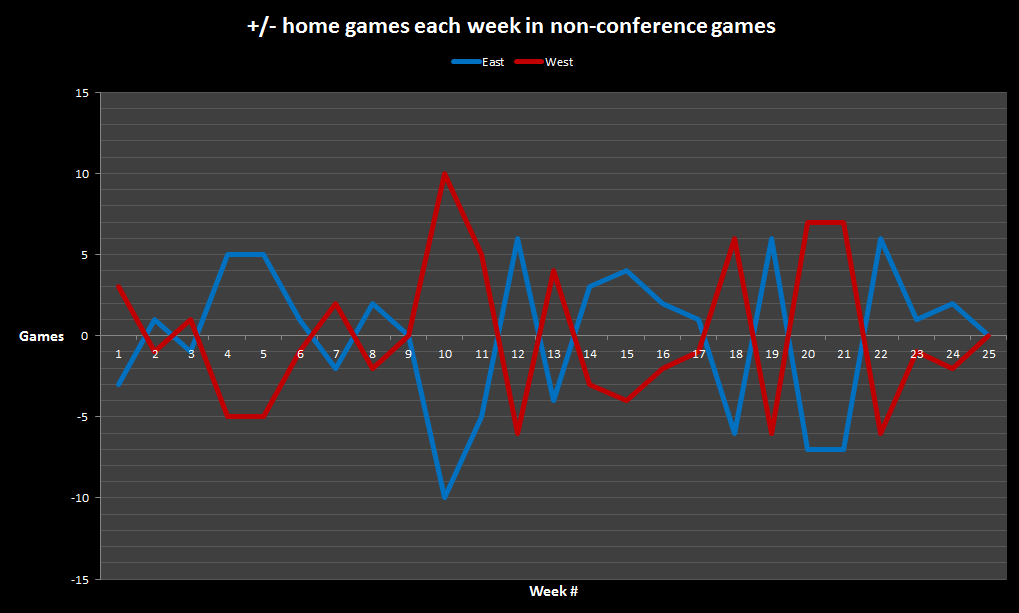
And though each team has 15 home and road non-conference games, they don’t happen equally either. Below is a chart looking at how many more home games each conference plays versus the other each week. For example, on the first week (10/28-11/2) the West has five home non-conference games versus two for the East, which amounts to +3 in the chart.

2015 non-conf home and road games

The East will have more home games early on, but it will catch up to them as we head into 2015 when the West will have 30 of the 45 games from 12/30 to 1/11 at home. From 1/26 to 2/22, the East will have 10 more home games than the West, but then the West hits another home-heavy stretch from 3/9 to 3/22.

Rest is also a factor in quite a few non-conference games. 238 (52.9 percent) of the 450 matchups will feature teams playing on equal days of rest, with 191 featuring both the West and East team on a one-day breather. Below is a chart of the total games on equal rest and those that feature rest advantages:

2015 non-conference rest


The advantage of playing games on more rest than an opponent goes to the East, 108 to the West’s 104, but the West holds arguably the most important rest advantage: Games with rest vs squads on back-to-backs, 69 games to 65 but also a 60 to 49 edge in games at home vs squads on a back-to-back. An advantage for the East is having six more games where they’ll have more rest vs opponents coming off a one-day break, best when an opponent is in the middle of a stretch of four games in five nights or three in four.

Of course, not all back-to-backs are equal. A back-to-back combo of Philadelphia and Boston is less intimidating than 2/3 of the Texas Triangle. Then again, the Knicks went 2-1 through the Spurs, Rockets, and Mavericks. Injuries and mid-season trades also happen, though the latter not nearly as often as in the past.

Predictions for teams and conferences is pointless to me, but I still see a top-5 point differential for the West with the reason as simple as the West remaining lo-o-o-oaded. That prediction isn’t as bold as saying the West will record their best ever winning percentage versus the East, but like last year a ton would have to go wrong for that to have a chance of happening. For the sake of a great season and competitive balance, hopefully Derrick Rose and the Bulls stay healthy, Toronto picks up where they left off since trading Rudy Gay, Chris Bosh returns to a strong #1 option, Cleveland has a hell of a year with LeBron James, Kevin Love, and Kyrie Irving, and the middle of the East wins a few more games than last season.

But we’re still over two months away from the regular season, which I struggle to accept. First hopeful thing comes first: Hopefully this off-season doesn’t last forever.