Tag Archives: Kevin Durant

How Kendrick Perkins’ offense can be salvaged

It’s long been an adventure watching Kendrick Perkins with a basketball in his hands. There have been passes to both empty spaces and opposing players, post ups that went nowhere and mid-range jumpers that barely grazed the rim.

Despite those moments, Scott Brooks still likes to involve his starting center in the offense because of all the other good things he does. After all, it’s damaging to have a player on the court who never shoots the ball, and Perkins is already in the bottom-10 in the NBA in field goals attempted per-36-minutes (Steven Adams also, to be fair). Arguably the easiest and most valuable solution would be to not start him. A second, similar solution would be to play him the least possible minutes he’s content with. Both seem to have little to no chance of happening outside of a Finals matchup with Miami, so another alternative is to make halfway-decent lemonade with $9 million worth of lemons.

Just where Perkins is best with the ball, though, is tough to answer. He’s usually not quick enough to contribute to fast breaks and has trouble finishing around the rim in general, second-worst among big men with 50 or more attempts within the restricted area. The extra half-second he takes to bend his knees before elevating impacts him the most around that part of the floor, allowing quick-recovering defenders to turn open layups into heavily contested ones. That’s a problem nobody else in the Thunder’s otherwise freakishly athletic rotation seems to have.

Another option is post ups, one of the most frequent looks for Perkins even though they’re a shaky choice at best. He’ll often take a second too long to measure up his defender, overthinking the process of scoring. Perk can physically impose his will to a decent spot, one that allows him to use a jump hook that sometimes doesn’t look half-bad but other times appears clunky, but when matched with a player that gives up little ground he’ll attempt a turnaround fadeaway that doesn’t exactly mimic LaMarcus Aldridges. Movement from every other Thunder player often comes to a screeching halt.

Then there’s Perkins’ jump shot, one that gets little to no respect for good reason but I can’t blame him for hoisting one anyway. It’s often an attempt to penalize his defenders for choosing to disrupt off-ball movement, but some jumpers come in the flow of the game like as the beneficiary of a drive-and-kick. Percentage-wise, Perkins’ shot hasn’t been bad over the last two seasons, shooting 39.8 percent. The sample size is small, though, as he’s only averaged less than one mid-range jumper per game, and I’m not sure there’s ever been a ~40 percent shooter from that area who has air balled or barely grazed rim on so many shots as he has:

So what scoring options are left if Perkins has a tough time near the rim, in the post, and from 15 feet?

Believe it or not, he’s shown off a floater. It doesn’t exactly mimic Shawn Marion’s, but the floater from the 280-pound center has been an effective way (he’s 10-for-15, according to video from NBA.com) to capitalize on attention Durant draws from multiple defenders. Surely he’d benefit off Russell Westbrook too if he were healthy.

Below are a few examples in slideshow format.

The floater solves a ton of Perkins’ problems. He takes those shots just outside the restricted area where he struggles mightily, and the extra time he needs to bend his knees and elevate doesn’t pose as much of a problem when he’s catching passes mid-stride. Perk will stop and ready to shoot just outside of a help defender’s reach, though it’s fine if he causes them to contest his shot. Serge Ibaka, the Thunder player whose defender is most likely to rotate, often waits for the offensive rebound.

The floater also keeps Perkins free from thinking. It’s similar to what Seth Partnow at Where Offense Happens wrote about Harrison Barnes a few weeks ago, for example. Keep it simple, and Perk does when he goes with the floater. It means he doesn’t pump fake or back his defender down with a series of dribbles, but takes that silky, silky, silky smooth shot before the defense adjusts towards the paint. Like mentioned before, the quick floater by Perkins also gives Ibaka a greater chance at an offensive rebound since there’s one less opponent in the paint.

There’s also the realization from the opposition that Perkins is scoring on them. Back in the lockout-shortened 2012 season there was the game between the Timberwolves and Clippers where Kevin Love sank a game-winning three, but before that shot was a series of events that included Darko Milicic banking a floater off the dribble. Hubie Brown called it “demoralizing” for the Clippers. I’d like to it’s the same for anybody beat by the Thunder not because of Durant or Ibaka, but Kendrick Perkins.

The sample size is small for that shot, but going 10-for-15 is a nice start. Factored in with the rest of Perkins’ shots from five to nine feet out, he’s one of the best shooters in the league from that area. It won’t turn the world upside down if Oklahoma City gets him more of those looks than post ups (unless you’re netw3rk), but even if the floaters balance out to roughly 50 percent they’re still a two dropping at a similar rate as open mid-range jumpers from Ibaka. It’s also a nice alternative in the playoffs when pace slows down and every scoring option counts.

Going forward, whether that unusual shot from Perkins is enough to deflect attention from his flaws is hard to tell. If Scott Brooks continues to designs scoring options of Perkins, hopefully he helps the center become less of a comedic adventure with the basketball in his hands and more of a finisher.
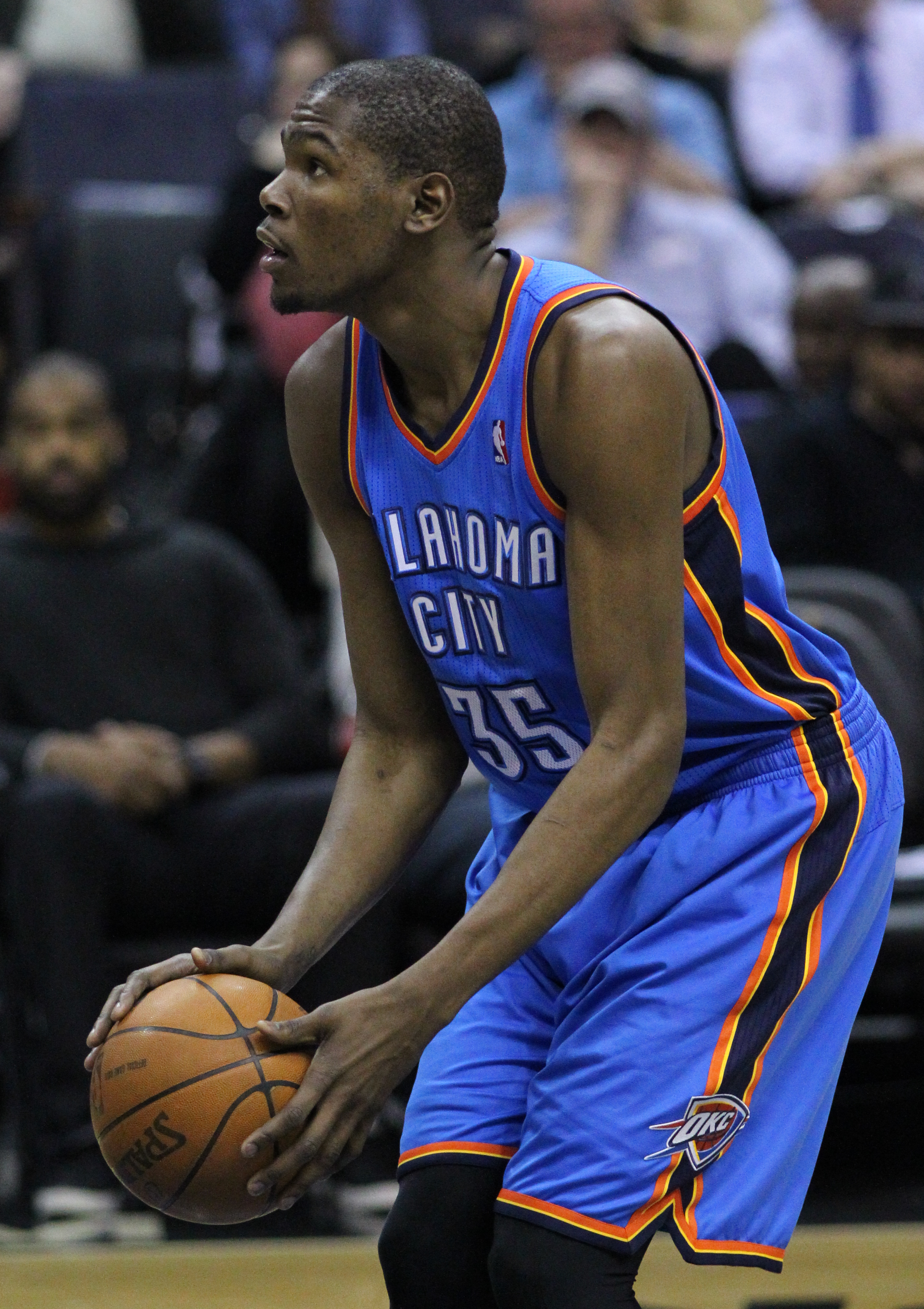
A look at 50-point games among active NBA players

Keith Allison | Flickr

Keith Allison | Flickr

Last night’s matchup between Golden State and Oklahoma City became the 70th time an active NBA player scored 50 or more points. Cheers to Kevin Durant, who scored 54 points on just 28 shots. I’ll take a look at that night and the 68 others that featured 50-point scorers who have yet to hang it up, or so I think. Basketball-Reference lists players like Tracy McGrady, Jerry Stackhouse, and Richard Hamilton as active, but probably because it’s only a matter of time before they play for Brooklyn and round up an All-2000s squad. (For a simple table of the 50-point scorers, click here.)

Overall, 25 active players make up the list of 70 fifty-point outings across over 15 different seasons. 23 teams have been the victim of 50-point games while seven remain free of the embarrassment, though that could change while Kevin Durant continues his efficient explosion without Russell Westbrook. It only makes sense that teams with the 50-point scorer have won 50 of those 69 games.

Kobe Bryant has 24 of the 70 fifty-point occurrences with 16 coming post-Shaquille O’Neal and pre-Pau Gasol. The Lakers were 17-7 in those offensive explosions, including four consecutive wins in March 2007 (he averaged 40.4 points per game for the month). Bryant and Antawn Jamison are the only active players to score 50 points both against each other and on the same night, which is why there are 69 different games instead of 70. Jamison had back-to-back 50 point games in December of 2000.

Age

Brandon Jennings is the youngest player (20 years, 52 days) to ever score 50 points. I miss comparing him to Allen Iverson, which didn’t last long at all but nevertheless long live ‘Fear the Deer‘. As far as active players go, Andre Miller is the oldest (33 years, 317 days) to score 50. Both outings for the two players happened in the 2009-10 season, and their shot charts greatly differentiate from one another. 

Least and most attempts

The least amount of field goal attempts on a 50-point night belongs to Kevin Martin, who relied on 23 free throws and a good chunk of threes. Bryant’s 62-points-on-31-shots on December 20, 2005 could’ve given Martin a run, but he needed a few more shots to hit the 50-point mark. Instead, Bryant’s needed the most field goal attempts to get to 50 points (42 shots) when he finished with 53 points off 44 attempts in a loss to Houston. Surprisingly, Jerry Stackhouse’s 50-point night didn’t need 50 shots. He took 36, tied for 13th-most.

Other stats with 50 points

20 double-doubles (three from 10+ assists, 17 from 10+ rebounds) have been recorded from players scoring 50 points. Eight of those came from players logging over 48 minutes. As far as tons of minutes are concerned, sixteen 50-point games were recorded while playing over 48.

Kobe Bryant, Carmelo Anthony, and Kevin Love each had 50-point games without logging a single assist with Love’s coming while playing 49 minutes. As for Bryant and Anthony, they also had 50-point games where they didn’t record a single turnover. Surprisingly, that’s happened to Kobe not once but twice. Rashard Lewis is the only other player to accomplish such a feat.

Starting games versus coming off the bench

Every one of those seventy 50-point nights were from players who started, but a (currently active) player off the bench has scored 40+ points 14 times. That features nine different players who all needed starter-level minutes (30 or more). Each one of them also made at least one three-pointer.

A BOLD statement

The three-pointer brings me to my closing remarks regarding these high-octane outings. Only four times has a player who scored 50 points not made a three with those games belonging to Jermaine O’Neal, Amar’e Stoudemire, Tim Duncan, and Paul Pierce.

Going forward, I’ll go on a limb and say no 50-point game will happen again without a made three-point shot.

MVPs rarely the best in fantasy basketball

What MVP really means has been a debate for as long as my 20-something self can remember. Is it the best player in the league? Is it the best player on the best team? Just how much do statistics factor into voting? What about boredom, bias, and anonymity from voters? It seems like the importance of each question weighs more or less depending on the season.

So it may or may not be surprising that, since 1996, only two players (Tim Duncan in 2002 and Kevin Garnett in 2004) have been the MVP and the highest-ranked in fantasy basketball in the same season, according to RotoMonsterespecially when what only matters in fantasy leagues are statistics. A player can be as big of a jerk to the media as he wants and be the best as many seasons prior to the current one, but he’ll always have a chance to be the best player in fantasy basketball because no votes are taken into account. It’s just stats, though doing anything resulting in a suspension would cause a dip in fantasy value.

There are seasons worth discussing though when the MVP in real and fantasy basketball weren’t the same player, such as 1997 when Karl Malone hijacked the MVP from Michael Jordan. Had Jordan won, he would’ve repeated as both MVP and the best in fantasy basketball’s 9-category and 8-category leagues. Ironically, Malone would be the best in fantasy basketball one year later while Jordan would be the ‘98 MVP. 

Then fast forward to the mid-2000s. I already wrote about Shawn Marion dominating from 2005 to 2007 even though he wasn’t the best player on his own team. Then Chris Paul’s fantasy basketball dominance came along in 2008, which is another weird season where a fair, even more logical case can be made for him winning the MVP over Kobe Bryant. Paul had one more year at the top of fantasy basketball before Kevin Durant took over, including one of the best statistical seasons of all-time in 2013. LeBron James would be second-best but they nearly flip-flopped when it came to MVP voting and rightfully so (Carmelo Anthony did receive one vote but whatever).

Some MVPs just aren’t made for fantasy basketball, no matter the season. Shaquille O’Neal and Allen Iverson were often risky picks because of their durability and shooting percentages, whether it was free throws for Shaq or field goals for Iverson. It’s pretty remarkable just how much Shaq’s free throws weighed him down. Even going by per-game stats, Shaq was only a top ten fantasy option once (1994), though a clever owner could work around free throw percentage by punting that entire category, which was basically required in order to draft him.

It’s also worth noting that the best overall player in fantasy basketball doesn’t necessarily mean the best player in every fantasy basketball league. If each league voted for MVP the same way the media votes for theirs, there would be at least 25 different winners when taking every fantasy league into account. Heck, if I win my league, either Paul Millsap or David Lee has my vote. Meanwhile, Durant is on a team where the owner has tuned out, evident by his or her lineups never being set. Not only that, but Yao Ming is starting. (I wasted my first two picks on Jason Collins and Allen Iverson though, so I can’t say much.)

But you have to believe that fantasy leagues where money for the winner or crazy punishments for the losers will lead to the best overall fantasy basketball player making the biggest difference. It’s also possible that the winner of a Most Improved Fantasy Basketball Player award, if it ever existed, could swing a team’s fortunes as well.

So far, this season’s a different kind of beast where Durant is competing with Kevin Love, James Harden, Chris Paul, and Anthony Davis for the most valuable fantasy basketball player. In real life, the Heat aren’t as big of a story as in the past, which opens the door for a different MVP on the real hardwood as well, even if it’s clear that LeBron’s the best player in the world.

The drought may continue concerning 10 straight seasons where MVPs in both real and fantasy basketball haven’t been the same player, but it wouldn’t be a travesty if LeBron were the MVP yet is second-best on the virtual courts yet again. And really, it’s not even an issue. None of this isn’t meant to change how an MVP is voted for either, though anonymous voting really needs to end. But hopefully it makes for some weird, nerdy discussions, especially when the opportunity is there for the drought to end.

All fantasy basketball stats and rankings are from RotoMonster.

What’s the big deal about half-court heaves?

The half-court heave: Arguably basketball’s most exciting way to score, save for a dunk or game-winning bucket.

Check out the crowd before and after these makes by Alonzo Gee and Jarrett Jack:

Even misses are exciting:

The heaves are like a golfer on their second shot of a par five 18th hole, going for a green that has zero hazards surrounding it. Rarely, if ever, will the golfer score eagle or better (or even a par if their putting is as bad as mine), but it doesn’t hurt to try.

That’s not how some players in the NBA see it though. Some see a massive pond surrounding the green, with alligators and all sorts of other potential danger lurking. Maybe the latter is an exaggeration, but not every player sees a last-second heave as a win-win. It’s viewed instead like a harm to their shooting percentages. After all, about 98 percent of all half-court to full-court heaves are missed. Since 2001, players are 104-for-4,451 from that extended area, according to Basketball-Reference. (For a yearly breakdown, click here.)

That’s a whopping 2.3 percent that drop. The effective field goal percentage (when taking into account that a three-point shot is worth more than a two) isn’t much better at 3.5. To reach an EFG% of 50, 1,483 of those 4,451 half-court to full-court shots would have to go in, or the 104 that dropped would have to be worth about 43 points each. If that were the case, several fans would have defined roles on NBA rosters.

For those who either don’t take the last-second shot or wait just after the buzzer to let them fly, the team is negatively impacted on a situation that should normally be a win-win. Back in February, Royce Young posted a great breakdown detailing how Thunder coach Scott Brooks practically begged for his players to take the last-second heaves, despite the odds being against them.

From Young’s piece at the Daily Thunder:

“We talked about it, about seven weeks ago maybe, couple months ago, and we talked about it,” Brooks said. “I said ‘We have to shoot that shot. There’s still time in the game — shoot it.’ The only time we don’t shoot it is if we’re up and it’s the last seconds because you don’t want to do that.

“We had that talk and somebody on our team did not take it that same night, and then we all got on him,” he said. “The next night, somebody made that shot.”

There was a divide between what each Thunder player would do if they had the ball in the backcourt with the clock winding down, most notably between stat-conscious players like Kevin Durant and Kevin Martin and others willing to let the heaves fly like Russell Westbrook and Thabo Sefolosha.

From Young’s piece once again:

How do Thunder players feel about the halfcourt heave? Should it be counted as an attempt? And do they pull the just-after-the-buzzer move? I asked some of them:

Kevin Durant: “It depends on what I’m shooting from the field. First quarter if I’m 4-for-4, I let it go. Third quarter if I’m like 10-for-16, or 10-for-17, I might let it go. But if I’m like 8-for-19, I’m going to go ahead and dribble one more second and let that buzzer go off and then throw it up there. So it depends on how the game’s going.”

Kevin Martin: “Yes, I’ve noticed it a lot. For myself? I like to be considered an efficient scorer, so I think that’ll answer your question on how I approach that shot … [Brooks] said something about if no one wants to shoot it, go up and grab it. Don’t be the person to grab it and wait. And then I think Eric Maynor hit a shot or Russ hit a shot … If they changed that rule [to not count it], I’d probably shoot a lot more of them. Some people like to shoot the halfcourt shot, some people don’t.”

Russell Westbrook: “No. Nope … If I was considering about [statistics] I’d do a lot of shit different.”

Thabo Sefolosha: “Personally if I have it, I shoot it. I’ve seen players not shoot it at all, or seen players shoot it late. I’ve seen that before … [Brooks] did, he mentioned it. In the team, most of us, I think we take the shot. But you see players that don’t do it … You gotta count it [as a shot]. You gotta count it. It’s a shot. But who cares really. I don’t care about that kind of stuff. One more shot, make or miss, is not going to break or make me, so I shoot it.”

Even Shane Battier expressed his thoughts about the last-second heaves in an interview with Sam Amick of USA Today Sports:

“If you’re a true shooter, those shots add up,” he said, while making it clear that his view was also the opinion of most, if not all, NBA players. “It’s not worth it (to shoot them). Even though statistically speaking, it’s a positive – it’s a plus-play (in terms of probabilities of success). If you shot every buzzer beater, you’re going to make one out of – whatever the odds are.

“Even the heave is a plus-play. But unfortunately we’re not judged on the plus-plays. We’re judged on (shooting) percentages. I think they should take the heave out of the stat book. It’s common sense.”

Bricking half-court shots in the beginning of the season might cause a worrisome downtick in shooting percentages, but they would be hardly noticeable by the end. If anything, fantasy basketball owners who drafted the heavers are likely impacted more than the heavers themselves.

Besides, whether Durant’s shooting 8-for-19 or 8-for-20, it’s still a bad shooting night. I actually thought it would be the other way around for him, more willing to take the low-percentage shot while having a bad game versus a good one. He was also in a chase last year for the 50-40-90 club (50 percent from the field, 40 percent from three and 90 percent on free throws), which he eventually achieved with 51-41.6-90.5 splits.

To fall below the 50-40-90 club, Durant would have had to take and miss 14 heaves, which would’ve been the highest yearly total in Basketball-Reference’s database that dates back to 2001. Jason “White Chocolate” Williams and Andre Miller each attempted 12 in 2001. Miller’s the most notorious heaver, going 3-for-102 over the last 13 seasons. Jason Kidd has the most makes with four (out of 44 attempts), but nobody comes to Andre Miller’s total attempts. Steve Blake is second with 46, while making only one. (There’s a few more players listed in a bit.)

The worrying about percentages is overblown when looking at Miller, whose heaves barely put a damper on his three-point shooting percentages. For his career, he’s 173-for-825 over 14 seasons. That’s good for a measly 21 percent. Take the heaves away and that’s bumped up to 23.5, only a 2.5 percent difference for someone who doesn’t even take one three-point attempt per game. The difference for Durant would be much smaller.

Season by season, Miller’s half-court attempts matter only slightly more. He took 12 heaves in the 2000-01 season and made one. Take the misses away and Miller’s three-point percentage goes from 26.6 to 32.1. That may seem like a big deal, but it still only amounts to Miller making 17 threes over 82 games. Even Rajon Rondo has done that. Miller probably made his threes in as similar a fashion as Rondo: from either being left wide open or with the shot clock winding down.

Besides three-point shooting, Miller does just about everything else well for a point guard and, as a result, has carved out a long-lasting career. The heaves won’t affect his chances at getting a new contract when it’s time to negotiate.

What about sharpshooters?

In the quotes by Battier, there was worry about players being judged by their percentages, likely concerning those who take the majority of their shots from beyond the arc. All-stars who get picked apart, volume shooters, and even sharpshooters (that Battier was likely concerning) have all taken their fair share of heaves throughout their careers though and have done just fine with finding teams to play for. Here are some of each:

Steve Blake: 1-46

Kobe Bryant: 0-44

Jason Kidd: 4-44

Baron Davis: 2-43

Jamal Crawford: 0-39

  • Had a terrible 2012 season yet got a four-year, $21.35 million contract from the Clippers the following summer.

J.R. Smith: 0-34

Andre Iguodala: 1-31

LeBron James: 0-30

Ray Allen: 0-30

  • Yep, one of the best shooters ever takes buzzer-beating heaves.

Nate Robinson: 1-29

  • He’s actually a pretty good three-point shooter and found his way to a new contract with the Nuggets.

Carmelo Anthony: 0-27

  • 27 heaves, even with a reputation literally as a chucker.

Martell Webster: 0-22

  • Got a four-year, $22 million contract from the Wiz this summer.

Dirk Nowitzki: 0-20

It’s still quite weird that the most heaves anyone has taken over their career, besides Miller’s, is 46 by Steve Blake. LeBron’s averaged only three heaves per season and it feels like there should be an extra zero at the end of the total by J.R. Smith.

What can be done to encourage more of these attempts from long, long range?

I left a quote out from Sam Amick’s interview with Shane Battier about what players would do if heaves were left out of the stat book. Here it is:

And if they did change the rule book to reflect this stance?

“You’d have guys fighting to take that shot, because it’s a hell of a fun shot,” he said. “We shoot those shots every day in practice.”

So fans love heaves and, deep down, players love them too.

The most simple solution to increase the frequency of them would be to only count those that go in, like a sacrifice bunt. It won’t go into the box scores if it’s a miss.

Not counting heaves in the stat book, unless they go in, also puts fantasy basketball owners of Andre Miller at ease. As for sports bettors who often take the under on scoring totals, good thing heaves rarely go in and don’t count for 40 points (yet). 

Until then, we’ll see if attempts from beyond half-court either stay steady or unfortunately decline. So far, so good, at least in the pre-season: 

It’ll be interesting to see if the fearless heaves continue once the regular season kicks off, or if more will be made by fans than actual NBA players.

A follow up that post can be found here.

Mavericks can still make a playoff push

Dallas’ unremarkable season continued Friday night with a second straight overtime loss to Oklahoma City. Dirk Nowitzki showed flashes (but only flashes) of what he’s capable of. He went just five for 19 from the field, but canned a jumper in overtime that gave Dallas an early three-point lead.

Unfortunately for them, Kevin Durant and Oklahoma City continued their tear through the NBA and finished the Mavs off for a three-point victory. The loss for Dallas dropped them to 17-24 in a (surprise, surprise) loaded Western Conference, four games down from eighth-place Portland.

But does Dallas still have hope? With the Lakers in desperation mode and Houston also in the playoff mix, the odds are definitely against the Mavericks.

That doesn’t mean it’s over (yet).

Imagine if OKC holds on to the number one seed in the Western Conference and Dallas has picked up serious steam in the second half, finishing 27-14, 44-38 overall, and the eighth seed in the West. Isn’t that a matchup that the Spurs and Clippers would love to watch the Thunder battle against in the first round of the playoffs?

Consider the history between Dallas and Oklahoma City. Nowitzki’s usually been stellar against Oklahoma City, averaging 32.6 points per game in the regular season since 2009. He’s averaging 33.9 if you subtract his lackluster performance on Friday. Against Oklahoma City in the playoffs, he’s scored 29.8 points per game.

It’s obvious that Nowitzki right now isn’t what he was two years ago or even last year, but Dallas can fly under the radar if he can get his legs under him sometime soon.

Kevin Durant has exploded against Dallas this season. He’s having his best season yet and one of the greatest offensive seasons ever, but he’s averaging a pedestrian (to him) 27.3 points per game versus Dallas in the playoffs and 28.6 in the regular season since 2010. It’s likely those numbers would climb, though, if the Thunder meet Dallas in the playoffs once again. He’s been so efficient to the point that he could make the 50-40-90 club.

But that doesn’t mean Oklahoma City would have it easy against the Mavericks. The Thunder have let leads slip away in the last seconds of their last two matchups. (Thanks to Darren Collison and O.J. Mayo.)

And don’t forget last season’s first round of the playoffs. It could’ve gone a very different route if Durant doesn’t save Oklahoma City from losing the first game of that series. The Thunder clearly have the upper hand, but the Mavericks have a knack for giving them all they can handle.

But, first thing’s first. Dallas has to take care of business now. Can they seriously get back into the fold? Let’s look at the last two playoff seeds which are held by Utah and Portland, despite negative point differentials.

Portland’s overachieved with a bench that’s as effective as an expired jar of peanut butter. They’ve also played a soft schedule, facing only 18 games against teams with a record above .500. That’s the lowest amount in the entire league. Meanwhile, Utah seems to be headed for another season of .500 ball. They’re terrific at home (12-4) but lackluster on the road (9-15).

Dallas’ schedule right now and in April also gives them a chance to get back into the mix. In their next 13 games they play Orlando, Phoenix, Portland, and Golden State all twice. Defeating Portland twice, though unlikely, would be a real step in the right direction. Also, Golden State might be 23-15 but they’ve fallen off the tracks as of late, losing five of their last six against a stiff schedule.

In that 13-game stretch, they have seven home games but will be on the road for five of their first seven. From there, they have a five-game home stand and no back-to-backs overall. That’s huge if they want to get their best out of Dirk as he comes back from arthroscopic surgery on his right knee.

Winning ten games during that stretch isn’t that crazy. They have six very winnable games against Sacramento, Orlando, and Phoenix. Going 4-3 or 5-2 in the other seven games would put Dallas right in the mix. It’s unlikely Dallas gets that hot, but, like Dallas’ playoff hopes overall, there’s still a chance.

And then there’s the last month of the regular season. Dallas starts with the Lakers and Denver in the first two games of April, but the schedule gets significantly lighter from there. Their last seven games feature two against New Orleans, one against Phoenix and one against Sacramento. Given the history of how lottery teams perform in April, Dallas has a favorable finish to the rest of the season.

The front office still has something to say about contending, too. Mark Cuban, like usual, is going to be a wildcard as the trade deadline approaches. He’s said he’s open to trades coming his way. Just for fun, I thought of Dallas sending Chris Kaman and picks to Cleveland for Anderson Vaerjao. Varejao’s injury all but kills this potential trade. Still, Cleveland would pick up cap space for next summer and continue to rebuild while Dallas gets an All-Star caliber big man in return.

Could Dallas try to pry DeMarcus Cousins away from Sacramento? I think Seattle Sacramento holds on to Cousins for one more season before seriously considering moving him. His rookie contract is a great bargain for the talent he has.

Dallas could also look into trading with Utah for either Al Jefferson or Paul Millsap. Millsap, right now, is the cheaper of the two at $8.6 million compared to Jefferson’s $15 million. They could also take Raja Bell off of Utah’s hands for one of many of Dallas’ point guards.

Even though Cuban is open to trades, I highly doubt he would dangle O.J. Mayo. He’s been breathtaking in the open court and terrific from downtown, shooting a career-best 42 percent on five attempts per game. Mayo’s hit a wall as of late, going 45-109 and 10-37 from three, but things will be a lot easier for him if he can get open looks from Nowitzki.

He’s been a terrific bargain: 18 points per game for $4 million. A player option means he’s likely going to hit the market this summer for more money, but he’s obviously worth keeping if Dallas is going to make a push for the playoffs.