Tag Archives: NBA

Half-court heaves: A follow up on pre-season curiosity

It’s that time of the season where I’ll be following up on posts I made three to four months ago, most likely relating to predictions or curiosity about a player or team. For example, a few days ago I looked at Josh Smith’s shot selection that I was fine with in November but now fascinated by how badly it could regress. Today I’ll go even further with low-percentage shots, following up with pre-season curiosity about how players would approach buzzer-beating half-court shots in a time when efficiency is as important as ever.

With the way the heaves are counted in the stats, they create a unique conflict between a team and the player holding the ball during the final seconds of a quarter. Taking those shots with the clock winding down would obviously be efficient from a team’s standpoint. The opposition is never getting the ball back so it’s a chance for a free three points, points a team is rewarded with about 2.3 percent of the time (more on that soon). That percentage, however, has made some players hesitant to take those shots because of the harm to their individual shooting numbers.

Fast forward to now and this season’s heave total is actually on pace to match 2013’s, give or take a few attempts. Below is a season-by-season tally according to Basketball-Reference that dates back to when they first charted shots. Only attempts taken from 47 feet and beyond were accounted for, though I thought about 45 before staying literal with heaves beyond half court.

Since the league only needs five more made heaves to break the record set in 2010, I just might have to update (or not) whenever one goes in. Below are the eight players who have made shots so far.

Though my calculations might be off, to reach an effective field goal percentage of .500 we’d need one of the following two to happen:

  1. 1,562 of those 4,686 total heaves would have to go in. This is where Stephen Curry becomes useful.
  2. The actual 110 that went in would have to be worth about 42.5 points each. 2014’s “heater” took a sliver off their possible value. Coming into the season, they would’ve been worth closer to 43. Whatever. This is where Curry would become VERY useful. Jamal Crawford, too.

In the first post about the heaves, I wrote that the impact of those shots to a player’s shooting stats isn’t as big of a deal as they might think and both past and current all-stars like Jason Kidd, Ray Allen, LeBron James, and Kobe Bryant all have taken over 30 career heaves from beyond half court (all the cool kids are doing it!). Unfortunately, that alone likely wouldn’t encourage more shots. A better chance would be implementing a rule that treats heaves like how baseball treats sacrifice bunts and flies. If the shots go in they’ll count and if they miss it’s absent from the stat sheet.

Regardless, now that the season’s over halfway done we can look at how heaves have affected three-point percentages so far. Below is a table featuring every player who has taken three or more shots from half court and beyond.

Most players’ three-point percentages change by less than one point and each team still has 30 or more games to go, so there’s plenty of time for the impact of heaves to look even smaller.

Lance Stephenson arguably has the most at stake, though, as he hangs around league-average three-point shooting while on an expiring contract. Reggie Jackson (who leads the league in heaves this season with seven) and Alec Burks are other players to watch, but a few missed buzzer-beaters shouldn’t matter for others. Guys like Andre Miller (the most notorious heaver with over 100 career attempts) and Tyreke Evans, for example, aren’t known for their range. Their percentage from 50 feet out is roughly the same from 25, well almost. Looking at the table, Tony Wroten‘s actually a close call.

Those who are the most negatively affected by heaves are probably sports bettors who have the under on a point total and fantasy basketball owners of players who take last-second shots. A fantasy team with Evans, Miller, and Burks might have to punt three-pointers and maybe even points, though the latter wouldn’t be the case if half-court heaves were worth over 40 points.
Throwback Thursday: NBA Live 99 and the lockout

Happy Throwback Thursday, everyone. 15 years and one day ago the lockout-shortened 1999 season tipped off. Labor disputes only lasted so long because Antoine Walker was on the cover of NBA Live 99.

Fine, that’s not true, probably. Maybe Walker wasn’t the best choice for the cover of the game, but neither was Tim Hardaway the year before and I played NBA Live 98 long after the Jordan era ended. ’99 held up in reviews too with IGN rating it an 8.0 for Nintendo 64, 8.6 for PC, and 9.0 for PlayStation. GameSpot wasn’t as friendly, basically giving the game one less point than IGN did for each respective gaming system.

There was nothing too memorable about the game to me, mostly because I bought it with a value pack with Tiger Woods PGA Tour ’99, Madden 99, and NHL 99. (Also, I was only 10 years old.) It was the first time the NBA Live series had a franchise mode, though, lasting 10 years. From what I remember, you could also goaltend either by mistake or intentionally. I turned that rule off, made my dream team featuring Chris Webber, among others, and protected the rim to the point SportVU’s player tracking data would blow up.

Antoine Walkers 1999 campaign wasn’t too shabby either, at least compared to the rest of his career. Looking at his Basketball-Reference page, a couple things stick out from that season:

  1. Walker shot a career-best 36.9 percent from three, which sums up his career but still. Okay, he followed that up in 2000 by shooting a career-worst 25.6 percent on 3.5 attempts, then took nearly 1,250 threes the next two seasons, but moving on.
  2. Walker recorded 1.9 defensive win shares, as many if not more than players like Shaquille O’Neal, Doug Christie, Kobe Bryant, Dale Davis, and Tracy McGrady. As I’ve mentioned in previous posts though, win shares have their flaws like any other stat. Heck, during the Detroit Pistons’ title seasons of 1989 and ’90, Dennis Rodman had twice the offensive win shares as Isiah Thomas. Also, Walker recorded 5.2 defensive win shares in 2002. His steal totals were nice and Boston was fifth in defensive efficiency that season according to NBA.com, but no.

Regardless of what happened in 1999, the NBA Live series came out with a bang in 2000 both with the cover player (Tim Duncan) and the gameplay itself. Kevin Garnett made the arguably the best cover the following year and then…ugh. To me, Steve Francis on the cover of NBA Live 2002 marked the beginning of the end of the franchise as king of the hill. It’s hard to find where it hit rock bottom but Kyrie Irving on this season’s cover is a decent starting point, especially after last night.

Any thoughts on NBA Live during the the ’90s are certainly welcome.

Josh Smith’s shooting has reached it’s low point, or has it?

Keith Allison | Flickr

Keith Allison | Flickr

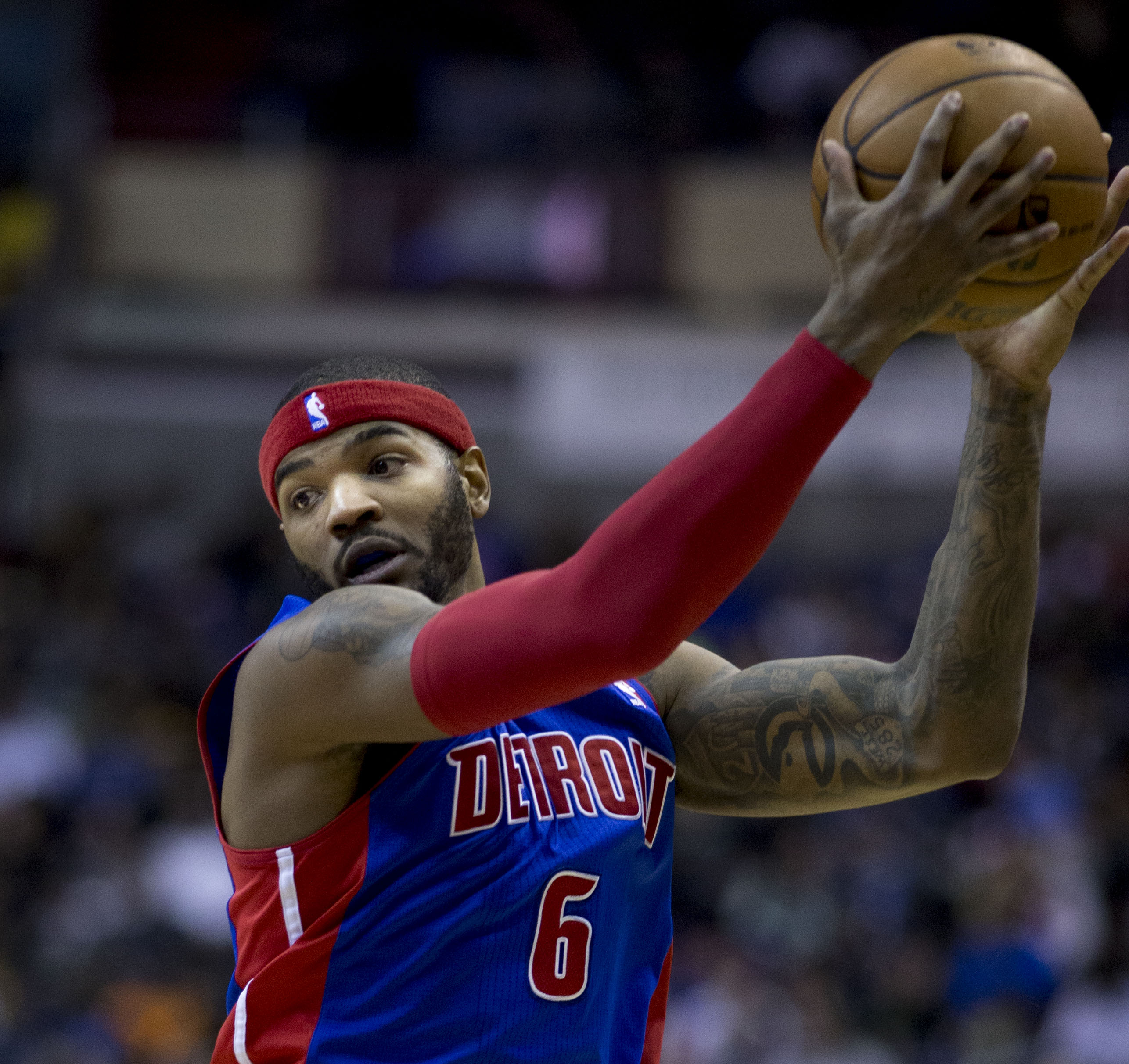
Three months ago I dedicated a post to Josh Smith’s shot selection, back when it wasn’t so rough on the eyes. The newly-signed Pistons forward hoisted 23 threes through the first three games of the season but the mid-range attempts were mostly absent. A long shot to be an above-average shooter, having Smith take a step behind the line instead of taking 20-foot two-pointers was a step in the right direction, one that would yield more points per attempt from jump shots he’d have to take when playing alongside Greg Monroe and Andre Drummond. It was a hopeful sign of efficiency.

Fast forward to now. Smith’s recording career-lows in PER, true shooting percentage, effective field goal percentage, and free throw rate. His threes and shots in the dead zone combine for about half his field goal attempts, most of them being bricks that create shot chart blood. However, the floor on Smith’s three-point percentage is most remarkable, possibly still untapped despite being on pace to be the worst three-point shooter of all time by a whole two percentage points, minimum 200 attempts. His 166 tries have dropped 23.5 percent of the time but the monthly splits worsen each month:

smithgraph1

Smith’s just 16-for-87 beyond the arc (18.4 percent) over his last 30 games. SportVU lists him as the worst three-point shooter in catch-and-shoot situations (24.7 percent) among the top 100 players in attempts, with teammate Charlie Villanueva second to last. His percentages are even worse in pull up attempts, though those shots have rarely occurred and it’s common for players to struggle shooting off the dribble versus a pass.

The good news is that Smith’s three-point rate is dropping. Here’s a table of those monthly splits with his mid-range rate and free throw rate included, via NBA.com. (I left out October and February because small sample size.)

smithgraph2

The three-point rates in December and January match up with Smith’s last season in Atlanta. Maybe they have to do with Detroit’s big three of Smith, Drummond, and Monroe playing together less frequently each month. According to NBA.com, the trio was together 18.7 minutes in November, 16.2 in December, and 15.0 in January. Neither monthly split yielded positive results, though that’s not 100 percent on Smith. The trio needs to be severely staggered, and Brandon Jennings at point guard hasn’t helped any.

The other evil in Smith’s game is the mid-range shot. The heater from that area of the floor last month, one that gave him a nice uptick in true shooting percentage was obvious, possibly even fatal fool’s gold after last night’s performance in Miami. Smith’s never shot better than 39 percent from mid-range in a single season, and there’s a chance if the three-point line was shortened like it was from 1995 to 1997 that he’d likely experience little to no improvement like players listed here.

As disappointing as Smith’s shooting has been, he’s not the sole reason for Detroit sitting in ninth place behind Charlotte and Washington. His shooting is costly but he would have more to offer if he wasn’t playing small forward over half the time, a position that helps neglect the skills he provides on both offense and defense. The Pistons, however, are going nowhere unless a third of its frontline is shipped out. Trading Smith would be impressive when he’s on the books until 2017 at $13.5 million a pop, but Monroe seems like the most moveable piece given his looming, steep raise next summer, one possibly not worth it given the holes in his defense.

Then again, the same could’ve been said about Smith’s contract and whether or not it’s worth paying him to play on the perimeter. Joe Dumars must’ve thought it was but the results, at least on offense, have been a three-month migraine. There’s plenty of room for improvement in Smith’s shooting with some of it bound to happen given how bad things have become, but the slight possibility that the worst-case scenario remains to be seen is amazing in itself.

Non-conference update: The West wins another week, plus a look at their non-conference games left

It was another winning week for the West, going 15-8 against the lowly Eastern Conference where only Indiana and Miami have more than 10 wins in non-conference play. The West has won 12 of the season’s 14 weeks so far with 12 to go.

Here’s the updated week-by-week breakdown:

Last week, Milwaukee continued to struggle in non-conference play as they went 0-3 and are now 1-16 for the season. It also didn’t help for the East that Indiana and Miami, the only two teams to have a non-conference record over .500, both lost games against the West on their home courts. It’s a good thing the Pacers won’t match up with Goran Dragic and the Suns in the playoffs. Miami and Oklahoma City, on the other hand…

The Milwaukee of the West is looking to be the Lakers, who are getting beat up by the East lately when just about every other Western team uses non-conference games as a standings-padder. Only Sacramento comes close to having as bad of a non-conference record, who are 5-9 while the Lakers are 7-13. It’s unlikely Sacramento stays that bad when they can play six more games against the East.

Speaking of games left against the East, in my opinion it’s a decent argument to use when looking at which West teams will make the playoffs. Here’s a breakdown of that too:

I thought about including a table for the East, but Miami and Indiana are on a crash course to meet in the Conference Finals. The first round matchups for them should be snoozers.

Of course, non-conference games don’t say everything about the rest of the NBA schedule. Back-to-backs, home vs road games, and the strength of the remaining games are all key too. As you can see though, even without Mike Conley the Grizzlies should tread water just fine when they play five more non-conference games than Dallas. Meanwhile, the Chris Paul-less Clippers might regress after capitalizing on an East-heavy schedule the last few weeks.

Of course, teams with extra non-conference games still have to play and win them versus just giving them the W, but so far the West has had a historical upper hand this season.

90s NBA: Players who shot worse from the shortened three-point line

During last night’s barn/dome burner at Syracuse, I noticed Derrick Coleman getting some love from the broadcasters. Looking at his NBA stats from Basketball-Reference, I noticed two odd things:

  1. Coleman shot threes, but like Charles Barkley and Josh Smith he bricked many.
  2. Coleman shot worse from the shortened three-point line, the one that went from 23’9″ around the arc to a uniform 22 feet from 1995 to 1997, than he did from the modern-day line. From 1995 to 1997, he shot 67-for-260 (25.8 percent) from three. His other seasons combined: 259-for-845 (30.7 percent).

Some searching on Basketball-Reference showed that quite a few other players had the same, weird drop-off in three-point percentage from a shortened line. Others shot better when the arc went back to the normal 23’9″ (with the 22-foot corners staying) in 1998 while some experienced both the drop off from 1994 to 1995-1997 and the uptick the following season.

Whatever the case, below is a table to show those players who met the criteria previously listed with an additional two requirements:

  1. Play at least 50 games in a season.
  2. Average at least one three-point attempt per game.

Seasons with the shortened three-point line are highlighted in blue and regular three-point lines highlighted in red. It’s a decent-sized list, so just use the bar on the right side to scroll up or down.

Some reasons off the top of my head on why players would struggle with a shorter three-point line:

  1. With a shorter arc, defenders had less distance to cover when running a shooter off it. Shooters who took an extra tenth of a second to get their shot off would be affected the most.
  2. Three-point specialists might not have been used to shooting a foot or two closer to the hoop, though in time they would adjust.
  3. Some players are asked to create with the shot clock winding down. A closer three-point line may have led to more contested shots from beyond the arc versus 22-foot twos. That’s not a problem when three points are worth more than two, but the three-point percentage took a dip nonetheless.
  4. It was just variance running it’s course, though more often than not it reared its ugly head at the players listed in the table.

Other thoughts are certainly welcome.

Just for fun, I’ll end this post with a table featuring notable players who benefited from the shorter three-point line and then saw their three-point percentage (and possibly three-point attempts) decline after the 1997 season.

Opposite from the previous table, the shortened three-point line is highlighted in red and the modern-day line in blue:

Any excuses I made about players shooting worse from the shortened line might be crushed thanks to that second table. There’s a lot of what-ifs after looking at it, such as Allen Iverson and Michael Jordan, among others, having even more ridiculous point totals had the arc remained shortened. Clyde Drexler‘s another shooting guard who would’ve benefited.

Big men like Terry Mills and Arvydas Sabonis would’ve had all sorts of fun, and if a time machine could take LaMarcus Aldridge to 1995 to 1997, he too would feast. LUNCH MEAT.