Tag Archives: sports

East vs. West Week 20: The West’s chase for two records against the East

The non-conference update follows games pitting the Western Conference’s teams versus the East’s. This season, the West has often held a winning percentage so large it hasn’t been seen in over 50 years.

After going 8-20 in non-conference play from February 24 to March 2, the East bounced back to go 11-10 last week. Toronto moved to over .500 versus the West, joining Brooklyn, Miami, and Indiana in that somewhat special club since none of them are even at 20 wins yet. The conference’s winning percentage from February to now is quite respectable, though, at 46.4 percent. It’s put a dent in the West’s potential for a record-high in winning percentage, set in 2004 at 63.3 percent.

More on that and another potential record in a bit. Below is the updated week-by-week breakdown along with non-conference games left in each week:

For the West to surpass their winning percentage from 2004, they’ll have to finish the rest of the 57 non-conference games 40-17. That’s possible since 34 of them will be hosted by their teams, but it’s still more than a 70 percent win rate to pull off.

So with a record-high winning percentage unlikely to be accomplished, there’s another record worth looking for. All current playoff contenders out West have a shot at winning 20 non-conference games, something never accomplished by either conference. The closest calls came in 2005, when six playoff teams from the West won 20-plus and the other two (Houston and Memphis) won 18, and in 2010 when seven West teams had 19-plus wins while the one other playoff squad (Portland) finished with 17.

Right now, the top eight West teams all have at least 18 wins and no more than nine losses. Below is a table showing their non-conference records, as well as ninth place Phoenix’s:

Oklahoma City and Portland should be fine, even if the latter has been on a brutal downswing with or without LaMarcus Aldridge. The Clippers have to beat one of Milwaukee or Detroit left on their schedule, and all Dallas has to do is beat Boston tonight and they, too, are at the 20-win mark. Boston’s coming off last night’s loss to New Orleans in which Anthony Davis pulled off a 40-20 line, by the way. No big f’in deal or anything.

Golden State should beat Milwaukee and Orlando this week to reach 20 wins as well. The problems come from Memphis and Phoenix, and one of them will be in the playoffs unless Kevin Love goes 1962 Wilt Chamberlain until season’s end.

Memphis finishes their non-conference games April 11 at home against Philadelphia, but they’ll have two games against Miami before that happens and one versus Indiana. Two of those three against the East’s best come in a back-to-back this weekend. Not exactly ideal, though Indiana will be on the tail end of a back-to-back too when they face the Grizz, and their first opponent is Chicago. All of those games on Friday and Saturday have the potential to swing votes for All-NBA and All-Defensive teams, as well as who is Defensive Player of the Year.

In Memphis’ second game against the Heat, Miami will be on the tail end of a back-to-back after playing a Thursday night game versus Brooklyn. All the Grizzlies have to do is win one of those three games and then Philadelphia, but that’s easier said than done.

For Phoenix, they’d have to go 5-1 over their last six non-conference games, which is something they’ll probably have to do anyway if they want to make the playoffs. Goran Dragic is finally reunited with Eric Bledsoe again, but they’ll be finishing a back-to-back at Brooklyn tonight. After that, they’ll finish their East games over the next two weeks starting with Orlando and Detroit but finish with Atlanta, Washington, and New York. Worth mentioning is their sweep of Mount Hibbert and Indiana, by the way.

Every game matters for Memphis and Phoenix, and non-conference matchups have been often regarded as ways for West contenders to build winning streaks. Both teams will have to topple some East squads looking to rise in their own conference’s playoff seeding, however. By next week there should be a clearer picture on whether or not the West’s playoff hopefuls can all accomplish that 20-win feat, as well as if the conference as a whole is within reach of their highest winning percentage ever versus the East.

Month by month lottery movement in GIFs and tables

About a month ago I wrote about the ongoing battle in the middle of the NBA lottery and how that’s often a spot where a team can increase their odds at a top-3 pick by as much as 33 percent, depending on where they are with a couple months left in the season.

For the heck of it, I took a look at this season’s lottery movement month by month, starting with December 16. I chose that odd starting point because of this season ending on April 16.

Below is a GIF of teams with their odds of landing a top-3 pick, and below that is a table showing changes in percentages by each month. Neither of them take account into draft picks owed from trades.

lotto on Make A Gif

I’m in the process of putting together something similar to that GIF, but way more interesting to look at and to be shown on the night the lottery balls come out. More than likely I’ll post it sooner, though, because boredom.

For now, it seems like New Orleans, a team that would be scary with another lottery pick, never gained enough steam to get within the top-5 protection their draft pick has. That’s even with missed time by Anthony Davis and Jrue Holiday. They only have one percent more of a chance at landing a top-3 pick as Goran Dragic and the Suns. As for Milwaukee, they’ve been consistently the worst team in the league standings-wise for the whole season. Congrats, Larry Drew and Larry Sanders.

With a month left in the season still, there’s bound to be more movement below the Bucks and especially in the fourth through seventh spots. Detroit’s also in position to keep their top-8 protected draft pick, but who would they even draft to play with Josh Smith, Greg Monroe, Andre Drummond, and Brandon Jennings? For all that talent, there are still quite a few holes to fill. Some of those will disappear with Drummond’s progression, though. Hopefully.

Lastly, below is a table showing percentages by month and records:

Any other thoughts are welcome.

High-usage backcourts and efficiency of their lineups

High-usage backcourts were something I fooled around with earlier in the season, though the filters I made back then (usage rates: 25 percent, players had to start together) were so stiff I had to look at backcourts across nearly 20 seasons. That was sort of the point, but at the same time there weren’t as many really high-usage backcourts as I initially thought.

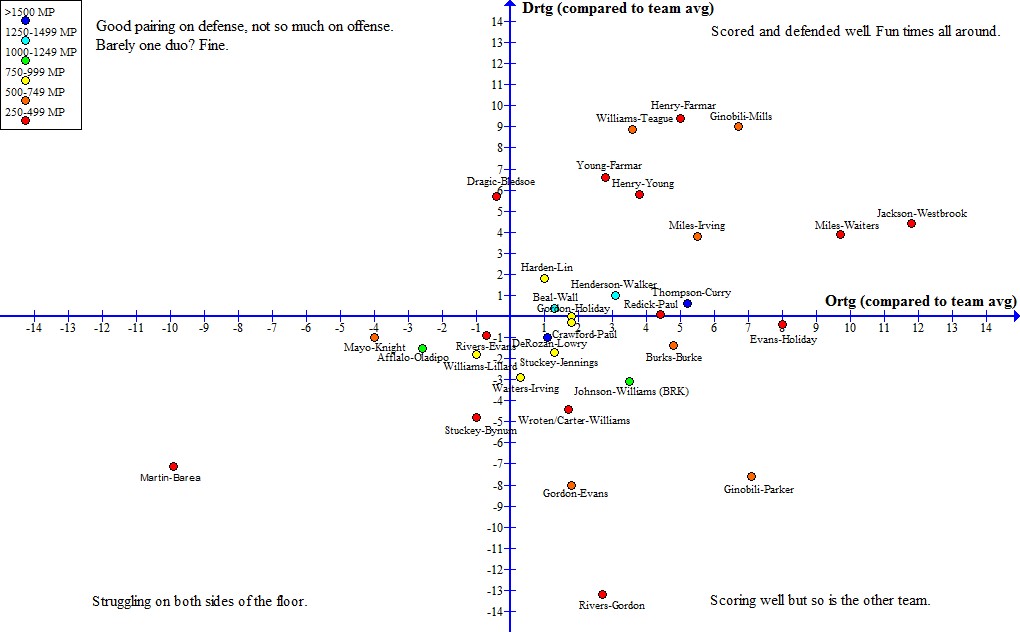
This time I scaled back on the filters, making room for guards this season (74) that used higher than 20 percent of their team’s possessions. I also didn’t leave out players who didn’t start and instead fiddled with 2-man lineup stats from NBA.com featuring guards meeting both the 20 percent usage rate requirement and logging over 250 minutes together. In the end, 32 backcourt pairings made the cut. If I went by duos that each used up 25 percent of their team’s possessions, only the Dion Waiters/Kyrie Irving and Wroten/Carter-Williams duos make the list, though those tandems have rarely started games together.

Below is a visualization of each duo’s efficiency while on the court compared to their team’s average. For example, Brooklyn has scored 3.5 more points per 100 possessions than their team average with Deron Williams and Joe Johnson playing together but they’ve allowed 3.1 more points on defense. I also added “BRK” next to that duo because of how common their last names are. Hopefully the others are self-explanatory.

The color of each duo represents the range of minutes they fall in, located in the upper left. Klay Thompson and Stephen Curry have both logged more total minutes (1,904) and averaged more minutes per game (30.7) together than any other tandem, though DeMar DeRozan and Kyle Lowry are close behind (1,803 and 30.0, respectively). Duos that are in the bottom-half of the chart have their names below their dots and the opposite for those in the upper-half.

duos Rtgs adjusted (MP)

Click to enlarge.

It doesn’t seem too surprising that no combo is stifling on defense but bad on offense. Goran Dragic and Eric Bledsoe barely make that fourth of the graph with Suns lineups scoring 0.4 points less per 100 possessions with both of them on the court. If anything, lineups would normally be the other way around which is the case for 10 of the 25 pairings that score higher than their team’s average.

It’s also not surprising that the combos that stray furthest from the average are the ones with the smallest sample sizes. The larger the minute total, the closer they should be to their team’s average. Minutes per game will be looked at further down in this post.

19 of 32 backcourts logged a positive net rating, but five of the seven with nets of +9 or higher belong to the Lakers and Cavaliers combos. Some of this is because they overlap with each other while working as a trio. Below are the three most notable teams with trios along with their minutes and efficiency splits. all according to NBA.com:

Cleveland

  • Irving-Waiters-C.J. Miles: 82 minutes, 112.7/107.2/+5.5

Los Angeles Lakers

  • Jordan Farmar-Nick Young-Xavier Henry:  133 minutes, 113.2/89.3/+23.9

New Orleans

  • Gordon-Evans-Austin Rivers: 104 minutes, 109.3/125.2/-15.8

The Thunder’s combo of Russell Westbrook and Reggie Jackson (+16.2) and the Spurs’ of Manu Ginobili and Patty Mills (+15.8) stand above the five pairings from the Cavs and Lakers as the best duos.

The biggest disaster comes from Minnesota with Kevin Martin and J.J. Barea, logging 313 minutes together over 49 games for a net of -17 points/100 possessions, at least compared to their team’s overall efficiency. Over 100 of their minutes have come with Corey Brewer, Kevin Love, and either Dante Cunningham or Nikola Pekovic. The one with Cunningham gets killed on the glass and can’t take care of the ball, altogether allowing 133 points per 100 possessions while the unit with Pek has a net of -8.3 points. There are a couple Barea-Martin lineups that have yielded good results, though they’ve totaled only 20 minutes or so. Judging by the players filling out the rest of those positive lineups (Alexey Shved, Robbie Hummel, etc.), they likely beat up an opposition’s second unit.

Overall their sample size is one of the smallest. Not nearly as big of a struggle, though still pretty bad are the Gordon-Rivers and Evans-Gordon combos in New Orleans and the Rodney Stuckey-Will Bynum duo in Detroit.

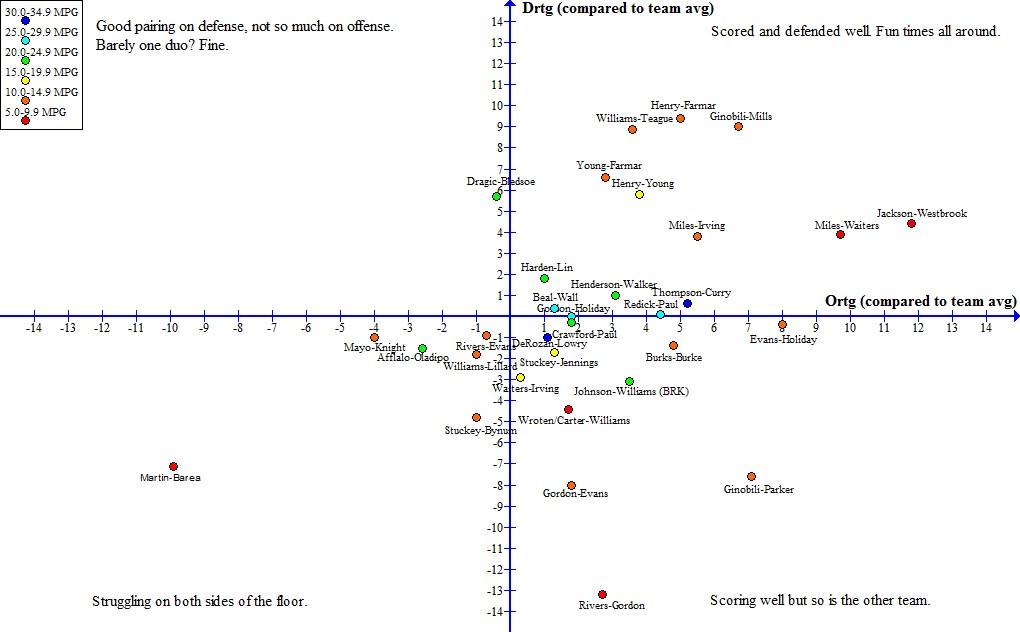
So the biggest upswings or downswings come from duos and their lineups with the smallest samples, but do they also log the least amount of minutes per game? Below are the same pairings with the color of their dots representing minutes per game instead of total minutes. As usual, click to enlarge if you’d like.

duos Rtgs adjusted (MPG)

Below is a GIF that might help look at combos that log the most minutes per game.

mp/mpg on Make A Gif

There’s a slight difference in the combos that are negatives on both sides of the floor, but probably the most noticeable change comes where other pairings score a few points more. Most play a good chunk of minutes per game. Dragic and Bledsoe fit into that category and would log hundreds of more minutes if not for the latter guard being sidelined with a right knee injury.

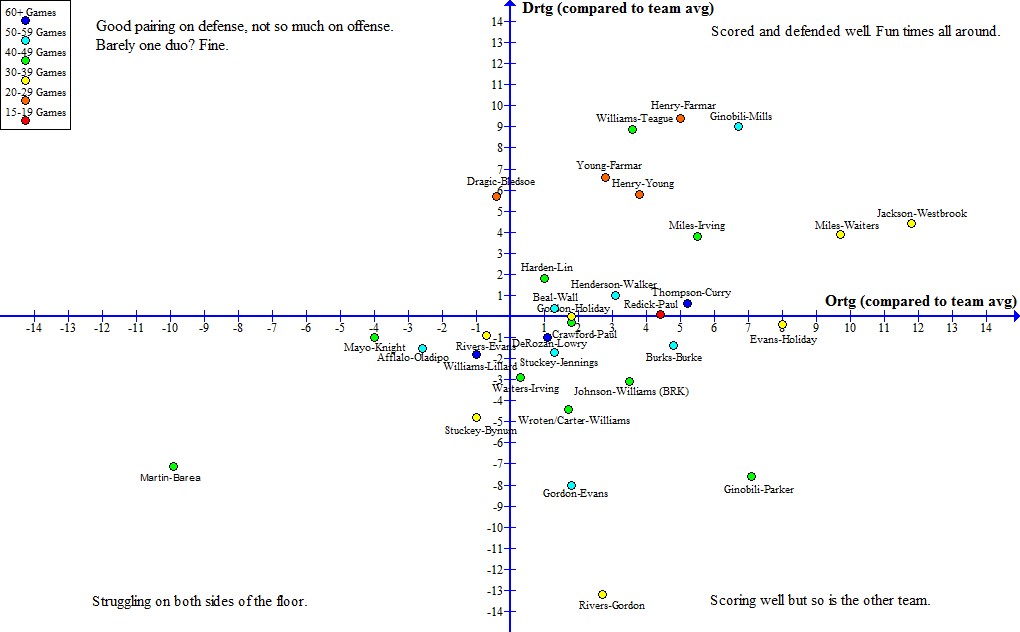
The last graph shows which duos play the most games:

duos Rtgs adjusted (GP)

This all isn’t to say these combos are the only reason for the collective success or failure of their lineups. Maybe they compliment each other or the rest of the lineup well (or not, in terms of negative duos), benefit from playing alongside a star forward or center (or not), or beat up a second unit as opposed to starters (or…not..). As noted before, some sample sizes are smaller than others.

Some of the duos, though, just look like they’ll give up more points than they generate over the long haul, like Tony Wroten and Michael Carter-Williams not exactly being a pairing that will stretch the defense. Others like Dragic and Bledsoe look like they’ll cause chaos no matter who they play.

Any other thoughts are certainly welcome.

All stats are according to NBA.com unless noted otherwise.

Solid final quarter of season a common trait among champions

Every team has a peak and valley during their season, even the 76ers who started the season 3-0 but are now dealing with a winless five-week stretch. For a team looking to grab a top-3 pick in this year’s draft, that’s probably the right time to find their high and really, really low points of the season. As for the title contenders it should be the opposite, though a few teams are going through some recent woes whether it’s from a difficult stretch of games (Miami dealing with Joakim Noah and Boris Diaw), adjusting after a trade (Indiana with Evan Turner and other problems) or whatever else factoring into a slump (it’s all Russell Westbrook’s fault!).

History has shown that it’s fine to experience those downswings as long as they don’t carry too deep into March or April. Over the past 30 years, 26 of the eventual champions played .600 ball or better in the final quarter of the season. Also worth noting is that, with the help of Basketball-Reference, 26 of the last 28 champions finished the same stretch of games with a positive net rating.

Below are the last 30 champions with their records, offensive and defensive efficiency, and net rating over the final fourth of the season. Highlighted are the outliers. All stats are according to Basketball-Reference:

The outliers:

1995 Houston Rockets

Hakeem Olajuwon missed eight of the final 20 games with the Rockets going 3-5 over that stretch. Clyde Drexler played out of his mind during Dream’s absence, averaging a stat line of 30.0/9.3/5.5/2.4/0.9. He also made over 30 percent of his threes, something not totally guaranteed throughout his career.

In the 12 games Olajuwon played, Houston squeaked out a positive net rating of 0.1. Also, Zan Tabak played in only eight of the last 20 games. Absolutely has to be noted.

Orlando finished 9-11 as well, though they had efficiency splits of 114.2/112.3/+1.9. Long live the mid-90s Magic jerseys and Penny Hardaway.

2006 Miami Heat

Dwyane Wade missed three games while Shaquille O’Neal missed five. Each sat out the last two games, paving the way for a Michael Doleac-Wayne Simien-Antoine Walker-Dorell Wright-Jason Williams starting lineup. Miami lost both. Fun times.

Dallas also finished 11-9 that season and Dirk Nowitzki played 81 games, so what might be their best excuse? Their schedule wasn’t the greatest as they played the Cavaliers, Clippers, and Kings each twice and the Jazz, Nets, Nuggets, Pistons, Spurs, Suns, and Wizards each once. That’s not exactly the most murderous row of opponents but a mix of title contenders and playoff-worthy teams jousting for seeding nonetheless. Also mixed in the final 20 games were the Hornets with a rookie Chris Paul, the Magic with a young Dwight Howard, and the Warriors who…they stunk down the stretch, sure, but we all know what happened next year. Regardless, that’s 19 of the final 20 games. Joe Johnson and the Atlanta Hawks were the other squad Dallas faced (and defeated).

2010 Los Angeles Lakers

Andrew Bynum missed the last 13 games of the season while Kobe Bryant missed four. Pau Gasol was awesome down the stretch, though, averaging a line of 24.2/12.9/3.8 with 2.2 blocks.

2012 Miami Heat

A lockout-shortened season where resting core players was rarely a bad move. LeBron James, Wade, and Chris Bosh made only 31 appearances out of a possible 48, making way for front courts of some combination of Eddy Curry, Dexter Pittman, Udonis Haslem, James Jones, and Shane Battier. Arguably more fun times than 2006.

It might seem standard for solid teams to play any fourth of the season with a positive net rating, but that’s not exactly true. Using the net ratings from NBA.com, below are 10 notable teams of the last 15 seasons that dipped into the negatives over the final quarter:

Sure, a lot of those teams were pseudo-contenders. The 2001 Sixers, for example, were never going to win four games against a Lakers squad that mowed over their first three opponents with an offense-defense efficiency line of 113.0/96.3/+16.7, but maybe sputtering down the stretch contributed to those teams not being among the league’s elite during their respective seasons. As for the 2010 Lakers and 2013 Spurs, they clearly stand above the eight other teams in terms of talent and confidence they’d make a deep run in the postseason.

Some team over the next five weeks is bound to hit a rough patch. Maybe they’ll right themselves in time for what should be a hell of a postseason, but they could also end up as a team to write off whether it’s in April, May, or possibly even June. Below is a breakdown of the remaining schedules for a mix of title contenders and ones I don’t think will go that far in the playoffs, but included them anyway just because. Each team also has their own sheet with their last 20 games, including the (color-filtered) difficulty of their opponents. It’s a fricken rainbow.

Every team seems to have a few games in a row against teams competing (or about to compete) for lottery balls, though teams out West appear to have more daunting schedules overall.

There’s always the chance for an outlier like four of the last 30 seasons, though, but the Clips at least look well on their way to fit the minimum requirements to be labeled as a contender. That’s at least in regards to finishing steady.

But to include one last table, ending the last quarter of the season over .600 and with a sexy net rating doesn’t always guarantee making the deepest of runs in the playoffs. Below is a table of the best nets in the final fourth of seasons since 1997, according to NBA.com:

If that final table makes a team finishing hot suddenly worrisome, it probably shouldn’t. When looking at net ratings provided by Basketball-Reference in the very first table, champions often had very respectable ones. Chicago’s from 1996 is unreal.

Anyway, a lot still needs to be addressed regarding quite a few playoff teams. Let’s see how the last five weeks play out. The next two days should especially be entertaining thanks to a ton of good matchups.

For related posts, check out drastic movements in the lottery over the last two months of the season and what 20 wins before Christmas means in the West.

Non-conference update: West back on track for a record winning percentage

The non-conference update follows games pitting the Western Conference’s teams versus the East’s. This season, the West has often held a winning percentage so large it hasn’t been seen in over 50 years.

Over the month of February, the East put up a respectable fight against the West in non-conference play and ended a four-week span 40-46. It put the possibility of the West surpassing their best winning percentage of 63.3 at risk, having to go 71-35 for the rest of the season to set a new high.

Last week’s non-conference results made that mark reachable yet again, however, with the West going 20-8. Below is an updated week-by-week breakdown of non-conference matchups:

(Don’t ask about the colors I’ve been using to outline winning or tied weeks for the East. Both were random choices.)

Western Conference teams won all five games against the East’s heavyweights of Miami and Indiana, including Houston defeating both teams at home. Texas got the best of both of them overall, which isn’t that surprising. It also helped that LeBron James and Paul George, among other players from the two squads, each had an inconsistent week. Some of that blame/credit should go to the defenses of the squads they faced, however.

Even the lowly Kings and Jazz nabbed a couple wins. The Timberwolves, however, lost two games and saw their playoff hopes wash away. They beat Detroit, though, who I still can’t believe is 24-39, yet three games out from the free falling eighth-seeded Hawks team, but gives me no reason to believe they’ll make the playoffs. Maybe we’ll see Carmelo Anthony in the playoffs after all.

Below is a look at the league standings with non-conference games left. Conferences are separated by different sheets, so to view the West simply go to the bottom and click on sheet labeled after it:

Detroit’s seriously 4-20 against the West, putting them in similar company as Boston, Orlando, Philadelphia (POOR THADDEUS YOUNG), and Milwaukee. The only problem is that their record may be too good to keep their top-8 protected pick (good luck surpassing anyone below them but Cleveland). That, combined with not being good enough to make the playoffs, deciding on Greg Monroe this summer, and having Josh Smith and Brandon Jennings on the books until 2016, is about as going nowhere can get. Bad times all around.

Anyway, they have a winnable non-conference game at home on Tuesday against Sacramento, making for a matchup between Andre Drummond and DeMarcus Cousins. Fun, hopefully…!

Below are the rest of the non-conference games this week, 21 games overall:

To reach their record-high in non-conference winning percentage, the West will need to continue with a winning rate similar to last week. They play 15 road games to 6 home games, however. Playoff hopefuls from that conference play 11 games with four of them at home.

For the East’s title contenders, Miami plays two home games while Indiana has no non-conference games this week. We’ll get a good look at the Heat’s rematch against Houston on Sunday as well as Houston’s Thursday night game against Chicago and Joakim Noah, who I have a feeling will live forever or something else totally tubular.

Until next week.