Category Archives: 2014 NBA Season

When Josh Smith makes consecutive threes

Over the last four months I’ve posted both optimistic words about Josh Smith’s shot selection and amazement of how bad it’s become. Hopefully this post is somewhere in the middle, both accepting of his jump shot and that I can’tstopwriting about him.

Josh Smith can do many good things on an NBA court. Catering his game to what math says about it, well, that’s not one of them (though that’s also on Joe Dumars). He’s taken nearly as many shots within five feet, where he averages 1.282 points per attempt, as he does from 20 feet and beyond where he averages .705 points per attempt. It also feels mandatory to mention that because Smith’s a 23.6 percent shooter from the arc that he’s five attempts away from becoming the worst in league history, minimum 200 shots. He’ll be the worst even if he makes every one of those five attempts. Fun times.

Making five threes in a row is possible, by the way. The current chance of Smith accomplishing that is 0.0011 percent or basically the chances of making a straight flush in poker, but the former event actually happened over two games in the 2012-2013 season against Memphis and Miami, when the likelihood of such an occurrence back then was slightly higher at .0053 percent.

Smith’s a streaky three-point shooter, proven as recent as last night when he laughed in the face of math by making two threes in a row against the Spurs. He came into the game shooting 22.9 percent from three (again, on nearly 200 shots) which meant the chance of making his next two attempts was 5.2 percent. If we go by his accuracy since January 1, that percentage drops to 3.1.

That’s exactly what happened, though.

As his 3-point percentage might show, however, Smith will have cold spells where he misses, say, eight in a row. His longest drought this season is currently 11 threes from December 23 to January 7, according to Basketball-Reference, which is currently about as likely to happen again as making another pair of threes. The odds for each are 5.55 percent and 5.18, respectively.

Here are some other occurrences in the NBA about as likely to happen as Smith either making two threes in a row or missing 11 straight, going off his new three-point percentage that’s a shade under 23.6 percent:

  • Brandon Jennings missing seven straight threes from above the break. Don’t count this out. Judging by the distance of a lot of his threes, this has happened multiple times this season.
  • Chris Bosh missing five mid-range shots in a row. With the looks LeBron James and Dwyane Wade give him, that possibility seems, um, not possible.
  • Carmelo Anthony missing five straight threes from above the break. More likely is Anthony making five straight threes and the Knicks still losing.
  • Stephen Curry missing in general, which feels like never.
  • And for the poker players, making two-pair is slightly less likely, calculating to 4.75 percent.

Smith doesn’t care for math, though, as last night was far from the only time he’s made consecutive threes this season — he’s accomplished that eight other times. Smith’s made 46 threes at a 23.5 percent clip, which should mean on average he’d only make two threes in a row just twice and maybe three in a contract year. A similar thing happened in 2013 when Smith shot just 30.3 percent from the arc, making 61 of 201 attempts but he made consecutive threes at twice the average occurrence — 12 compared to 5.6. As usual, the downswings were rough as he once missed 15 straight threes. Earlier seasons show similar variance, though this might be common for several shooters.

Smith’s been a downright streaky three-point shooter, for better or for worse with last night showing both sides. After making two consecutive threes early against San Antonio, Smith attempted another in the fourth quarter in which he proceeded to miss everything. Order was restored, but he’s going to keep hoisting threes whether his shooting hand is hot or so cold it confirms my suspicion he shoots with mittens.

If my math is off, feel free to chime in.

Non-conference update: The East ties and a breakdown of games left

The non-conference update follows games pitting the Western Conference’s teams versus the East’s. This season, the West has often held a winning percentage so large it hasn’t been seen in over 50 years.

A day late because of my Monday post about the New York Knicks, the East and West tied last week in non-conference play. It’s the first time the East tied or won a week since the seven days before Christmas and only third time in the 17 weeks this season.

Below is the updated week-by-week breakdown:

The last three weeks have been respectable outcomes for the East with a combined winning percentage of 46.3 percent. That fits right in with the past 14 years against the West. As for the entire season, the West’s winning percentage has now fallen below 63.3 percent which was their highest mark ever, recorded in the 2003-04 season.

This week the West is currently 3-0, including Dirk Nowitzki’s unbelievable-yet-totally-believable buzzer-beater over Carmelo Anthony last night, but there’s still 16 games to go.

Below is a table of all the non-conference games remaining as well as a separate column for games featuring the Sixers (poor Thaddeus Young), Bucks (poor Caron Butler), Magic (poor Arron Afflalo), Celtics (poor Rajon Rondo?), Kings (poor DeMarcus Cousins???), Lakers (poor Kobe Bryant?????), and Jazz (poor Gordon Hayward???????):

Without taking into account back-to-backs and home and road games, Golden State has a small yet nice edge over a few West teams on the fringe by playing three games against East teams that, from here on out, might not win more than 15 games combined.

New York is worth mentioning too, even if there’s the possibility Raymond Felton misses significant time for, well, Sports Illustrated has a breakdown of what happened and what could happen next. They might even be better without him even if they just bought out Beno Udrih. Washington is also another team with a few winnable non-conference games, though they’re without Nene Hilario for at least a month after spraining his MCL.

Overall, there’s still over a month left in the NBA season and over 120 non-conference games left. The East could continue chipping away at what was once an embarrassing winning percentage, or the West could surpass their 2004 mark as their best non-conference record ever.

Tables with shot location splits (from the Knicks post)

Below are some shot location splits I made to compare New York’s recent, excessive jump shooting with the rest of the league.

The first table looks at how many shots a team takes outside of the paint, according to NBA.com’s shooting stats. Here’s a link to it for maybe an easier view. This one should make it downloadable on Excel, where sorting columns are hopefully a possibility.

Anyway, here’s the posted table(s) from Google Sheets:

There isn’t anything too telling with how shots in the paint or out of it impacts offensive rating. The top 10 most efficient teams are scattered across the board. It’s worth noting, though, that only seven teams have taken more than half their shots in the paint.

Splits in wins and losses, found in the second sheet, also vary. In wins, the Nets, Pistons, Clippers, and Lakers all take a few less shots in the paint. The Bobcats, Cavaliers, Heat, and Magic have the opposite result. For Charlotte and Miami, maybe that’s from the impact of Al Jefferson and LeBron James, respectively.

Overall, though, I’m not sure it’s worth looking too into the stats because of, well, the difference in points from a mid-range jumper and a three-point shot not being specified (but will be in the second batch of tables). That doesn’t mean it’s not cool to post the splits, though, well hopefully.

But the next table’s a little more specific with where a team distributes their shots, sorting ones that often generate the most points (around the rim and from the arc) from the lowest (in the paint but not in the restricted area, and from mid-range). Here’s a link to the table for possibly easier viewing. This link should hopefully load in Excel.

This table has a more clear relation to both offensive rating and effective field goal percentage, though outliers like Philadelphia (poor Thaddeus Young, by the way) still remain. Detroit’s also one of the top teams to shoot around the rim or from three, though their efficiency takes a hit from Brandon Jennings and Josh Smith, among other players.

On the other side of the outliers is Oklahoma City, who’s in the middle of the pack with how many attempts they take around the rim and from three, though they’re sixth in offensive rating and EFG%. It helps to have nice mid-range shooters in Kevin Durant and Serge Ibaka. Same goes for Dallas with Dirk Nowitzki and Portland with LaMarcus Aldridge.

No team takes less than half of their shots from the high-efficiency areas of the floor, though Memphis is tip-toeing that ground with a near 50-50 split. Related: they’re 20th in offensive rating and 21st in EFG%.

Win-loss splits still vary. Golden State, for example, attempts two to three more shots from either mid-range or the non-restricted area part of the paint (that part of the floor seriously needs a better, shorter name) in wins. Swinging the other way are the Mavericks, Clippers, Pelicans, and Jazz all taking a few less shots from those low-efficiency spots on the floor with the Clippers having the biggest decrease, taking over five less shots in wins. Unsurprisingly, their EFG% improves by 9.1 percent though every team’s percentage has increased in wins. There’s hardly a difference in shot distribution for some teams like the Lakers, Magic, and Blazers, all changing by less than a quarter of a percent.

Just for fun, I included an extra table featuring which teams take more mid-range shots than ones around the rim, something I included in the Knicks-related post this morning. Unsurprisingly, Portland’s both at the top of that table and the only team to be in the top 10 in scoring efficiency. The rest of the teams, save for the Knicks, are either at the bottom 10 or flirting with it.

I also wanted to include game-by-game logs but they’re so big that I didn’t want to make this post extremely slow to load. They can be found here on Google Sheets or a link to Excel.

Any other thoughts are certainly welcome, and as a reminder this was related to the Knicks column I posted earlier today about their overreliance on the jump shot, even by their standards.

The Knicks’ recent overreliance on the jump shot

The last couple of Knicks games have been, well, rather Knicksy. Their defense has been lacking and badly, allowing 114.6 per 100 possessions according to NBA.com. Recently, though, New York’s scoring efficiency (104.7 points/100 possessions) has actually been higher than their average rate of 103.9 in their other 54 games, and how they distributed their shots across the floor is more than worth discussing by itself.

By design, New York takes a lot of shots from the perimeter, most notably when Carmelo Anthony is playing power forward. That’s usually fine since that happened for most of 2013 and their offense finished third in scoring efficiency. This season’s starting lineups have been different for a lot of reasons, but during the last two games their lineup had a makeup similar to 2013: Anthony at power forward with Tyson Chandler, two point guards, and a small forward to space the floor that’s currently J.R. Smith, though Iman Shumpert would likely start in his place if he were healthy.

The result has been A LOT of shots outside the paint, for better or worse. Below are their shot charts against Orlando and Atlanta with the former on the left and the latter on the right, via ESPN.com:

NY-ORL 2-21

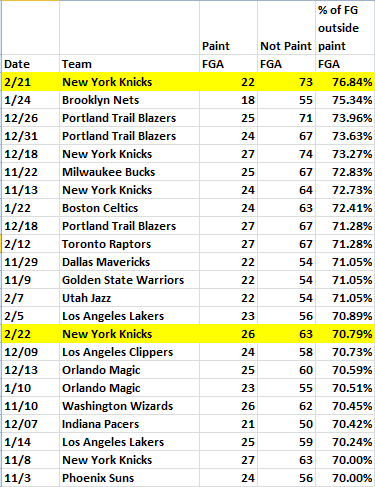
The love for the jump shot is probably more noticeable against Orlando when the Knicks attempted 73 field goals outside the paint, according to NBA.com, which is the second-highest total by any team this season and surpassed only by their incredibly Knicksy game at Milwaukee on December 18. The percentage of shots they took outside the paint against Orlando, however, was the highest by any team at 76.84 percent, well above their league-leading average of 61. As for their outing against Atlanta, it was the 15th-highest percentage by any team at 70.79.

Teams on average take 52.7 percent of their shots outside the paint. I’ll have another blog post sharing a table of that, among other things. For now, here’s where the Knicks’ last two games fit in with the 21 other instances of excessive perimeter shooting:

New York

The Knicks are responsible for five of those 23 games and are the only team to pull them off in consecutive ones.

Anthony, Smith, Tim Hardaway Jr., and Raymond Felton combined for 109 of those 136 shots outside the paint, though they’re not totally bad attempts. Obviously, three-pointers are worth more than 20-foot twos and the Knicks took seven more threes on average than they normally would, but they also took 11 more mid-range shots per game. The shots that vanished were from around the rim, taking eight less attempts per game against Atlanta and Orlando. Even Chandler, who supplied a good chunk of the attempts around the rim thanks to alley-oops, got in on the fun from the dead zone of the floor but had little success.

Below is a simple breakdown of New York’s shot locations with the last two games bolded. The other 54 games are in regular font:

The same accuracy from the arc is nice to see, though Anthony hit some insane, heavily contested attempts during that stretch which helps explain the lower assist percentage. The mid-range accuracy is also steady but Amar’e Stoudemire and Anthony, for example, had upticks from there while combining for six less shots around the rim per game. For Anthony, some of that’s obvious when looking at his scoring outbursts from those games. He’d have isolations against a defender like Tobias Harris, someone he could probably take off the dribble whenever he wanted, but pulled up from either the arc or mid-range with (to his credit) decent success.

Overall, the Knicks’ shot distribution was out of whack when factoring in how many shots were taken in high-efficiency spots (around the rim and the arc) versus low-efficiency ones (non-restricted area spots in the paint and mid-range). New York took about the same number of shots from each with a 49-46 high-low efficiency distribution versus Orlando and 45-44 against Atlanta. That’s not exactly great when teams on average take about 57.5 percent of their shots either around the rim or from the three-point line, and each of those games placed among the bottom 25 percent of all outings this season in terms of what percentage of a team’s shots were taken from high-efficiency spots of the floor.

For the season, New York has been slightly above average with their distribution between high-efficiency shots and low ones, currently at 58.1 percent. Part of that isn’t surprising when they take the sixth-most threes per game, but they also take more shots from mid-range than they do at the rim, something the Blazers, Pacers, Wizards, Cavaliers, Magic, and Celtics do. Last year, 66.1 percent of their shots were from around the rim or three. That would’ve ranked 2nd this year.

Is this all something to panic over? The Knicks are in a state of panic as is. As constructed, though, they’re a team that relies on scoring with range with or without some their players currently injured. Once in a while there will be nights like the last two where they’ll fall head over heels in love with the jump shot, and along with their inconsistent defense it will cost them games. To be an optimist, though, there’s also the potential for their shooting to catch fire and get them back in the playoff hunt. Heck, it might open up more looks at the rim.

Whether New York lives or dies by the jump shot, it’s been remarkable watching just how much they can attach to it. They’ll host Dallas tonight, a team in the middle of the pack in allowing both shots around the rim and threes, according to NBA.com. Whether the Knicks continue to look allergic to the paint is something to look for along with the chance Vince Carter scores a season-high at the Garden.

Revisiting if Roy Hibbert could block more shots than an entire team

SONY DSC

Zach Primozic | Flickr

Once in a while I’ll revisit weird accomplishments I thought might happen, like a team winning more games than the Celtics and Lakers combined, or impressions left on me in the beginning of the season, like Josh Smith’s once-promising shot selection. Today I’ll revisit the possibility I brought up over two months ago of Roy Hibbert blocking more shots than an entire team.

If that sounds like a lofty accomplishment for the Pacers center, that’s because it is, but it’s not impossible. The last time a player recorded more blocks than another team was in 2009 when Dwight Howard had 231 blocks to the New York Knicks’ 204. New York, coached by Mike D’Antoni with a starting frontcourt of David Lee and Al Harrington, set the record for the least blocks during an 82-game season, though it wasn’t much better the season before when they were coached by Isiah Thomas. The Knicks of 2008, with a frontcourt of Zach Randolph and Eddy Curry, blocked just 213 shots. Josh Smith (227 blocks) and Marcus Camby (285) outswatted that squad and then some.

At the time of the first post, two squads this season were in danger of becoming like the Knicks of the late-2000s: the Kings and Timberwolves. Hibbert had 62 blocks to Sacramento’s 48, though Minnesota was within distance without Ronny Turiaf and their starting frontcourt of Kevin Love and Nikola Pekovic not posing much of a threat above the rim. As for the Kings, they had frontcourt depth consisting of DeMarcus Cousins, Chuck Hayes, Derrick Williams, Patrick Patterson and Jason Thompson. They come in all shapes and sizes, but none are elite shot blockers. Hayes and Patterson would eventually be traded for Rudy Gay.

Meanwhile, Hibbert was also just coming down to earth after recording 4.3 blocks per game over 30 minutes in his first 13 games. His block percentage while on the court, 10.2, had only been done over a full season six times with five coming from Manute Bol, and the most minutes played during any of those seasons was 26.1 during Bol’s 1986 campaign. Naturally, Hibbert’s block totals started to average out. He only had seven over his next six games and just two combined against the block-prone Bobcats and Timberwolves (Hibbert was also blockless Wednesday night in his second matchup against Minnesota). His block percentage during that six-game span was 2.7, right around the same percentage Paul Millsap and Chris Bosh have recorded this season. That’s not bad, but it’s also not even half the frequency Hibbert logged last season.

Note: Now is probably a good time to mention I’m not saying Hibbert or anyone else is a bad defender if/when they don’t block shots. They obviously don’t measure everything about inside defense and the same goes for looking at steals to evaluate perimeter defense. In fact, it’s pretty noticeable that Hibbert would rather be in position to use verticality to his advantage than go for a block and risk fouling. I’m also not exactly rooting for Hibbert or anyone else to block more shots if it comes at the expense of good, sound defense. It’s not the end of the world if someone does or doesn’t block more shots than an entire team, but it would be fun to talk about if it happened. Obviously, for me it’s been worth dedicating at least a couple posts just about the potential of accomplishment it.

So Hibbert went through a heater of some sort in the block department and then hit his version of a valley, averaging out to a block percentage of 8.1 through his first 18 games, according to Basketball-Reference. That rate, or one a sliver below it, would have to be sustained for a whole season to outblock a whole team. Howard, Camby, and Smith were 1-2 percentage points lower, but all played a handful more minutes per game and Camby’s Nuggets played at the league’s fastest pace in 2008. Indiana’s currently in the middle of the pack this year at 96.08, according to NBA.com, but no faster than the Kings or Timberwolves.

Hibbert’s block rates couldn’t hold up over his next 36 games, however, blocking only five percent of opposing shots in the same 30 minutes per game. For the season, his block percentage is 6.1. He’s been surpassed by a few other players in total blocks, and teams he once competed with such as the Kings and Timberwolves have since upped their blocks. Every team but Minnesota has totaled more than the 2009 Knicks did over 82 games.

Below is a table with Hibbert, a few other leading blockers, and four teams with the least blocks per game.

Player/Team Total Blocks BPG Games Block%* Minutes per
DeAndre Jordan 135 2.4 56 5.1 35.9
Roy Hibbert 133 2.5 54 6.1 30.4
Serge Ibaka 139 2.5 55 6.2 32.6
Anthony Davis 140 3.1 45 7.3 35.8
Minnesota Timberwolves 197 3.6 54 48.2
Cleveland Cavaliers 215 3.9 55 48.8
Sacramento Kings 214 4.0 54 48.5
Dallas Mavericks 228 4.1 55 48.1

* – according to Basketball-Reference.

Minnesota’s still far behind even the second-worst Cavaliers but they’ve blocked 5.4 shots per game in February, a top-10 mark in the league. They’re also in the top five in opponent field goal percentage around the rim at 57.4, though they allow the fourth most attempts so I’m not sure that’s worth the tradeoff (as well as playing without Pek). Indiana, meanwhile, has been suffocating as they’ve held opponents to just 49 percent. I’m pretty sure Hibbert and the rest of the Pacers will take that in exchange for less blocks.

Cleveland’s lacked in blocks lately, just 2.8 per game over their last 20. As nice of a player as Anderson Varejao has been, he’s never been much of a blocker yet he leads the team in that statistic. Spencer Hawes will be suiting up for them in the near future and he’s averaging 1.3 blocks per game, but the Sixers’ pace and defense have to be taken into account. Philadelphia’s the fastest team in the league by a wide margin and this month they’re flirting with last in both attempts at the rim and field goal percentage from there, all according to NBA.com. (Also, I doubt blocks are the main reason Cleveland traded for him, but this post is dedicated to those and not everything defense or the other side of the court.)

As for the players listed, it would’ve been fun if Anthony Davis were healthy the whole first half of the season. Add another 30 blocks to his total and it at least makes things interesting, especially if Cleveland continues their recent low tally in that statistic.

I guess the Brow made up for it though with this commercial:

Going forward, Davis and Jordan look like the best bets to block more shots than a team. As mentioned before, Hibbert has understandably looked to use verticality to his advantage rather than get a hand on the ball and risk foul trouble. Davis and Jordan are far more mobile and freakishly athletic to recover from situations where they’re either beat or hair late on a rotation to a driving guard. They also play in that 35-minute range that allows them more opportunities to tally blocks.

If I had to choose one or the other, though, it’d be Davis because of the likelihood his minutes not only stay the same next season but also increase. He’s also basically untradeable, something Jordan can’t say himself. Who knows if Jordan plays 36 minutes under most other coaches, which would keep him from flirting with 200 total blocks in one season.

Potential wildcards next year: JaVale McGee, Andre Drummond, and Larry Sanders. I like all of them when given the playing time and good health by the basketball gods. This season seems like a lost cause, though, which means the search for other weird stats continues.