Category Archives: Stats

LaMarcus Aldridge’s rebounding compared to Rasheed Wallace’s

Tiago Hammil | Flickr

Tiago Hammil | Flickr

Over the last decade or so, a few of the NBA’s premier forwards have been with the Portland Trail Blazers. Rasheed Wallace was traded when Zach Randolph‘s career was just getting started, then Randolph was traded just when LaMarcus Aldridge became (and remains) a building block for Portland. Of the three forwards, Aldridge is the only one who’s kept his head on straight through the first half of his career. Let’s hope that doesn’t change.

And last night against Houston, Aldridge became the only one of the three to accomplish the statistical feat of 30+ points and 25 rebounds as a Blazer. No player in the franchise’s history had accomplished that. One particular offensive rebound — leading to a bucket and a foul — triggered memories of Wallace a decade ago. Where was this when ‘Sheed was in his prime? He’s one of my favorite players ever, but I can’t get past him never averaging 20 points and 10 rebounds (let alone nine) for a single year. More on his rebounding in a bit.

Aldridge has been on an absolute tear recently, averaging 13 rebounds in his last 10 games along with 25.9 points, 2.9 assists, just 1.3 turnovers, and 1.5 fouls. The rebounding numbers are a little misleading since Aldridge is the only rebounder in the top 25 to grab less than 30 percent of contested boards, according to SportVU, but it’s nonetheless impressive.

We know now that Wallace never became elite on the glass, but Aldridge had only been an average rebounder going into this season, similar to ‘Sheed at the same stage of his career. Because of that, I wanted to look at the two forwards who came to Portland ten years apart and their rebounding, specifically between the ages of 25 to 28 when both came into their own as players. 

We’ll start with their rebounding stats per-36 minutes:

Player Season ORB DRB TRB PTS
Rasheed Wallace 2000-03 1.7 5.8 7.4 17.8
LaMarcus Aldridge 2011-14 2.7 5.7 8.4 20.6

Adding field goal attempts, free throws, etc. was tempting, but those stats don’t necessarily make rebounding much worse if at all. (You’ll see in the next graph that ‘Sheed’s rebounding actually improved when he started taking threes.) From the per-36 numbers, though, neither player’s rebounding stats are all that impressive. Wallace’s look quite terrible.

We can see if those numbers by either player deceive or confirm how they look in a table showing the percentage of rebounds they grab while on the court:

Player  Season Age G PER 3PAr ORB% DRB% TRB% USG%
Rasheed Wallace 1999-00 25 81 18.1 0.048 5.6% 17.2% 11.7% 21.9%
Rasheed Wallace 2000-01 26 77 20.9 0.138 6.2% 17.9% 12.2% 23.4%
Rasheed Wallace 2001-02 27 79 19.3 0.246 5.3% 20.4% 12.8% 23.7%
Rasheed Wallace 2002-03 28 74 18.5 0.281 5.1% 19.6% 12.3% 23.3%
Total 2000-03   311 19.2 0.182 5.6% 18.8% 12.3% 23.1%
LaMarcus Aldridge
2010-11 25 81 21.5 0.016 10.1% 17.2% 13.5% 25.7%
LaMarcus Aldridge
2011-12 26 55 22.7 0.012 8.6% 17.5% 12.9% 27.0%
LaMarcus Aldridge 2012-13 27 74 20.4 0.011 7.2% 20.9% 14.0% 26.5%
LaMarcus Aldridge 2013-14 28 23 23.8 0.004 6.7% 24.7% 15.8 28.7%
Total 2011-14   233 21.6 0.012 8.5% 19.1% 13.7% 26.5%

Worth noting: Last night, Aldridge nearly doubled his percentages coming into the game, getting 12.2 percent of available offensive rebounds, 45 percent of defensive ones, and 29.2 percent total.

Neither player’s total rebounding percentage over a four-year span lights up the league, though. Among the 290 forwards and centers from 2011 to 2014 (minimum 40 games played), Aldridge is ranked 119th. As for Wallace, from 2000 to 2003 (minimum 50 games), he was 163rd out of 279. Aldridge sits between the top-third and top-half of the league, Wallace lies between the bottom-half and bottom-third with a percentage less than Eddy Curry‘s, post-surgery Tom Gugliotta‘s, Keith Van Horn‘s, and Dirk Nowitzki‘s, among other players not known for their rebounding either.

What separates Aldridge from Wallace a decade ago is the offensive glass, even if Aldridge’s seems to be declining each season. Like mentioned earlier, Wallace’s rebounding percentages increased when he started taking threes, but the offensive rebounding dipped slightly. He was 226th out of 279 forwards and centers in offensive rebounding percentage while Aldridge is currently 125th out of 290, a clear difference between terrible and average.

Rasheed  Wallace in Detroit. (Keith Allison via Flickr)

Rasheed Wallace as a Piston in 2008. (Keith Allison via Flickr)

Personnel also affects rebounding totals. There’s just not as many rebounds available when playing alongside Marcus Camby and Gerald Wallace, which Aldridge occasionally did during 2011 and 2012. His rebounding improved when playing alongside J.J. Hickson and Nicholas Batum, the former replaced by Robin Lopez this season. 

It’s a similar case for Wallace, who played with Brian Grant (traded after ’00) and Arvydas Sabonis in through ’01 before improving in defensive rebounding with Dale Davis at center. Sabonis came back in ’03 to play a limited role.

Regardless, Portland was a top-10 team in total rebound percentage from ’00 to ’03, according to NBA.com. They were also in the top-eight each year in offensive rebounding and no worse than 12th in defensive boards.  The Blazers from ’11 to ’14 were hot and cold on the glass, though. In their seasons as a playoff team — ’11 and likely ’14 — they’ve been both the best offensive rebounding teams and at stopping the fast break. In their lottery-bound seasons of ’12 and ’13, however, they were a bottom-10 team in each category. Defensive rebounding percentage over those four seasons has been consistently below average, never above 18th.

In the years following ‘Sheed’s stint with Portland, his rebounding percentages fluctuated. They were often higher in Detroit but dipping in Boston. (Bill Simmons was especially not happy with his performance as a Celtic.) As for his cup of coffee with New York, I pretend it doesn’t really exist.

Meanwhile, Aldridge’s rebounding used to be something that neither jumped out nor was worth getting too frustrated about. Through one-fourth of this season, it’s helped him become an MVP candidate.

Can he keep it up?

All statistics via Basketball-Reference unless noted otherwise.

Revisiting Boston’s odds to win the Atlantic

2427163934_81eb5665de

Paul Keleher | Flickr

About a month before the season, LVH SuperBook at Las Vegas released their 2013-14 NBA Division odds as well as over/under win totals for each team.

While the win totals provide for plenty of discussion five weeks into the season, betting the correct side of the over/unders yields only so much of a return on the initial investment (unless you can do a parlay). Going far against the odds when picking division winners, however, could mean loads of winnings if everything comes to place. Let’s take a look at the one division where that could most likely happen: the Atlantic.

Once again, odds are according to LVH SuperBook:

Brooklyn Nets: 4-7

New York Knicks: 3-2

Toronto Raptors: 10-1

Boston Celtics: 60-1

Philadelphia 76ers: 500-1

Boston currently holds a three-game lead over Brooklyn and New York. That’s nothing at this point, especially when Boston’s goals this season are likely different from the two favorites coming into the season, but it makes you wonder if anyone put a wager on the Celtics’ hopes in the Atlantic as a joke (ahem, Bill Simmons?) then recently started following it closer than expected because you never know.

Currently, John Hollinger’s odds of the Celtics winning the Atlantic are 62.4 percent, something I don’t agree with since it doesn’t seem to take into account recent transactions and how much of an impact the 2014 Draft has on certain teams. Toronto, for instance, has a 63.2 percent chance of making the playoffs (26.5 percent to win the division).

I’ll bet against that when they just traded Rudy Gay, which is addition by subtraction but still; Toronto will make another move soon. Kyle Lowry seems to be the latest Raptor on the block, but we could see more players shipped in the near future. The same could be said for Boston, but probably not until they get a feel for what the team is like with Rajon Rondo.

The odds are sure to change after this week. Boston plays at Brooklyn tonight and hosts New York on Friday, the latter in an eight-game stretch where seven are at home. We might even see Boston on top of the Atlantic for the rest of December, one of the bigger surprises this season probably to both fans and those who bet in their favor.

Also, if you were wondering, Portland was 10-1 to win the Northwest.

Kyle Korver and everyone else who’s made six threes this season

Photo: Mark Runyon |

Photo: Mark Runyon | BasketballSchedule.net

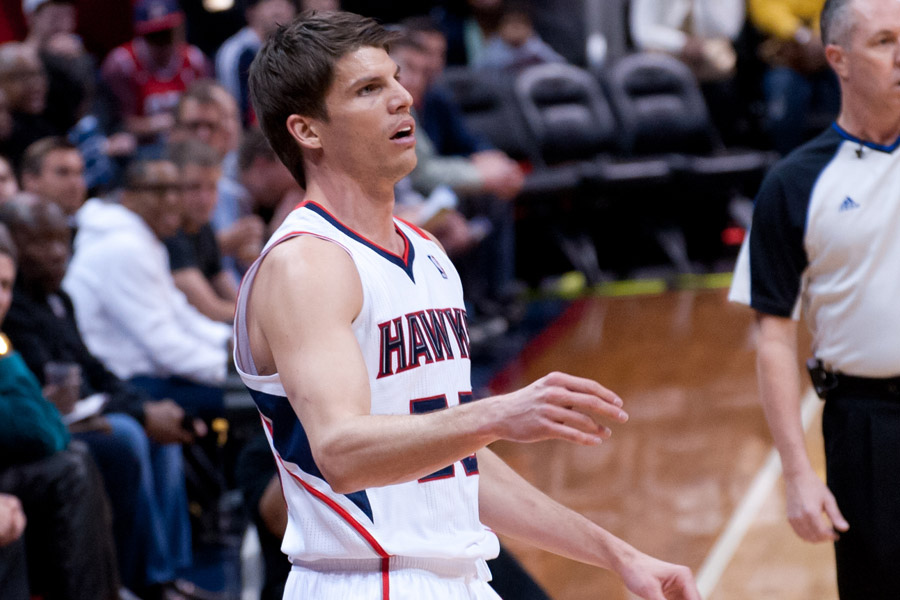
Kyle Korver has been terrific out of the gates, making nearly 52 percent of his threes on over five attempts per game. Fantasy basketball-wise, the Hawks’ starting small forward (or shooting guard, depending on the night) is ranked in the top 50 for both eight and nine-category leagues, according to Basketball Monster.

Korver went off last night against the Clippers, shooting 6-for-9 on threes to help the Eastern Conference nab a rare win over a team out West, but just how many players have made six or more threes in a game this season? I took a look, via Basketball-Reference. At first, I wanted to list every time an active player made six threes in their career, but that totaled to about 800. That, and Basketball-Reference uses the term “active” a little loosely since Tracy McGrady, among others, is still listed as that.

Anyway, take a look at this year’s six threes club. I also included minutes, home/away games, win-loss results, and some others just to look at the differences between each player listed:

Player Six-threes games Total       games Home/
Away
Win/
Loss
Minutes per game 3PM per game 3PA per game Points per game
Klay Thompson 4 19 2-2 4-0 39.3 6.5 10.3 26.8
Ryan Anderson 3 9 1-2 3-0 40.0 6.7 10.7 31.0
Arron Afflalo 2 18 2-0 1-1 37.5 7.5 10.0 33.0
Bradley Beal 2 13 0-2 1-1 41.5 6.0 7.5 30.0
Stephen Curry 2 16 0-2 0-2 40.0 7.5 12 33.5
Gerald Green 2 19 1-1 1-1 33.5 6.0 9.0 20.5
Kyle Korver 2 16 1-1  1-1 35.0 6.0 7.5 22.5
James Anderson 1 19 1-0 1-0 44 6 8 36
Trevor Ariza 1 13 0-1 0-1 38 6 11 28
Aaron Brooks 1 17 1-0 1-0 25 6 7 26
Jose Calderon 1 19 0-1 0-1 33 6 8 21
Jamal Crawford 1 19 1-0 1-0 30 6 11 21
Mike Dunleavy 1 16 1-0 0-1 48 6 10 23
Paul George 1 19 0-1 0-1 38 7 15 43
Danny Green 1 18 0-1 1-0 23 6 9 24
Andre Iguodala 1 13 0-1 1-0 33 7 11 32
Joe Johnson 1 18 1-0 0-1 44 8 10 34
Wesley Johnson 1 18 0-1 1-0 33 6 7 27
Damian Lillard 1 19 0-1 0-1 42 6 12 32
Jeremy Lin 1 16 0-1 0-1 49 9 15 34
O.J. Mayo 1 18 1-0 1-0 33 6 7 28
Chandler Parsons 1 18 1-0 1-0 27 6 6 21
Derrick Rose 1 10 1-0 1-0 31 6 11 20
C.J. Watson 1 18 0-1 1-0 30 6 7 18
Shawne Williams 1 16 0-1 1-0 31 6 11 20
 Totals/Averages 35 414 15/20 22/13 36.0 6.5 9.7 27.4

Unsurprisingly, a team with a player who’s made six threes has won just under two-thirds of those games. More interesting is how often those threes were made on the road. You’d expect some role players off the bench who are listed here to perform better at home. Maybe they do and the three-point outburst is just an outlier. We’ll see if that’s true as the season progresses.

Also worth noting, 8.5 percent of total games by those players have involved making over six threes. Should that frequency remain the same, someone on that list will make six threes on Friday night at the latest. Let’s see who that is, or if another player will join the club exclusive to only…25 players. That’s kind of a big club through just five weeks and it’s obvious what the password is to get in, but whatever. It’s great to witness three-point barrages and there’s still four months left for them to happen.

Could Roy Hibbert really block more shots than an entire team?

The rest of the league has finally caught up to Roy Hibbert’s blocks. Well, for the most part.

Just two weekends ago, Hibbert had 56 blocks in 13 games, good for more than eight teams: Washington (55 blocks), Orlando (54), Minnesota (54), New York (53), Memphis (52), Brooklyn (52), Chicago (47), and Sacramento (34).

But Hibbert has been in a “slump” since then, blocking just six shots in his last five games with two of those matchups coming against teams most often rejected: Minnesota and Charlotte. Seven of the eight previously listed teams caught up or surpassed the 7’2” behemoth, leaving only Sacramento behind. The current block score between Hibbert and the Kings: 62-48 in Hibbert’s favor.

Can he keep this up for a whole season?

Not since 2009 has one player single-handedly blocked more shots than an entire team, when Dwight Howard had 231 to the New York Knicks’ 204, the lowest of any team in NBA history save for the lockout-shortened 1998-99 season, according to Basketball-Reference. That Knicks squad, coached by Mike D’Antoni, played a ton of small ball with David Lee in the middle and Al Harrington at the ‘4’. The same thing also happened to the Knicks of ’08, led by Isiah Thomas where they blocked less shots (213) than Marcus Camby (285) and Josh Smith (227) while going possibly too big with Eddy Curry and Zach Randolph.

This year’s Kings fit somewhere in between those two Knicks rosters. They’re neither as mobile up front as D’Antoni’s Knicks nor as large as the Knicks of 2008, but there’s a chance Sacramento is equally as dysfunctional as the two. So there’s that.

The Kings just don’t have the personnel up front to be even an average shot-blocking team. DeMarcus Cousins can swat some but he fouls 5.1 times per 36 minutes, and there’s little protection when he’s in foul trouble or needs a breather. Chuck Hayes is an immovable force but that’s for better and for worse, Derrick Williams is like Blake Griffin in the way his athleticism doesn’t translate to blocking shots (and it doesn’t help that he logs time at small forward), Jason Thompson at least looks like he could get up and swat a couple, but his foul rate so far, 6.0 per-36, hasn’t helped and Patrick Patterson, like mostly every other power forward on the Kings, is undersized and a gamble on defense (though offensively he fits in).

Some of the lack of blocks can be attributed to the Kings allowing the least amount of shots within the restricted area by a comfortable margin, according to NBA.com, but there has to be a correlation between that and leading the league in fouling. Still, despite opposing teams scoring at will once they’re near the rim (68.4 percent, last in the league), Sacramento’s allowed only 20.1 attempts from there. Second-place Washington has allowed 23.3 attempts while Indiana sits in seventh place at 24.8.

And really, the Kings are safe from breaking the ’09 Knicks record for the least amount of blocks in an 82-game season. They’re on pace for 262 which is doable when DeMarcus Cousins, as unpredictable as he can be, has at least been consistently durable throughout his career. An injury (or suspension) to him, though, and things could get interesting.

Minnesota also lurks as a possible candidate to be outblocked by Hibbert. There’s not much between a slashing guard and the rim when Kevin Love and Nikola Pekovic are the frontline, but guys like Dante Cunningham, Ronny Turiaf, and Gorgui Dieng are threats in their limited playing time off the bench. Cunningham’s the only player consistently in the rotation, though, while Turiaf is out with a fractured elbow and Dieng has been slow to adjust to the NBA, fouling 7.9 times per-36. The Timberwolves make up for the lack of a rim presence by forcing turnovers and not fouling. When that doesn’t work, though, it’s kind of a really big problem.

And some of this weird accomplishment of blocking more shots than an entire team is up to Hibbert, after all. Right now, his foul rate of 3.7 per 36 minutes isn’t an outlier; it’s back down to about where it was in 2012. His blocking frequency is more of a concern. Only 26 times in NBA history has a player blocked eight percent of field goal attempts while on the floor and playing over 70 games, according to Basketball-Reference, the latter necessary should Hibbert block more than Sacramento or Minnesota. That may seem like a realistic rate for an entire season but Manute Bol, Jim McIlvaine, and Shawn Bradley account for over half of those 26 occurrences. That, and only five times has a player had a block rate of eight percent while logging 30 minutes per game.

Like DeMarcus Cousins though, Hibbert has been durable throughout his career. And like in the previous paragraph, his foul rate is down which has allowed him to play a couple more minutes per game.

Besides, the statistics aren’t that much of an outlier when his work over the off-season got the attention of Grantland, among others. He also dwarfed Tim Duncan, Tiago Splitter, and Ian Mahinmi in one specific, amusing photo. All that hard work is aimed towards helping the Pacers with their journey to a championship, not some weird statistical accomplishment that doesn’t accomplish anything if it doesn’t come with all the little things a great defense like Indiana’s is made of.

Maybe the last five games are just variance anyway, balancing out the ridiculous start Hibbert had. We’re still in “SMALL SAMPLE SIZE ALERT!” territory, after all. But if blocking more shots than an entire team comes within the confines of playing great defense, it would be one of multiple ways showing how Hibbert has become a premier force of nature.

For more odd accomplishments I hope for this season, check this out

Since 2003, over 3/4 of teams under .500 on November 18 miss the playoffs (continued)

Yesterday I worked through a little boredom, looking at how often teams miss the playoffs after starting out under .500 through November 18, yesterday’s date.

The result was higher than I thought, with 76.7 percent finishing in the lottery since 2003. I decided to expand on that statistic by looking at the rest of the months of the season and how often teams can overcome not just a sluggish start but an extra underwhelming month or two or four. Here are the results while skipping the lockout-shortened 2012 season, though I moved the day from December/January/February/March 18 to 19 just to keep up with the current date thing. I don’t know. I’m weird:

Under .500 through December 19: 28 teams out of a possible 143 still made the playoffs (19.6 percent).

Under .500 through January 19: 25/117 (21.4 percent).

Under.500 through February 19: 21/125 (16.8 percent).

Under .500 through March 19: 14/140 (10 percent).

As you can see, the likelihood declines as the season enters the dog days of basketball, and even further after the trade deadline. The percentages are a little misleading though when, since 2003, the Eastern Conference has had nine teams make the playoffs with a record under .500. We’ll more than likely see a couple teams do that again this year. Finish with less than 41 wins in the West though and you’re toast.

No more than five teams under .500 in any month have gone on to make the playoffs. For March 19, it shrunk to three teams. That could change this year, though we’re still four months away from seeing if that holds up.

Four months away still! This season is going to last forever.