Congratulating Alex Len, who now has more points than fouls

In between back-tapping missed shots and setting solid screens, Alex Len found a way to tally a career-high nine points last night while not committing a single foul. While that might only be baby steps for the Suns’ rookie center (he’s only played 12 games), the performance helped kick himself out of the as-many-fouls-as-points (AMFAP) club, at least for now. He has 25 points and 18 fouls for the season.

Good for Len, because the AMFAP club is one usually reserved for elite hackers and the offensively-challenged. There will be outliers since members often experience a majority of their minutes either during garbage time or very short, situational stints. Those with short-term contracts are also vulnerable to being cut from their respective teams before they can work their way out of a club only 12 players are a member of this season.

Those 12 players (via Basketball-Reference):

The current 2013-14 AMFAP club

Player Team MP* PF PTS PER
Greg Stiemsma NOP 263 46 46 7.8
Louis Amundson NOP 184 49 38 9.2
Jamaal Tinsley UTA 110 10 9 2.0
Aaron Gray TOT 109 30 23 2.3
Peyton Siva DET 76 11 4 -4.5
Hamady N’Diaye SAC 74 15 6 2.9
Ognjen Kuzmic GSW 51 11 8 -3.9
Earl Watson POR 49 11 2 -2.8
Andris Biedrins UTA 45 6 3 2.4
Erik Murphy CHI 41 4 4 -3.2
Hasheem Thabeet OKC 38 10 8 3.4
Mike James CHI 38 8 2 -4.6

* – Minimum 36 minutes played.

260 different players have been in the AMFAP club for at least one season. Five are VIP members, ones who finished their careers with over 1,000 minutes and more fouls than points. Charles Jones is the President after qualifying in 11 of his 15 seasons. He logged over 14,000 minutes with 2,076 fouls and 1,826 points.

Here are some other notable players who finished at least one season in the AMFAP club, sorted by their combined minutes in the seasons they qualified:

Notable AMFAP members

Player Seasons in AMFAP club AMFAP Minutes AMFAP Fouls AMFAP Points
Jason Collins 2007-11 4530 743 519
Manute Bol 1989-92, 1994 4215 530 419
Mark Madsen 2005-09 2017 360 238
Dennis Rodman 1998-2000 1046 112 83
Reggie Evans 2012 771 118 104
Juwan Howard 2008 353 62 57
Luc Longley 2001 301 51 49
Vin Baker 2005 204 38 35
Robert Swift 2005, 2008 170 32 29
Tim Legler 1998 76 11 9

There are still 42 games left in the Suns’ season, which gives Len both plenty of time to distance himself from the not-so prestigious club and find himself back in it. Let’s hope it’s the former since the Suns could use extra contributions from everyone while competing without Eric Bledsoe. Heck, if he finishes the season with more points than fouls I’ll celebrate with a ham sandwich.

Last but not least, here are 15 players (not including Len) who are flirting with the AMFAP club:

2013-14 AMFAP close calls

Player Team MP* PF PTS PER
Steven Adams OKC 630 122 164 13.0
Kendrick Perkins OKC 765 114 134 6.4
Ian Mahinmi IND 611 102 111 8.0
Brandon Davies PHI 430 70 91 5.8
Reggie Evans BRK 356 50 65 8.8
Phil Pressey BOS 468 43 62 7.0
Alexis Ajinca NOP 203 40 58 13.1
Rudy Gobert UTA 198 33 40 10.0
Gorgui Dieng MIN 122 30 33 13.1
Meyers Leonard POR 140 29 38 10.6
Ronnie Price ORL 198 25 37 9.8
Andre Roberson OKC 142 22 29 11.8
Jamaal Franklin MEM 137 18 27 3.0
Ronny Turiaf MIN 132 15 21 12.3
Joel Anthony MIA 37 4 6 8.

* – Minimum 36 minutes played.

Not listed is Jan Vesely, who’s resembled a professional basketball player this season. He had one of the more exciting AMFAP chases in league history last season. Or something like that.

Also, the AMFAP club could use a more clever name or abbreviation. Recommendations are welcome.
A look at 50-point games among active NBA players

Keith Allison | Flickr

Keith Allison | Flickr

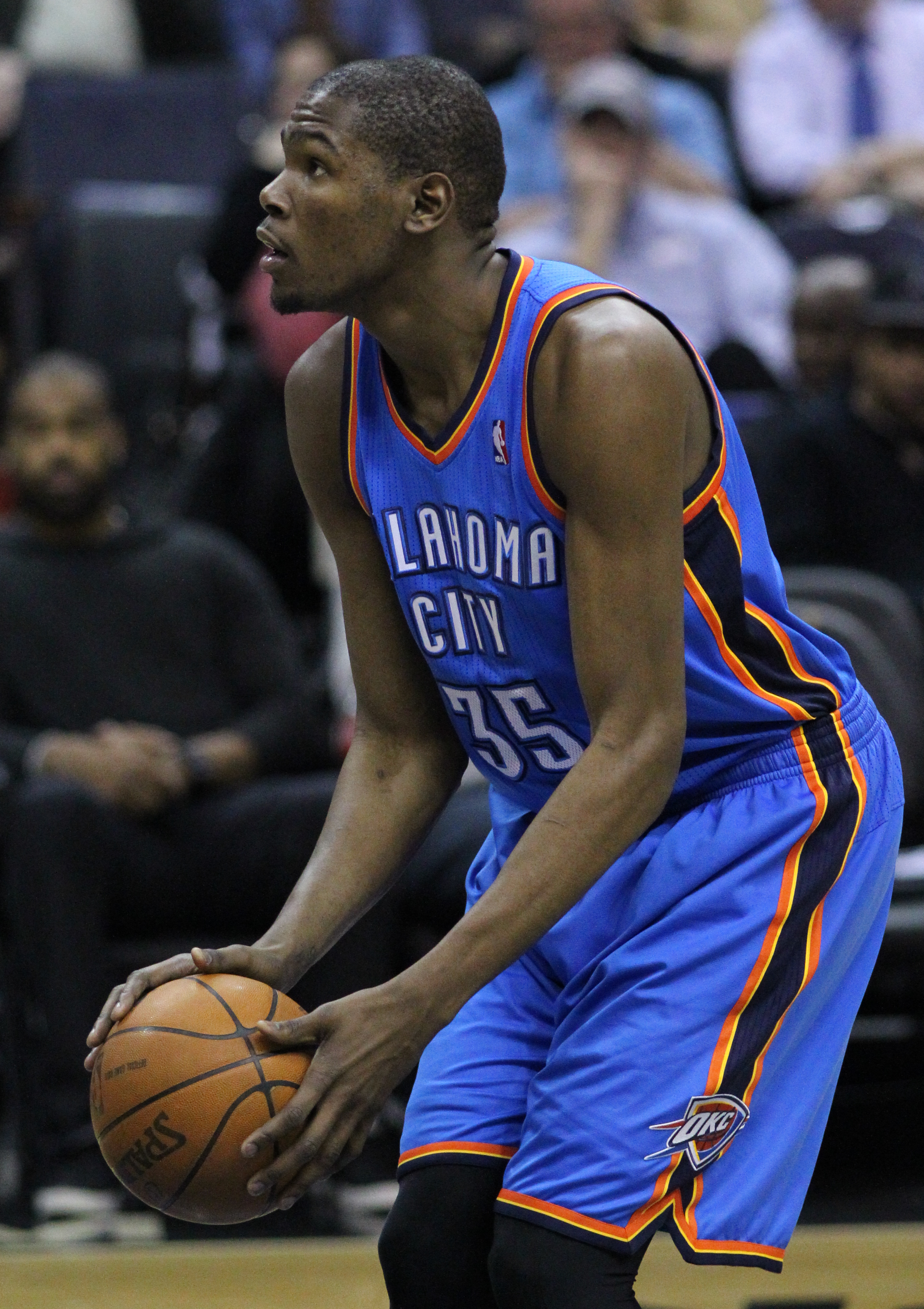
Last night’s matchup between Golden State and Oklahoma City became the 70th time an active NBA player scored 50 or more points. Cheers to Kevin Durant, who scored 54 points on just 28 shots. I’ll take a look at that night and the 68 others that featured 50-point scorers who have yet to hang it up, or so I think. Basketball-Reference lists players like Tracy McGrady, Jerry Stackhouse, and Richard Hamilton as active, but probably because it’s only a matter of time before they play for Brooklyn and round up an All-2000s squad. (For a simple table of the 50-point scorers, click here.)

Overall, 25 active players make up the list of 70 fifty-point outings across over 15 different seasons. 23 teams have been the victim of 50-point games while seven remain free of the embarrassment, though that could change while Kevin Durant continues his efficient explosion without Russell Westbrook. It only makes sense that teams with the 50-point scorer have won 50 of those 69 games.

Kobe Bryant has 24 of the 70 fifty-point occurrences with 16 coming post-Shaquille O’Neal and pre-Pau Gasol. The Lakers were 17-7 in those offensive explosions, including four consecutive wins in March 2007 (he averaged 40.4 points per game for the month). Bryant and Antawn Jamison are the only active players to score 50 points both against each other and on the same night, which is why there are 69 different games instead of 70. Jamison had back-to-back 50 point games in December of 2000.

Age

Brandon Jennings is the youngest player (20 years, 52 days) to ever score 50 points. I miss comparing him to Allen Iverson, which didn’t last long at all but nevertheless long live ‘Fear the Deer‘. As far as active players go, Andre Miller is the oldest (33 years, 317 days) to score 50. Both outings for the two players happened in the 2009-10 season, and their shot charts greatly differentiate from one another. 

Least and most attempts

The least amount of field goal attempts on a 50-point night belongs to Kevin Martin, who relied on 23 free throws and a good chunk of threes. Bryant’s 62-points-on-31-shots on December 20, 2005 could’ve given Martin a run, but he needed a few more shots to hit the 50-point mark. Instead, Bryant’s needed the most field goal attempts to get to 50 points (42 shots) when he finished with 53 points off 44 attempts in a loss to Houston. Surprisingly, Jerry Stackhouse’s 50-point night didn’t need 50 shots. He took 36, tied for 13th-most.

Other stats with 50 points

20 double-doubles (three from 10+ assists, 17 from 10+ rebounds) have been recorded from players scoring 50 points. Eight of those came from players logging over 48 minutes. As far as tons of minutes are concerned, sixteen 50-point games were recorded while playing over 48.

Kobe Bryant, Carmelo Anthony, and Kevin Love each had 50-point games without logging a single assist with Love’s coming while playing 49 minutes. As for Bryant and Anthony, they also had 50-point games where they didn’t record a single turnover. Surprisingly, that’s happened to Kobe not once but twice. Rashard Lewis is the only other player to accomplish such a feat.

Starting games versus coming off the bench

Every one of those seventy 50-point nights were from players who started, but a (currently active) player off the bench has scored 40+ points 14 times. That features nine different players who all needed starter-level minutes (30 or more). Each one of them also made at least one three-pointer.

A BOLD statement

The three-pointer brings me to my closing remarks regarding these high-octane outings. Only four times has a player who scored 50 points not made a three with those games belonging to Jermaine O’Neal, Amar’e Stoudemire, Tim Duncan, and Paul Pierce.

Going forward, I’ll go on a limb and say no 50-point game will happen again without a made three-point shot.

Paul George and his hot hand from the corner three

It seems like Paul George takes that “next step” every season. He was the NBA’s Most Improved Player last season, but like Kevin Love in 2011 and 2012, there’s always curiosity about him winning it a second-straight time.

Arguably this season’s most obvious improvement in George’s game has been his comfort handling the ball while attacking just about every area of the court. That’s huge when he’s taken on a bigger load of the offense. He’s upped his usage rate from 23.5 percent in 2013 to 28.1, but trimmed his rate of turnovers from 15.2 percent to 11.8. He’s also been scoring more efficiently with an increase in his true shooting percentage, effective field goal percentage, and free throw rate. In particular, measuring his usage and true shooting puts him in company with only nine other players this season.

While a lot of that has been aided by a mid-range jumper that makes George a handful to guard, he’s also been red-hot from the corners where he’s shooting a ridiculous 59 percent. That’s surprisingly not first but second-best in the league, minimum 20 attempts. (For Paul George’s complete shot chart, click here.)

Here are the top 10 shooters. I only included usage rate because I needed another category to help fix formatting issues, but that statistic will come in handy later.

Top 10 Corner Shooters


Player
 
C3FGM
 
C3FGA
 
C3FG%

Usage
Mirza Teletovic (BKN) 13 21 61.9% 19.3
Paul George (IND) 32 54 59.3% 28.1
Mario Chalmers (MIA) 20 35 57.1% 17.0
Andre Iguodala (GSW) 17 32 53.1% 13.3
Marco Belinelli (SAS) 18 34 52.9% 19.6
LeBron James (MIA) 11 21 52.4% 29.5
Omri Casspi (HOU) 12 23 52.2% 18.9
Mike Miller (MEM) 14 27 51.9% 13.6
Darren Collison (LAC) 15 29 51.7% 19.9
Damian Lillard (POR) 15 29 51.7% 24.8
Anthony Tolliver (CHA) 18 35 51.4% 10.5

Over the years, other elite wings have been up and down with how many corner threes they’ve taken. That isn’t surprising when expanding players like George to that area takes away the impact of role players who specialize in shooting corner threes. (You could also say this about LaMarcus Aldridge, who has Wes Matthews and Nicolas Batum taking plenty of shots from the corners, and Dirk Nowitzki throughout his career.) Kevin Durant doesn’t take many shots from the corners at all while Kobe Bryant and Carmelo Anthony have been hot and cold throughout their careers.

George is an exception along with LeBron James, who developed a killer right corner three last season. For George, he’s averaged about one corner three attempt per game since 2012, and though he tends to favor the right corner he’s been equally good (or in 2012, bad) from either side. He’s currently 13-for-24 from the left corner three and 19-for-30 from the right side with most makes coming from spotting up in transition, being the beneficiary of drive-and-kicks, and capitalizing on meltdowns from opponents while defending Indiana’s inbound plays.

90 percent of George’s corner threes this season have been assisted, a standard mark for that area of the floor. Lance Stephenson has been his main feeder, responsible for nine out of 29 assisted threes, according to NBA.com. That’s no surprise when Stephenson’s become capable (and sometimes obviously confident) of running the offense and finding shots for not only himself but everyone else. George Hill has been another primary passer to Paul George, responsible for seven assisted corner threes. I expected Roy Hibbert to have a similar impact, which he has been but primarily when George is either going to the hoop or on the left side of the arc. The difference in where each player assists to another is interesting in itself.

Is George’s current percentage from the corners sustainable? He’s on pace to take 116 attempts this season, or about 1.4 per game if he never took a game off. Mitch Richmond’s the only player to make over 50 percent of his corner threes, take over 100 attempts, and carry a similar weight of a team’s offense like George currently has, according to NBA.com. (Edit: Here’s a player comparison between that season and George’s 2014 campaign, via Basketball-Reference.)

Otherwise, shooting around 50 percent from the corners is usually reserved for role players, but ones that become incredibly valuable when defenses have to adjust for their shooting. Here are some players who came close to matching each criterion, sorted by the season. Richmond’s hot shooting is also included:

100 attempted corner threes, nearly 50 percent made, with a usage rate near 28%
(according to NBA.com)

Player Season C3FGM/C3FGA C3FG% Usage
Paul George (IND) 2013-14 69-116* 59.3 28.1
Joe Johnson (ATL) 2005-06 55-119 46.2 24.6
Rashard Lewis (SEA) 2004-05 66-134 49.3 24.0
Latrell Sprewell (NYK) 2002-03 54-116 46.6 22.6
Jamal Mashburn (MIA) 1999-00 74-157 47.4 23.8
Ray Allen (MIL, SEA) Any from 2000-07 A lot-A lot 40-45ish 27.0
Mitch Richmond (SAC) 1996-97 56-103 54.4 29.4

* – projected if George played 82 games.

In the second half of this season, variance will probably rear its ugly head towards Paul George’s corner threes. It would take him out of the hunt for the rare accomplishment previously listed, but it’s nowhere near the end of the world if that really happens. The corner three is a nice weapon for George just like it was last season, but it’s the other improvements like tightening his handles and adding a mid-range game that’s placed him among the league’s elite.

Non-conference play and its importance to the West

It was nearly a month ago when Mark Jackson was on the hot seat. Golden State had fallen to 14-13, losing to a short-handed San Antonio Spurs on national television. Championship expectations by fans were replaced with hope to just make the playoffs. The Warriors were in ninth place in the West, grouped with the mediocrity of the Denver Nuggets and Los Angeles Lakers, among other teams.

Then Golden State beat both of those teams, rattled off home wins against the Clips and Suns, and went on a seven-game road trip out East where they finished 6-1. Their best stretch of the season was topped off with a win at home against Boston. 14-13 became 25-14. Title-contention was back to being realistic, though still a long shot in the loaded West.

The road trip out East helped the Warriors arguably the most in their quest to outdo last season’s exit in the Western Conference Semifinals. (Those hopes may have gotten a little higher today, thanks to a three-way trade to acquire Jordan Crawford and MarShon Brooks.)

All but one Western Conference playoff contender has used road trips out East – and games against the lowly conference in general – to beef up their win total. That one, singled-out contender is Phoenix who’s .500 in non-conference play.

Beating up on the East has been key for Western Conference playoff contenders since 2000, when the West took the upper hand in non-conference play, but it’s at its highest importance this season. That all might be obvious, but it’s nonetheless important to note that over the last 14 seasons just five Western Conference squads made the playoffs while finishing under .500 against the East:

Team vs East Record Seed  Finish
2000 Seattle SuperSonics 14-16 45-37 7 Lost First Round
2004 Denver Nuggets 14-16 43-39 8 Lost First Round
2006 Sacramento Kings 14-16 44-38 8 Lost First Round
2007 Golden State Warriors 14-16 42-40 8 Lost Semifinals
2007 Los Angeles Lakers 14-16 42-40 7 Lost First Round

The East just doesn’t have the same urge to win their battles against Western foes, able to stay in contention if they stumble during a road trip on Pacific coast, for example. Over the same seasons, they’ve had 50 teams in the playoffs with non-conference records below .500. Only one team, the 2012 Boston Celtics, has done that and made it all the way to the Conference Finals, but they needed some injury luck to get there. There’s always a chance they upset a top-seeded Bulls squad with a healthy Derrick Rose, but it’s an unlikely one.

Again, it might seem obvious about teams out West need to beat those out West to do well over 82 games. Related to the first table, below are the playoff teams with the second-worst non-conference records in those same seasons:

Team vs East Record Seed Finish
2000 Minnesota Timberwolves 18-12 50-32 6 Lost First Round
2004 Dallas Mavericks 19-11 52-30 5 Lost First Round
2006 Memphis Grizzlies 18-12 49-33 5 Lost First Round
2006 Los Angeles Lakers 18-12 45-37 7 Lost First Round
2007 Denver Nuggets 18-12 45-47 6 Lost First Round

The teams in the first table gave up, at the very least, four games to fellow playoff contenders. That worked out fine for the 2007 Golden State Warriors, but every other team missed out on the possibility of improving their seeding by one to three spots.

Of course, another (and more frequent) way of moving up in the standings is by winning games against contenders in the same conference, but some teams have gotten by with cherry picking — winning a good chunk of their games against the East. Here are some of the most egregious instances. For one squad, it wasn’t enough to make the postseason:

Team vs East vs West Record Seed Finish
2001 Houston Rockets 25-5 20-32 45-37 9 Missed Playoffs
2004 Houston Rockets 24-6 21-31 45-37 7 Lost First Round
2012 Denver Nuggets 16-2 22-26 38-28 6 Lost First Round
2013 Houston Rockets 21-9 24-28 45-37 8 Lost First Round

This season’s Minnesota Timberwolves, currently 11-5 versus the East but 7-14 against the West, might join the few and not-so-proud of that grouping.

Every 82-game season requires 30 non-conference games, though, and every one of those count given how stacked the West is this season. It’s also not any team’s fault for winning games they’re supposed to. Minnesota (and Denver and Memphis, for that matter) are hanging around with the help of that one edge available for about one-third of the season, but it would certainly help if they beat a few teams currently in the playoff seeds they’re trying to overtake.

For more posts about the East-West battles, check this out.

NBA backcourt tandems with the highest usage rates

3097581672_1303674524_o

Photos by Keith Allison, via Flickr

Going off my last post, I decided to list the other starting backcourts with usage ratings (possessions when a player takes a field goal, gets fouled or turns the ball over) of over 25 percent each. There were some guidelines, though:

  • They couldn’t be formed after a mid-season trade. (Allen Iverson played only three games for Denver before being traded to Detroit, so I included the ’09 Pistons.)
  • Both players had to start together, not just each starting whenever the other missed a few games.
  • I sorted through the Lottery Era up to last season.

There were quite a few cases where tandems interfered with the first two guidelines, but it made it easier to narrow down the list of qualified candidates and then calculate their effective field goal percentages, compare it to the team they played for, and then see how it matches up with the league average. 

Free throw attempts per game will be missing from the table as well as some other notable stats. I had to narrow it down to a doable list otherwise it wouldn’t format correctly. Here’s what’s left of it, sorting each duo by the season. The stats are according to Basketball-Reference.

Backcourt duos with >25% usage rate each

Player Year Team MinPG FG% 3PT% PTSPG Usage DuoEFG TmEFG LgEFG W/L
Jerry Stackhouse 1996 PHI 37.5 .414 .318 19.2 26.0 .458 .474 .499 18-64
Vernon Maxwell 32.9 .390 .317 16.2 25.6
Allen Iverson 1997 PHI 40.1 .416 .341 23.5 28.9 .458 .470 .493 22-60
Jerry Stackhouse 39.1 .407 .298 20.7 25.6
Ray Allen 2000 MIL 37.4 .466 .423 22.1 25.6 .498 .494 .478 42-40
Sam Cassell 35.8 .455 .289 18.6 25.0
Latrell Sprewell 2001 NYK 39.2 .430 .381 17.7 25.8 .467 .476 .473 48-34
Allan Houston 36.6 .449 .304 18.7 25.7
Sam Cassell 2002 MIL 35.2 .463 .348 19.7 27.3 .526 .507 .477 41-41
Ray Allen 36.6 .462 .434 21.8 26.2
Allan Houston 2002 NYK 37.8 .437 .393 20.4 25.9 .471 .468 .477 30-52
Latrell Sprewell 41.1 .404 .360 19.4 25.1
Michael Jordan 2002 WAS 34.9 .416 .189 22.9 36.0 .430 .464 .477 37-45
Richard Hamilton 35.0 .435 .381 20.0 28.6
Michael Jordan 2003 WAS 37.0 .445 .291 20.0 28.7 .444 .460 .474 37-45
Jerry Stackhouse 39.2 .409 .290 21.5 27.9
Larry Hughes 2004 WAS 33.8 .397 .341 18.8 28.1 .447 .454 .471 25-57
Gilbert Arenas 37.6 .392 .375 19.6 27.4
Gilbert Arenas 2005 WAS 40.9 .431 .365 25.5 27.3 .481 .474 .482 45-37
Larry Hughes 38.7 .430 .282 22.0 26.6
Jason Richardson 2006 GSW 38.4 .446 .384 23.2 27.6 .486 .479 .490 34-48
Baron Davis 36.5 .389 .315 17.9 25.9
Allen Iverson 2009 DET 36.5 .416 .286 17.5 25.9 .459 .483 .500 39-43
Richard Hamilton 34.0 .447 .368 18.3 27.0
Devin Harris 2009 NJN 36.1 .438 .291 21.3 28.4 .482 .497 .500 34-48
Vince Carter 36.8 .437 .385 20.8 26.8
Richard Hamilton 2010 DET 33.7 .409 .228 18.1 27.9 .438 .474 .501 27-55
Rodney Stuckey 34.2 .405 .297 16.6 26.4
Manu Ginobili 2011 SAS 30.3 .433 .349 17.4 26.0 .520 .491 .498 61-21
Tony Parker 32.4 .519 .357 17.5 25.5
Kyrie Irving 2013 CLE 34.7 .452 .391 22.5 30.2 .485 .473 .473 24-58
Dion Waiters 28.8 .412 .310 14.7 26.1

You can pick and choose what stands out here, if anything. Here are a few thoughts:

Backcourts who carry the load of an offense can be risky, but that’s not to say they often struggle. They can succeed when implemented with the right group of complimentary players and system. For example, I’m pretty comfortable letting Tony Parker and Manu Ginobili carry the offense, though I can’t say the same for two guys who couldn’t stretch the floor like Jerry Stackhouse and Michael Jordan.

I DON’T know how often some duo’s minutes were staggered because lineup data on NBA.com is only available from 2008 and on. Some backcourts, like Sixers of ’97, just look like they played a ton of time together. That couldn’t have been a good thing. Here are the minutes the previously-listed backcourt tandems logged together over the last six seasons, though:

  • Allen Iverson and Richard Hamilton: 23.2
  • Devin Harris and Vince Carter: 27.7
  • Richard Hamilton and Rodney Stuckey: 25.0
  • Tony Parker and Manu Ginobili: 19.6
  • Kyrie Irving and Dion Waiters: 21.4

The combo of Jordan and Stackhouse/Hamilton made the list when neither were point guards. Looking back, there wasn’t a whole ton of talent at that position for Washington. It speaks for itself when, in 2003, 70 percent of Larry Hughes’ minutes came at the point, according to Basketball-Reference. It’s kind of amazing that he, a 39-year-old Michael Jordan, and Jerry Stackhouse won even 37 games with their shooting, but that’s the power of MJ, I guess. It’s also impressive that Jordan used up 36 percent of the Wiz’s possessions in 2002. Overall, Washington had high-usage backcourt combos for four straight seasons until Cleveland splurged on Hughes.

Another oddity was Allan Houston and Latrell Sprewell making the list too. Basketball-Reference has them listed as a shooting guard during their careers at one point or another, though. I chose not to remove them from the list. Shooting guard and small forward tandems, or teams with three starting wings who used a ton of possessions (the early-2000s Bucks, for example) might be something I’ll look into in the near-future.

Again, this post isn’t meant to say high-usage backcourts often lead teams into mediocrity. Point guard-shooting guard duos (or in some cases, two shooting guards with one as a small forward) are just something I find interesting and worth looking at. It made me think, though, that if those backcourts used up a ton of possessions, then the team is more often than not sorely lacking talent in one other position.

It’s also pretty obvious that teams with two players taking a combined ~30 or more shots per game with inefficient stats (and one of them being the point guard) just won’t perform well. They might not frequently get to the line, take (and miss) several jumpshots, play lackluster defense in order to save energy on O, or some combination of the three. To repeat what I mentioned earlier, some (not all) of that can be helped by staggering minutes.

Going forward, I wonder how often we’ll see two guards with similar high usage rates, and how well their teams perform. Right now, Philadelphia and Washington have duos that would join the list but neither squad is doing all that well this season.

Anything else worth mentioning? Feel free to leave a comment.