Tag Archives: Detroit Pistons

Josh Smith’s shooting has reached it’s low point, or has it?

Keith Allison | Flickr

Keith Allison | Flickr

Three months ago I dedicated a post to Josh Smith’s shot selection, back when it wasn’t so rough on the eyes. The newly-signed Pistons forward hoisted 23 threes through the first three games of the season but the mid-range attempts were mostly absent. A long shot to be an above-average shooter, having Smith take a step behind the line instead of taking 20-foot two-pointers was a step in the right direction, one that would yield more points per attempt from jump shots he’d have to take when playing alongside Greg Monroe and Andre Drummond. It was a hopeful sign of efficiency.

Fast forward to now. Smith’s recording career-lows in PER, true shooting percentage, effective field goal percentage, and free throw rate. His threes and shots in the dead zone combine for about half his field goal attempts, most of them being bricks that create shot chart blood. However, the floor on Smith’s three-point percentage is most remarkable, possibly still untapped despite being on pace to be the worst three-point shooter of all time by a whole two percentage points, minimum 200 attempts. His 166 tries have dropped 23.5 percent of the time but the monthly splits worsen each month:

smithgraph1

Smith’s just 16-for-87 beyond the arc (18.4 percent) over his last 30 games. SportVU lists him as the worst three-point shooter in catch-and-shoot situations (24.7 percent) among the top 100 players in attempts, with teammate Charlie Villanueva second to last. His percentages are even worse in pull up attempts, though those shots have rarely occurred and it’s common for players to struggle shooting off the dribble versus a pass.

The good news is that Smith’s three-point rate is dropping. Here’s a table of those monthly splits with his mid-range rate and free throw rate included, via NBA.com. (I left out October and February because small sample size.)

smithgraph2

The three-point rates in December and January match up with Smith’s last season in Atlanta. Maybe they have to do with Detroit’s big three of Smith, Drummond, and Monroe playing together less frequently each month. According to NBA.com, the trio was together 18.7 minutes in November, 16.2 in December, and 15.0 in January. Neither monthly split yielded positive results, though that’s not 100 percent on Smith. The trio needs to be severely staggered, and Brandon Jennings at point guard hasn’t helped any.

The other evil in Smith’s game is the mid-range shot. The heater from that area of the floor last month, one that gave him a nice uptick in true shooting percentage was obvious, possibly even fatal fool’s gold after last night’s performance in Miami. Smith’s never shot better than 39 percent from mid-range in a single season, and there’s a chance if the three-point line was shortened like it was from 1995 to 1997 that he’d likely experience little to no improvement like players listed here.

As disappointing as Smith’s shooting has been, he’s not the sole reason for Detroit sitting in ninth place behind Charlotte and Washington. His shooting is costly but he would have more to offer if he wasn’t playing small forward over half the time, a position that helps neglect the skills he provides on both offense and defense. The Pistons, however, are going nowhere unless a third of its frontline is shipped out. Trading Smith would be impressive when he’s on the books until 2017 at $13.5 million a pop, but Monroe seems like the most moveable piece given his looming, steep raise next summer, one possibly not worth it given the holes in his defense.

Then again, the same could’ve been said about Smith’s contract and whether or not it’s worth paying him to play on the perimeter. Joe Dumars must’ve thought it was but the results, at least on offense, have been a three-month migraine. There’s plenty of room for improvement in Smith’s shooting with some of it bound to happen given how bad things have become, but the slight possibility that the worst-case scenario remains to be seen is amazing in itself.
Josh Smith nearly goes documentary, barely misses out on 30-for-30 performance

Erik Drost | Flickr

Erik Drost | Flickr

What if I told you two days ago the Detroit Pistons had a 13-point fourth quarter lead against the 20-win Blazers, only to blow it and lose on a buzzer-beater by Damian Lillard? Not only that, but Josh Smith scored 31 points on only 17 shots.

We’ll probably never see that efficient of a performance again by Smith, who Detroit should’ve kept feeding the ball to while they had a double-digit lead. Unfortunately, he only took one shot in the fourth quarter and overtime combined. Detroit wouldn’t let that happen twice in a row, not even against the best defense in the league in Indiana.

For better or for worse, Smith was chucking all game last night against the Pacers, nearly mimicking the ESPN documentary series by finishing with 29 shots and 30 points. There were moments of brilliance that were overshadowed by frustrating shot selection: fade away jumpers, long twos with 12 seconds on the shot clock, isolations leading to more long twos. All three of those kind of shots by Smith resulted in barely grazing the rim when they didn’t go through the net. When the first long two swished, Indiana must’ve had an evil grin knowing Smith would continue flirting outside the paint.

And for the most part, he did:

Shotchart_1387306921333

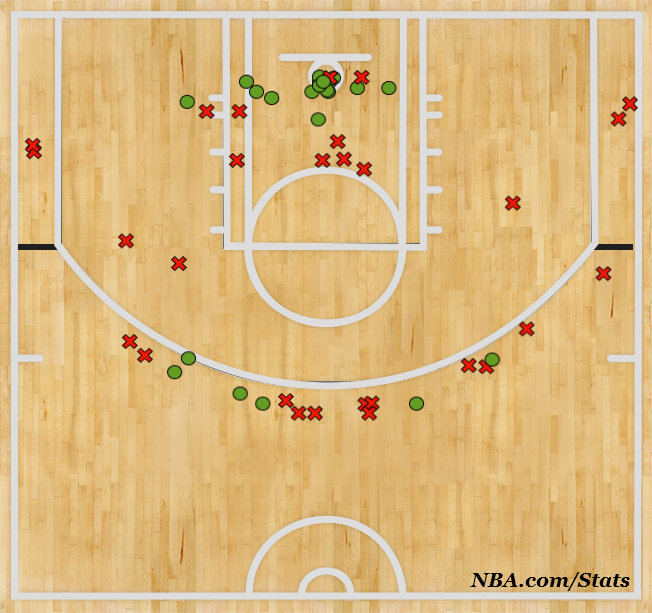
Josh Smith’s shot chart versus Indiana

As you can see from the shot chart above, long jumpers accounted for over half (!!!) his attempts, bringing back memories of Rudy Gay‘s performance against Houston. Though Smith was effective from those spots percentage-wise, he was at his best when he scored by moving off the ball. Twice he took advantage of miscommunication between Paul George and whoever was guarding Greg Monroe.

Rather than showing Smith’s baskets from moving without the ball by pasting screenshots that take up a ton of space, I put them in a short video with captions up top:

Smith could’ve easily sat around the perimeter, hoping Brandon Jennings would feed him for, you know, a jumper he only makes 25 percent of the time on over 200 attempts, according to NBA.com. He produces just 0.68 points per spot-up shot, according to Synergy, ranking 205th in the league. That’s not good when 20 percent of his shots come from that situation. 

Good thing Smith cut to the rim instead, an area where he shoots nearly 67 percent from and produces 1.24 points per attempt (35th-best). He also showed off a lefty jump hook last night, one he doesn’t take anywhere near as often probably because of the cramped spacing between him, Monroe, and Andre Drummond. Not a lot of those hook shots dropped versus Luis Scola, Paul George or David West, but for the season he’s 24-of-44. Efficiency!

But those efficient shots were scattered between the long jumpers Smith chucked to varying degrees of success. Maybe he took more of them than usual because of Mount Hibbert lurking in the paint, but they’ve become a daily occurrence regardless of the opponent. It puts an earlier blog post praising his shot selection to waste, though it does make Detroit handing Indiana their first home loss of the season that much more impressive.

Hack-A-Drummond could be wakeup call for Detroit

If there’s a great thing about being a basketball player in a small market, it’s that nobody knows your weaknesses. DeAndre Jordan and Dwight Howard play in two of the biggest markets, unlike Andre Drummond who resides in Motor City, which explains why the first two are widely known as terribly free throw shooters and intentionally fouled because of it while Drummond has gone unnoticed. 

Actually, that was a terrible attempt at sarcasm. Also, I have no idea why teams haven’t intentionally fouled Drummond yet. Sure, Howard and Jordan’s shooting woes from the line are discussed more frequently, but Drummond’s percentage has been far worse, down to 16 percent after last night’s loss to the Lakers. That percentage comes from a small sample size, however, since he’s only attempted 1.3 free throws per game.

But there lies what’s so surprising. Why haven’t teams intentionally fouled him? It’s not like Drummond’s an energy guy off the bench; he plays 35.1 minutes per game, right up there with Howard and Jordan. He also logs 7.4 minutes per fourth quarter, according to NBA.com, so the opportunity to put him on the line is there when opponents need to make up ground and quickly. This isn’t meant to rip on Drummond, who’s one of the most intriguing players in the league and uploads some of the best Vines,  among other things, but he has a glaring weakness in his game that teams haven’t taken advantage of. 

Maybe the intentional fouls are coming, but if they could actually be a blessing in disguise for Detroit. This is a reach, but hack-a-Drummond could signal Maurice Cheeks to further stagger the minutes of Detroit’s best three frontcourt players of Drummond, Greg Monroe, and Josh Smith, who play 20 minutes together per game according to NBA.com. They’ve bled points on defense and cramped the spacing on offense no matter who has started in the backcourt, though the CaldwellPope and Jennings pairing at the guard positions has yielded solid defensive numbers through two games. It’s also been at the expense of having even an average offense. 

That doesn’t mean Drummond’s free throw shooting makes him unplayable, but when teams are in the penalty and outside of two minutes, they can hack away and grind Detroit’s offense to a halt. It also doesn’t mean Drummonds at fault for the frontcourt’s failures. It would be unfortunate for its split to come at the hands of teams exposing his poor free throw shooting, but if that’s the calling card for Mo Cheeks to search for more efficient frontcourt combos, then it could be for the better. 

Overreaction of Week 1: Josh Smith’s shot selection

overreaction

This post was initially devoted to all sorts of weird happenings over the first week of the NBA’s season. Michael Carter-Williams and the 76ers tanked so hard they ran over every team with their tank (until the Warriors ran them out of their own building), Boston was in pole position for the 2014 Draft as a result of the 76ers’ (and Suns’) unexpected starts, there were struggles from Derrick Rose and John Wall, and Milwaukee’s bench (21.5 points per game per-48-minutes) was the third-stingiest in the league and gave the incredibly average Bucks some hope for the postseason again.

But screw it. Of all the storylines to discuss, I wanted to write about what could possibly be this decade’s Rasheed Wallace in Detroit: Josh Smith. We’ll take a look at his offense through three measly games.

Last season, Smith took 363 shots (!) between ten feet and the arc which were good for just 30.5 percent. He also made only 29.9 percent of the 221 threes he hoisted. Overall, he was only a 30 percent shooter when he took jump shots. That’s just not acceptable for anyone, let alone a player where well over half of his field goal attempts were came from them.

What’s actually most frustrating though is how good he was around the rim at 77.1 percent, yet only about a third of his shots came from that area. His PER of 17.7 was his lowest since 2009, his three-point attempt rate of .170 was the highest of his career, and he recorded -0.3 offensive win shares. (All the stats listed so far are according to Basketball-Reference.)

It triggers the same reaction I had about Wallace, who’s now on the sidelines for the Pistons: Just get in the paint! Wallace was a much better three-point shooter than Smith has ever been, but the Pistons of the mid-2000s could’ve used more of a paint presence alongside the barrage of mid-range jumpers they were known for taking (but at least they made a respectable percentage of them).

Fast forward to this season as Smith enters the first year of his four-year, $54 million contract with the Detroit Pistons. The paint, where Smith is so good yet often neglects, is even more crowded with Andre Drummond and Greg Monroe starting alongside Smith, who’s now playing small forward. 25.6 of Smith’s 40 minutes per game have been spent with Drummond and Monroe with respectable results so far. Detroit’s outscored their opponents by 1.4 points per 100 possessions when all three are on the court.

But Smith’s shot selection has been controversial as usual. He’s averaging 7.3 three-point attempts per game — including an 11-attempt outing in a three-point loss at Memphis — and making only two on average. That’s good for 27.3 percent and he’s shooting only 20 percent on jump shots overall. Smith’s more than doubled his three-point rate from 2013, with 44 percent of his shots coming from beyond the arc. If anything, the frequency of his three-pointers could turn into a drinking game.

As a result, his free throw rate has been sliced by more than half. Smith’s typically been below average from the line, shooting a career-worst 51.3 percent last season, so there could be a correlation between that percentage and the decline in free throw attempts overall. But it could also be the result of a feeling out process now that Smith is playing with two frontcourt players who also work around the painted area.

There’s good news, though. Check out his shot chart through three games:

Shotchart_1383690868809

He hasn’t hugged the dead zones (at least so far) like in previous seasons. Only five of his first 50 shots have come between ten feet and the arc while eight have been attempted from five to nine feet where Smith has also typically struggled (and continues to do so, making just two shots from that area so far).

The rest of his shots (15) have come within five feet where Smith’s been terrific, making 13 of them for an 86.7 percent mark. It would be nice to see more of his shots taken there—as well as his three-point rate dropping back to a less-ridiculous level for his skill set—but Smith would be viewed differently so far if a couple more of those threes dropped.

If anything, his shot chart actually looks promising even if all the X’s from the arc say otherwise. If he’s going to chuck the long-range jumpers — and there’s barely a difference in accuracy between his 18-footers and three-pointers — wouldn’t you rather have Smith chuck from behind the arc? If both go in at a 30 percent clip, it’s an extra 0.3 points per attempt when Smith shoots from three. Whether that cures the headaches of fans of Detroit though is anyone’s guess.

There’s plenty of time to bring Smith’s game to the paint more frequently—and whether Pistons head coach Mo Cheeks wants it there—and for his jump shot to be a little less brick-worthy. Here’s the most Josh Smith three pointer of them all, by the way, unfortunately happening in the preseason:

We’ll see if his offense improves as the season goes on or if dedicating a post to his shot selection, with a tiny, tiny sample size, was just a waste.

Grant Hill: Ageless wonder

He looks the same now…

…as he did back in 1994. 1994!

For the sake of Hill, I hope the Clippers win a title in the next two years. He was an incredible player in his prime (a better version of Scottie Pippen) and still a key piece to any contender. Also, if Ralph Sampson can get into the Hall of Fame, so can he.

Now if Christian Laettner gets in, we got a problem.