Tag Archives: Los Angeles Lakers

Dream Team #3 within the salary cap, Part 2–Bench

zzzzzzzz

This is part 2 of my dream team series and now my most pointless off-season post. That is, until the next post is published, and then the one after that, and…(for part 1, click here)

It’s a two-part series dedicated to the bi-annual construction of a team that doesn’t even exist (you can view past ridiculous squads here and here). I try to mix talent with cap-friendliness since I can’t go over the salary cap for any reason. This year, that limit is $63.065 million. All contracts are fair game, save for rookie deals. From there, I try to make the best roster to my limited abilities. This post covers the reserves. Below is a quick look at the starters I selected. You can find more regarding them in part 1:

The starters combined for $49,397,823 which left $13,667,177 for the last seven players. That’s an average cap hit of $1,952,453 for each slot. Not great, not terrible. We can still splurge on a player who’s on a good, $5-9 million contract, and fill the rest of the bench with minimum deals.

So let’s get started. As a reminder, all cap hits are according to Spotrac.com. Shot charts are from Nylon Calculus.

#6: Goran Dragic, Phoenix Suns

  • Cap hit: $7,500,000

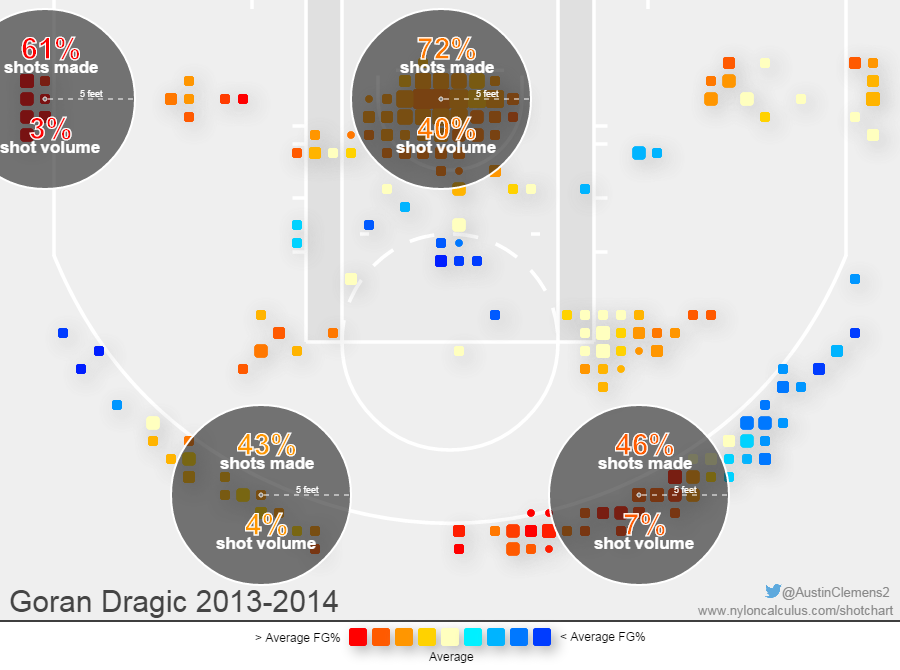
dragic 2014

I was lost on who to select. It felt mandatory to take Greg Monroe because of his qualifying offer, but I’m not sure a small ball center was best. Kyle Korver was another tempting player and I love his game, but he felt redundant with Dirk and Curry, Channing Frye would’ve made for some fun combos as a stretch-5, Wesley Matthews would’ve started but the extra few million impacted the options for this slot, and a few others were intriguing. For the sixth man I felt like I mashed buttons, clicked and prayed.

I settled with Goran Dragic. Mike Conley was another guard considered but, well, I don’t know.

Two words to describe Dragic, though, are electrifying and fearless, challenging behemoths at the rim even LeBron would shy from. Check out a couple of these moves against the Pacers:

Imagine the pick-and-roll with either Nowitzki or LeBron after being so good with Channing Frye. Dragic is also one of the best shooters in both pull-up and catch-and-shoot situations. Just look at his shot chart overall. It’s so nice and balanced. He finished 2014 with a true shooting percentage over 60%, a rarity for a 20+ points per game guard with above-average usage.

Is that all coming back in 2015? The threes concern me the most. In 2012 and 2013, Dragic shot a combined 32.6% off 478 three-point attempts, and the spike in 2014 was aided by a higher dose of attempts from the corners. Only 18 guards, 6’4″ or smaller, have finished two seasons shooting 40% from 3 with a usage rate over 20%, so that doesn’t help, but plenty of great point guards have cleared those arbitrary benchmarks only once. It’s not terrible to decline to, like, 37%.

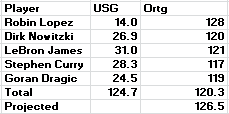
As you can see, though, I’m still talking myself out of this selection, and it’s weird that Dragic is coming off the freakin’ bench. It’s possible he’d in crunch time lineups. In part 1, I projected how many points the starters would score per 100 possessions, but let’s see what could happen if we plug in Dragic.

dragic lineups1dragic lineups2

As explained in part 1, a study by Eli Witus years ago showed that a lineups’ offensive rating increases by .25 points/100 possessions when it has to decrease it’s usage 1%, and vice versa. Depending on the 5-man unit featuring Dragic, it made for projected ratings of 126.5 and 124.6. Both ratings are higher than the 122.9 points/100 possessions for the starting lineup.

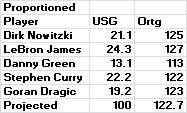
Using Neil Paine’s model that combines not just Witus’ but Dean Oliver‘s work, let’s see how these lineups perform when adjusting for all the high-usage players (again, for further explanation, check out part 1). Here’s what they look like when shifting usage proportionally:

projected1 projected2

And now optimizing for the best projected points per 100 possessions:

optimized1 optimized2

Not quite the results expected from Witus’ study alone, but still 120+ points per 100, so, that’s okay. Danny Green’s offensive rating means he disappears when fiddling with usage, and hurts the bottom line of these units. I didn’t project numbers for any other 5-man combos.

Player #7: Shawn Marion, Cleveland Cavaliers

  • Cap hit: $915,243

marion 2014

I may or may not be depressed Marion is 36 years old. It makes this something of a gamble even on a minimum contract. I’m using a roster spot on him, after all.

Al-Farouq Aminu was available and offers rebounding, but on my imaginary team I’d rather take the guy proven to also make a corner 3 and fit in right away. Maybe that’s why Cleveland went with Marion too. Should his defense slide, that’s an issue, but this roster doesn’t need him to turn back the clock.

Player #8: Patrick Beverley, Houston Rockets

  • Cap hit: $915,243

bevs 2014

A bit weird to select both Dragic and Beverley, but I’m not too confident Beverley can hound point guards for 31 minutes like last season, so he’s going to be turbo-charged for like 20, or something. He’ll be a pest off the bench during the season, playoffs, and even the pre-season. Remember this?

Like Green and LeBron, he’s a one-man wrecking crew versus fast breaks.

I’m not the biggest fan of the Houston Rockets, but Beverley alone makes them watchable. Below are two places, either games or eras, where I wish we’d see him play:

  • The ‘90s. Beverley may not be the tallest, strongest, or greatest point guard, but can you imagine him playing defense with the freedom defenders once had?
  • All-star games. If voted in, I could see Beverley sucking the the fun out of next year’s festivities.

Offensively, Beverley is all right. Low-usage, high-efficiency, league-average 3PT%, and below-average finishing but the mid-50% around the rim isn’t terrible. His defense certainly propels him into a rotation.

Player #9: Troy Daniels, Houston Rockets

  • Cap hit: $816,482

daniels 2014

Like Beverley, Daniels is a role player who should make the Rockets entertaining. I look forward to seeing what kind of looks Harden gives him with two seconds left on the shot clock.

Undrafted with only five NBA games (shot chart is from the D-League), Daniels is still a solid candidate to become one of the best shooters. In the D-League, he attempted 12.5 threes PER GAME and made 40% of them. Even the ‘meh’ areas in his chart look good. When he and Curry are on the floor, either on my fake team or against each other in real life, threes will be hoisted and fire will be made.

My backcourt is crowded. Finding minutes for Daniels will be tricky. Now to forwards and rim protectors:

Player #10: Cole Aldrich, New York Knicks

  • Cap hit: $915,243

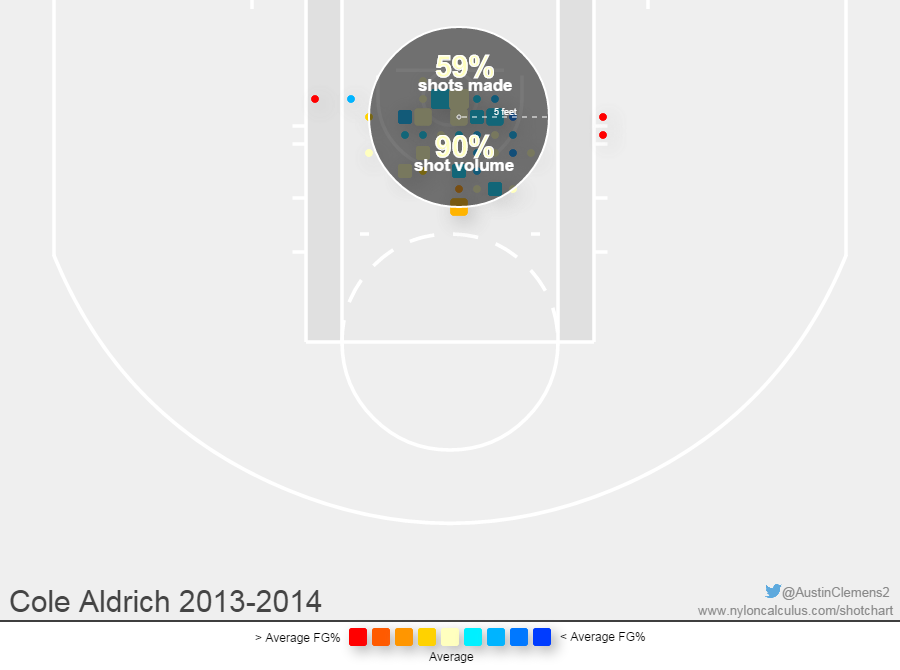
Cole  Aldrich 2014

I can’t believe I’m doing this, but I’ll admit Aldrich wasn’t so terrible as a backup for the Knicks.

When looking at per-36 numbers, Aldrich cracks the top 20 in Seth Partnow’s rim protection stats. He also grabs defensive rebounds like crazy, snatching 33.8% of all missed field goals while on the floor, and he blocked 4.8 shots per 100 possessions all while not looking like the hack he was in previous seasons with Oklahoma City, Houston, and Sacramento. He finished 2014 with a PER of 19.1.

The problem is that he’s rarely played, only logging 1,033 minutes over four seasons. In 2014, a good load of it was in garbage time versus fringe-rotation players. 60% of his 330 total minutes came in the fourth quarter and 70% while up or behind by double-digits, per NBA.com. Hopefully the Knicks take a closer look at what they might have in Aldrich, but if he wants to converse with Jose Calderon about human ham, that’s fine too. I selected another potential rim protector in case that happens.

Player #11: Ed Davis, Los Angeles Lakers

  • Cap hit: $981,084

ed davis 2014

The Lakers and their pull when it comes to minimum deals continues, as Davis is a nice third big deserving of a larger check. Hopefully he doesn’t get buried behind Carlos Boozer, Jordan Hill, and Julius Randle. The Lakers’ frontline is quite crowded.

Like Aldrich, Davis was a lottery pick in the 2010 Draft and probably expected to be a larger contributor by now, but let’s not confuse the two. He has a career sample size 5x as large and just barely missed 1,000 minutes with an OREB% and DREB% of 10 and 20, respectively. He’s long and rangy, an active defender, though with more important minutes under his belt he doesn’t hold up well in the same rim protection stats as Aldrich. His build also means he gets pushed around, but it also helps him move well for someone in that 6’10”-6’11″ish range.

Playing Davis with LeBron, Beverley, and either Lopez or Marion would be interesting defensively.

Player #12: Jon Leuer-Durant-Chamberlain-Jordan***, Memphis Grizzlies

Cap hit: $967,500

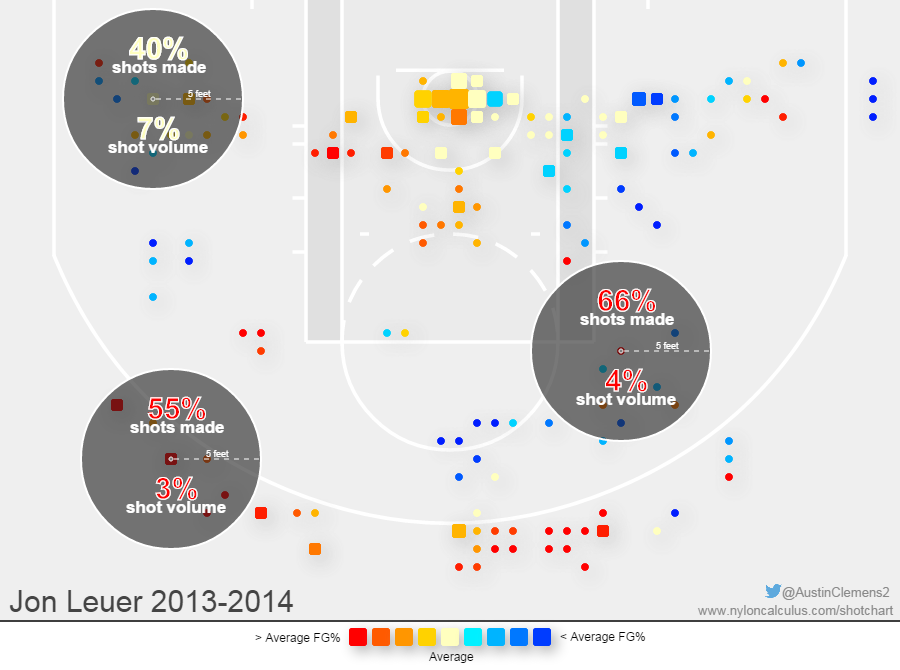
Leuer 2014

Saving the best for last, Leuer is the greatest player I’ve ever seen. He’s Memphis’ Kevin Durant, only better. Unfortunately, Leuer took only 49 threes last season, and defensively he doesn’t look too hot in a few all-in-one metrics. Hopefully he’ll be more consistent next year. Up to this point he’s played just 123 games and 1,384 minutes. Leuer needs to stop screwing around and take over the league already.

***This was a lame attempt to get Jon Leuer a nickname on Basketball-Reference.

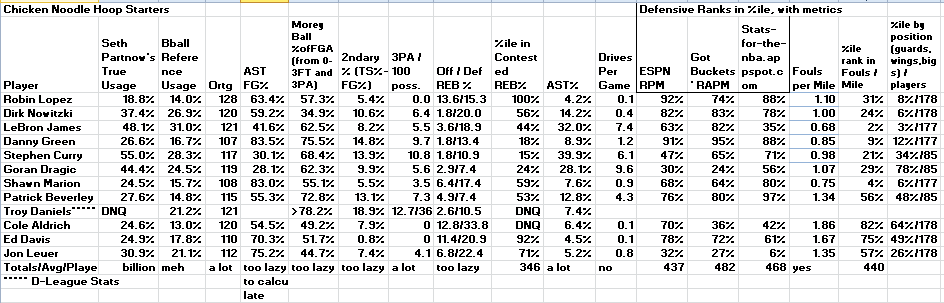
So there’s my 12-man squad. Below is a similar stat summary as in part 1, but with all the players. Click to enlarge because holy hell that looks blurry.

team overlay

Among other things, this is an efficient scoring bunch. Those that take more than a few mid-range shots (Curry, Nowitzki, LeBron) are either good to great at them. Also, look at Daniels’ secondary percentage. It’s from the D-League, sure, but that would flirt with the best marks in NBA history.

As for defensive metrics, they don’t look too bad for this team. It’s kind of embarrassing where Leuer ranks among the league, though, and all of my backup bigs are hacky. Walking fouls, literally.

Below is a breakdown of player salaries and how close I came to the cap:

team salary

The total salary of my roster left me with over $650,000. I spent $100,000 on a lifetime supply of waffles and used the rest to sign a 13th man. Like Leuer, the player I chose is a legend in the making:

Player #13: Sim Bhullar, Sacramento Kings

  • Cap hit: $507,336
embiid chart

Projected shot chart

This team would rule planet earth.

Honorable mentions:

Center: Pau Gasol, Omer Asik, and Channing Frye.

Power Forward: Nick Collison, Amir Johnson, Ryan Anderson, Greg Monroe, and Jeff Adrien.

Small Forward: Richard Jefferson, Paul Pierce, Kyle Korver, and Vince Carter. 

Shooting Guard: Arron Afflalo, Leandro Barbosa, Francisco Garcia, Alan Anderson, Wes Matthews, and Jamal Crawford.

Point Guard: Jose Calderon, C.J. Watson, Pablo Prigioni, Mike Conley, Jameer Nelson, and Qualifying Offer Eric Bledsoe

And any others who flew over my head.

Potential playoff upsets with SRS

Six of the eight first round matchups are extending to at least six games for the first time since the best-of-seven format started in 2003. To me, none of those series have felt like a slogfest either. We might even see a few upsets, starting tonight with both the eighth-seeded Hawks and seventh-seeded Grizzlies hosting Game 6’s with 3-2 leads.

Looking at where each of those teams were seeded, those would be huge wins for Atlanta and Memphis if they can pull them off, but if we look at how they match up in regular season SRS with Indiana and Oklahoma City, respectively, sealing their first round series tonight (or in a Game 7) would be arguably even more impressive.

SRS, or shortened for Simple Rating System, combines margin of victory and strength of schedule. As you’ll see below, it has its drawbacks since it doesn’t exactly value records that help determine seeding, but it’s easily understandable and often does enough to show how good teams were for 82 games. For more of an explanation, check this out, but it might also help to say that the best SRS in league history, according to Basketball-Reference, comes from the 1971 Milwaukee Bucks at 11.91, narrowly beating out the 11.80 from the ’96 Chicago Bulls. The worst goes to the 1993 Dallas Mavericks at -14.68 while the average SRS is 0, though no team has ever actually achieved that exact rating.

To go back to the playoffs, from 2003 to 2013, the team with the higher SRS in their first round series has advanced 79.6 percent of the time, or about the same rate as teams with the higher seed at 78.4 percent. Teams with both the higher SRS and the higher seed (75 occurrences) won 84 percent of their matchups. (Edit: Washington, with an SRS .72 points less than Chicago, advanced Tuesday night and Portland, .62 points less than Houston, can advance tomorrow.)

The higher the difference in SRS with home court, the higher the likelihood a team will win a series, which makes it all the more interesting that Atlanta (SRS: -0.88) and Memphis (2.18) can each clinch tonight. Each of theirs are at least four points lower than Indiana (3.63) and Oklahoma City (6.66) and are in two of five matchups this postseason with that large of a difference or more.

Below are the others with Hawks-Pacers and Grizzlies-Thunder included:

I’ve been fiddling with the SRS of every matchup since 1984, when the league went to their current playoff format 30 years ago. The scenario this season’s Hawks, Grizzlies, and the other three teams are in – an SRS at least four points worse than their opponent and without home court advantage – has often made for a heck of an uphill battle.

Below is a round-by-round look at how teams, ones in those same situations as this year’s previously listed five teams, have performed over the last 30 seasons:

The Charlotte Bobcats will join the list of those that couldn’t overcome their disadvantages, but Atlanta and Memphis have two outs while Brooklyn and Dallas can still extend their season with victories at home tomorrow night.

As for the table above (for the series wins, click here) the only win in the second round came last postseason when Memphis (3.69) beat the Russell Westbrook-less Oklahoma City Thunder (9.15). Another weird one came in 2001 when the Los Angeles Lakers (3.13) had an SRS 4.18 points lower than San Antonio in the Conference Finals. Going by SRS, those Lakers were an underdog in every round except for the NBA Finals, when they were 0.11 points higher than the 76ers. They ended up having the most dominant postseason run of all time, according to Neil Paine but most likely tons of others, too.

2013 featured two upsets meeting this post’s requirements, though 1995 has the most ever with three. This postseason definitely has a chance of matching either 2013 or 1995, but they could also surpass them both with four or more. With all that’s happened the last two weeks, would it really be that surprising if that happened?

Also (!!), I haven’t posted lately because of a high fever at first, but I then made my debut at the Washington Post‘s Fancy Stats. If the Hawks’ three-point shooting has stood out to you, check out my post on how they’ve taken more threes than free throws and how unique their starting five is.

Any other thoughts are welcome.

East vs. West Week 22: Comparing the West’s dominance with point differential

With another week of non-conference play in  the books, it was the same soup just reheated for the West as they went 12-7, a win rate similar to the season overall.

Every one of their playoff teams now has 20 wins against the East, something I brought up in previous posts about never being done before. Four teams out West are still in contention for the best non-conference record, but Milwaukee clinched the worst at 3-27. Two of those wins come from a sweep of the Los Angeles Lakers. Also worth noting is half the league finishing up non-conference play for the season. Gone are the West’s chances to build winning streaks against the middle and bottom of the East, which could mean movement in lottery balls.

Below is the updated week-by-week breakdown. I also included point differential for each week which I’ll then expand on by looking at how it stacks up against every other season since 1997. That’s as far back as NBA.com goes and, as far as I can tell, Basketball-Reference doesn’t yet have those splits to sort through. 1997 is a decent stopping point, though, because of expansion the season prior.

The West’s margin of victory month-by-month can be found here, for anyone curious.

Winning percentage shouldn’t be the only measuring stick for how dominant the West has been against the East. In fact, 2014 currently tops 2004 – the season with the West’s highest non-conference win rate ever – in average margin of victory:

That record-breaking point differential isn’t going to change much since there are only 11 non-conference games left. Neither are the complaints that Minnesota and one of Phoenix, Dallas, Memphis, and Golden State will miss the playoffs all while Atlanta is limping to the finish line.

I’ll have another blog post today regarding home/road, east/west splits. It’s actually something I kind of, sort of looked at six weeks ago but this time will be much more simple, hopefully less complicated and hopefully less ridiculous.

Edit: Maybe not, since Google Sheets doesn’t seem to be working for me.

All stats are according to NBA.com.

The Bobcatters and near-Bobcatters over the last 35 years

Embed from Getty Images

Bobcats can look cute. Bobcatting? Not quite.


It’s about that time of the season where the flack terrible teams get is turned up a notch, but this happens just about every year. Since 1980, 72 teams (plus two this year) have lost at least three-fourths of their games, which equals to an 82-game record of about 21-61. 50 of them are pre-2000 when the league was in the middle of expansion.

But it takes an extra level of ineptitude to finish a season like the 2012 Charlotte Bobcats – not just with the worst winning in percentage in history but also “Bobcatting”, a term for finishing last in offensive and defensive efficiency. While I hope the term changes to the nickname of the next franchise to pull off that dual accomplishment (with maybe a demotion from the league included), we can still look back on teams of the past that also Bobcatted or came close to doing so since 1980.

Altogether, three teams have Bobcatted over the last 35 seasons while 11, including one this season, came close or are currently close to doing so by finishing less than two points away from last place in efficiency on both sides of the court. I’ll take a quick look at every one of those teams, starting with the Bobcatters, and then see how they all match up among the league’s worst offenses and defenses since 1974, at least when compared to league averages.

All stats are according to Basketball-Reference.

The Bobcatters

1987 Los Angeles Clippers (12-70)

Efficiency

  • Offense: 101.2 (Tied for 18th-worst ever)
  • Defense: 112.3

Notable players: Michael Cage, Benoit Benjamin, Mike Woodson, Larry Drew, Cedric Maxwell.

Notable downswings

  • 3-3 turned into 5-36.
  • Went 2-26 in March and April, ended on 14-game losing streak. Allowed 121.3 points/100 possessions in the first nine of those losses.
  • Never won consecutive games.

Only the ’87 Clips and the ’05 Hawks (featured later) never had a winning streak over an 82-game season. The former team tied for the sixth-worst winning percentage in NBA history and allowed the highest effective field goal percentage of any team featured in this post.

This season’s Milwaukee Bucks just might join that list, by the way. The Lakers and Pistons are on the Bucks’ schedule over the next two weeks but each of those games are followed by matchups against the Heat. They also play the Cavs on April 11 but follow it up with a game at Washington the following night.

1993 Dallas Mavericks (11-71)

Efficiency

  • Offense: 99.5 (10th-worst ever)
  • Defense: 114.7 (10th-worst ever)

Notable players: Jim Jackson, Terry Davis, Derek Harper, Sean Rooks, Mike Iuzzolino, Walter Bond.

Notable downswings

  • Went 7-64 through first 71 games.
  • Only team featured in this post to lose by 20 or more points in four consecutive games.
  • Tied (with a team to be named later) for most consecutive losses by 10 or more points with 12.
  • Recorded the worst SRS in league history.

If not for the last fourth of the season, 1993 could’ve been a lot worse for the Mavs. They finished 7-14 with victories on the road over Seattle and Houston. Help would be on the way for Dallas, well sort of. Jamal Mashburn would be selected in the ‘93 NBA Draft followed by Jason Kidd in ’94, but we know that trio wasn’t meant to be. Three straight top-5 picks were gone by the 1997-98 season and their 1997 campaign featured 27 different players logging minutes for them. What a mess. Eventually Mark Cuban, with the help of Dirk Nowitzki, would turn the franchise around.

(Edit: Don Nelson deserves credit as well.)

2012 Charlotte Bobcats (7-59)

Efficiency

  • Offense: 95.2 (7th-worst ever)
  • Defense: 110.4 (tied for 19th-worst ever)

Notable players: Gerald Henderson, Kemba Walker, Byron Mullens, Bismack Biyombo, D.J. Augustin, Tyrus Thomas.

Notable downswings

  • Started 0-16. In the first eight games they scored 93.5 points/100 possessions.
  • Games 46 to 54, went 2-7 and allowed 118.8/100 possessions.
  • Games 58 to 66, scored just 89.3 points/100 possessions.
  • Finished season on 23-game losing streak.

Reason #505 why I’m glad I didn’t blog sooner: I thought this squad would be the eighth seed in the Eastern Conference. The 2014 Bucks might be this season’s version of the 2012 Bobcats.

Charlotte ended up with the worst winning percentage in history. They also had no player with a PER above the average of 15, which I’m just going to assume is the only time that’s ever happened. The Bobcats also never won consecutive games, but it was a shortened season with a gutted team, so I’ll cut them a tiny amount of slack.

At the end of the season, Charlotte didn’t even get Anthony Davis for their efforts, but they made The Onion multiple times, so there’s that. All of those events paved the way for the following season’s sighs, which will be included further down in this post.

Near-Bobcatters

It might seem typical for the worst teams each season to finish within two points of last place in both offensive and defensive efficiency, but it’s not the case. The 2003 Denver Nuggets, for example, had the league’s worst offense ever but for that season were a top-10 defense. They finished 17-65. Even rebuilding teams can still be average on one side of the court or the other.

With that said, below are the most notable teams that were awful all-around:

1980 Detroit Pistons (16-66)

Efficiency

  • Offense: 101.2 (22nd out of 22)
  • Defense: 108.8 (19th out of 22, 1.6 points from last place)

Notable players: Bob Lanier, Bob McAdoo, Kent Benson, Terry Tyler, John Long, even a Jackie Robinson.

Notable downswings

  • Went from 14-37 to 16-66.
  • Ended season on a 14-game losing streak. Combined with an 0-7 start to the 1981 season, it made for (at the time) the longest losing streak in NBA history.
  • Went six straight games without a made 3-pointer, the longest drought of any team featured in this post.

Game logs with offensive and defensive efficiency weren’t available for the 1980 season, but going 2-29 over the last 31 games probably says enough.

Also, Dick Vitale coached the first 12 games of the season, the last 12 of his career or so we think. If only the Knicks were interested in hiring him. It’s sad I’m not totally counting that out.

1995 Los Angeles Clippers (17-65)

Efficiency

  • Offense: 101.5 (27th out of 27)
  • Defense: 111.1 (23rd out of 27, 1.8 points from last place)

Notable players: Loy Vaught, Lamond Murray, Eric Piatkowski, Pooh Richardson, Terry Dehere, Malik Sealy, Bo Outlaw.

Notable downswings

  • Started 0-16. In the first eight games they scored only 93.5 points/100 possessions.
  • Games 46 to 54, went 2-7 and allowed 118.8/100 possessions.

A typical Clippers season pre-Blake Griffin and Chris Paul, the ’95 Clips were one of the worst 25 offenses ever until a team this season (listed further down) kicked/will eventually kick them out. They would be rewarded with Antonio McDyess in the following draft, though they traded him for Brent Barry and Rodney Rodgers. This was also the last season Bill Fitch coached.

Worse than the Clippers in defensive efficiency were the Washington Bullets (111.3 points/100 possessions) in their first season with Chris Webber and Juwan Howard, Golden State (112.2) without Webber, Minnesota (112.4) who eventually landed ex-Bullet and Warrior Tom Gugliotta, and Detroit (112.9) with a rookie Grant Hill. The Pistons got fried in their final 22 games, allowing 119.6 points/100 possessions with the first five of those games giving up 129.4.

1995 Timberwolves (21-61)

Efficiency

  • Offense: 102.6 (26th out of 27, 1.1 points from last place)
  • Defense: 112.4 (26th out of 27. 0.5 points from last place)

Notable players: Christian Laettner, Isaiah Rider, Sean Rooks, Doug West, Tom Gugliotta, Winston Garland.

Notable downswings

  • Started 1-13, including a five-game stretch where they scored only 88.4 points/100 possessions.
  • 41 to 45th games were efficiency splits of 96.5/124.2/-27.7.
  • Tied with the ’93 Mavericks for most consecutive losses by 10 or more points with twelve.

Two important things happened this season, the former more important than the latter:

  1. Gugliotta arrived, marking the birth of “GOOGLY OOGLY WOOGLY BABAY!!!” by then-Timberwolves color commentator Kevin Harlan. Minnesota has had some terrific broadcasting duos over the last 20-plus years.
  2. 1995 was the season I attended my first NBA game, or at least one where I didn’t bawl my eyes out because I thought the mascot was a real wolf, which happened during some Bulls-Wolves game in the early-90s. Ugh.

That’s about all that was fun for that season, at least from my six-year-old point of view. I guess it was all worth it, though, because Kevin Garnett arrived the following season while Isaiah Rider and Christian Laettner would be on their way out.

1997 Vancouver Grizzlies (14-68)

Efficiency

  • Offense: 100.3 (29th out of 29)
  • Defense: 111.8 (28th out of 29, 0.1 points from last place)

Notable players: Shareef Abdur-Rahim, Bryant Reeves, Anthony Peeler, Greg Anthony, George Lynch, Lee Mayberry, Roy Rogers.

Notable downswings

  • Started 0-7. The efficiency splits: 91.4/110.0/-18.6.
  • Games 55 to 79, went 1-24 including the last nine losses allowing 119.8 points/100 possessions.

Poor ‘Reef. Vancouver came within a tenth of a point per 100 possessions of Bobcatting. Consistently terrible, they lost at nearly the frequency they should’ve with six losing streaks between four and eight games when their winning percentage meant for a win every five or six.

Quite a few teams came within a point of becoming the league’s worst defense that season like Philadelphia with Jerry Stackhouse and Allen Iverson, and Boston with Antoine Walker. Each team had a defensive rating of 111.4. Golden State allowed 112 points/100 possessions and had a six-game stretch where they allowed 123.8.

San Antonio, the league’s worst defense, went 1-7 in a stretch where they allowed 124.5 points/100 possessions and went 5-20 over a span when they allowed 120.1. To finish the season, the Spurs went 1-8 in their last nine games with a defensive efficiency of 117.3 points. There’s just no topping all of that. Boston allowed 117.7 points/100 possessions over their final 20 games and Philadelphia had a defensive efficiency of 121.5 over their final 10, yet both were still over one point off from last place. Both of those teams would’ve been interesting landing spots for Tim Duncan, too.

2001 Golden State Warriors (17-65)

Efficiency

  • Offense: 97.8 (28th out of 29, 0.6 points from last place)
  • Defense: 107.4 (28th out of 29, 0.4 points from last place)

Notable players: Antawn Jamison, Chris Mullin, Mookie Blaylock, Larry Hughes, Bob Sura, Adonal Foyle, Marc Jackson.

Notable downswings:

  • Played .333 ball through 42 games (yay?), then went 3-37. Efficiency splits: 95.8/110.2/-14.4.
  • Games 72 to 77: 0-6 with efficiency splits of 92.1/115.1/-23.0.

Antawn Jamison logging 41 minutes per game aka Jimmy Butlering says enough about how Golden State would perform, but it’s not the like the Warriors had much depth to begin with. To Jamison’s credit, he was at least a solid piece for an offense, but that didn’t stop the Warriors from being the worst team in this post in regards to effective field goal percentage.

The 2001 NBA Draft ended up as a sick haul for Golden State. They’d select Jason Richardson, Tory Murphy and Gilbert Arenas, which has to be one of the best drafts ever. At the same time, it’s hard to give it that much weight when Arenas signed with Washington two seasons later. Still, imagine if that kind of haul happens today. It would be something like Oklahoma City in 2008 drafting Russell Westbrook and Serge Ibaka again, but also picking up Goran Dragic in the second round.

Golden State nearly Bobcatted in 2001, but another close call that season was the…

2001 Chicago Bulls (15-67)

Efficiency

  • Offense: 101.5 (29th out of 29)
  • Defense: 111.1 (29th out of 29, 0.5 points from last place)

Notable players: Elton Brand, Ron Mercer, Metta World Peace, Fred Hoiberg, Brad Miller, Jamal Crawford, Khalid El-Amin.

Notable downswings

  • Started 2-19 with 93.1/108.1/-15.0 efficiency splits.
  • 16-game losing streak from January 8 to February 12.
  • 1-17 from March 9 to April 16.
  • Games 46 to 54, went 2-7 and allowed 118.8/100 possessions.
  • Made less than five free throws in two consecutive games, only one of seven teams to do so.

The players on the Bulls rosters from 1999 to 2004 fascinate me. They featured the last seasons in Chicago from Toni Kukoc and Ron Harper, among others, the early years of Elton Brand, Metta World Peace, Jamal Crawford, Brad Miller, Ron Mercer, Tyson Chandler, Jay Williams, and Eddy Curry, and the veterans like Brent Barry and Jalen Rose. Even Charles Oakley played for them.

It looked like a rough go of things during those rebuilding years. Chicago at least finished 2001 on a good note with a two-game winning streak, possibly enough to keep themselves from Bobcatting since Golden State and Washington, the two teams worse in defensive efficiency, allowed a half-dozen more points per 100 possessions over their final two outings. The Wizards actually had a five-game winning streak all while finishing 19-63, which should never happen because math.

2005 Atlanta Hawks (13-69)

Efficiency

  • Offense: 100.6 (29th out of 30, 0.9 points from last place)
  • Defense: 111.1 (29th out of 30, 0.3 points from last place)

Notable players: Al Harrington, Antoine Walker, Josh Smith, Josh Childress, Tyronn Lue, Boris Diaw, Royal Ivey.

Notable downswings

  • Went 1-27 from February 10 to April 8, but beat the dreaded 2005 Timberwolves squad on my birthday. Ugh.

If a team’s leader in PER is Tyronn Lue, chances are the season is going down the drain with zero resistance. Lue led the Hawks at 16.2.

But just how well were they going to be with pre-stretch-four Al Harrington, Antoine Walker and a 19-year-old Josh Smith on either side of the court? The trio shot a combined 105 for 398 from 3, though 2/3 of those attempts came from Walker, who was eventually traded back to the Celtics for, among other things, the draft pick that became Rajon Rondo, which then became part of the trade that landed Joe Johnson.

On offense, the Hawks didn’t Bobcat thanks to New Orleans and their 2-29 start to the season. Baron Davis was eventually traded to Golden State, which meant about half their field goal attempts came from Lee Nailon, P.J. Brown, Dan Dickau, and a rookie J.R. Smith. Jamaal Magloire, a year after making the All-Star Game, produced a 12.9 PER and say what you want about win shares, but he produced -0.4 offensive ones. He would total -2.7 offensive win shares after his all-star season.

As for defensive efficiency, the Lakers finished dead last, though a stretch of games without Kobe Bryant yielded not-terrible efficiency splits of 106.8/110.6/-3.8 and went 6-8. The real damage came in the final 30 games when they allowed 118 points/100 possessions and went 6-24, including the final 13 where they allowed 120 points/100 possessions. Their offense was fine, though, finishing seventh overall on that end of the floor.

As for the Bobcats’ first season, they were 28th in offensive efficiency and 20th on defense. You can do far worse than that when finishing 18-64.

2006 Portland Trail Blazers (21-61)

Efficiency

  • Offense: 101.1 (30th out of 30)
  • Defense: 111.9 (28th out of 30, 2.5 points from last place, and tied for 21st-worst ever)

Notable players: Zach Randolph, Juan Dixon, Sebastian Telfair, Jarrett Jack, Darius Miles, Martell Webster, not Brandon Roy or LaMarcus Aldridge.

Notable downswings

  • Finished 4-33 with efficiency splits of 100.6/115.5/-14.9.
  • Zach Randolph, Darius Miles, and Ruben Patterson were on the same team. Yikes.

The guidelines for close calls were supposed to be teams that fell within two points of last place in both offensive and defensive efficiency. Portland met the criteria on offense, but not on defense.

I gave them a pass, though, because last-place Seattle tied for the worst defense ever relative to league average (see tables at the bottom of this post). In the middle-third of the season, the SuperSonics allowed 118.8 points/100 possessions, which probably happens whenever a team cycles through starting big men like Johan Petro, Robert Swift, Chris Wilcox, Reggie Evans, Vitaly Potapenko, Danny Fortson, and Vladimir Radmanovic.

As for the Trail Blazers, we know now how nicely they rebuilt through the 2006 NBA Draft and that the Jail Blazers era was finally coming to an end, but most importantly they made an appearance in The Onion.

2010 Timberwolves (17-65)

Efficiency

  • • Offense: 101.7 (29th out of 30, 1.1 points from last place)
  • • Defense: 111.6 (27th out of 30, 1.6 points from last place)

Notable players: Al Jefferson, Kevin Love, Corey Brewer, Jonny Flynn, Ryan Hollins, “The White Hole” Oleksiy Pecherov, Sasha Pavlovic.

Notable downswings

  • David Kahn.
  • Started 1-15.
  • Last third of the season: 1-23.

Who knew Kevin Love and Al Jefferson on the same team would generate only 15 wins? They were the only Timberwolves with PERs over 13, yet Ryan Hollins frequently started over Love. Kurt Rambis, everyone.

Also, in Sasha Pavlovic’s first season out of Cleveland, he had field goal-three point-free throw percentage splits of 36.3/29.7/38.5. That last mark is not a lie, more impressive than Mo Williams’ dropoff post-LeBron James. He nearly Bobcatted in shooting splits.

In the way of the Timberwolves Bobcatting were the Nets and Raptors on offense and defense, respectively. Toronto had Chris Bosh playing alongside Andrea Bargnani and post-Magic Hedo Turkoglu, which was actually one of the worst 25 defenses ever in both 2010 and 2011.

As for New Jersey, they traded Vince Carter the previous summer and started 0-18, scoring 94.5 points/100 possessions during that time. They finished the last third of the season well, at least by their standards, by going 6-22 with efficiency splits of 106.1/111.6/-5.5. Brook Lopez played 82 games and was teammates with Chris Douglas-Roberts, who’s now on the Bobcats and looks like a real-life Otto Rocket.

2013 Charlotte Bobcats (21-61)

Efficiency

  • Offense: 101.5 (28th out of 30, 1.3 points from last place)
  • Defense: 111.5 (30th out of 30, tied for 23rd-worst ever)

Notable players: Kemba Walker, Bismack Biyombo, Gerald Henderson, Michael Kidd-Gilchrist, Ben Gordon, Byron Mullens.

Notable downswings

  • Lost 18 straight from November 26 to December 29, but won on December 31. Happy New Year!

Charlotte could’ve Bobcatted in back-to-back seasons, but it helped when they scored 112.3 points/100 possessions over their final three games. There’s also the last 19 when they went 8-11 and scored 105.7 points/100 possessions, four or more points higher than 27th-ranked Orlando, 29th-ranked Phoenix, and last place Washington over the same stretch of games.

That helped three Bobcats finish with a PER above 15 (Walker, Sessions, and Henderson), something they didn’t accomplish the season before. They also got a first round pick from Joe Dumars before the season even started, one they might net this summer depending on where Detroit’s draft pick winds up this season. It’s top-8 protected, and with Charlotte losing their first round pick to Chicago (though owning Portland’s) it’d be helpful if Detroit got their act together by winning some games.

The Pistons play at Philadelphia on Saturday night, a game the 76ers will likely be coming into tied for the longest losing streak in NBA history at 26. Things could happen. Detroit’s season would be summed up perfectly by losing to a near-Bobcatting team like the…

2014 Philadelphia 76ers (15-56)

Efficiency

  • Offense: 98.2 (30th out of 30, currently 11th-worst ever)
  • Defense: 109.5 (26th out of 30, 1.8 points from last place)

Notable players: Michael Carter-Williams, Thaddeus Young, Evan Turner, Spencer Hawes, Tony Wroten, James Anderson.

Notable downswings

  • Currently on a 25-game losing streak dating back to January 31.
  • Games 52 to 57 had efficiency splits of 93.0/118.4/-25.4.
  • Scored at league-average efficiency just once over their last 14 games.
  • SRS and Pythagorean record far worse than Milwaukee’s, yet still two games behind them in the race for lottery balls.

We knew this team would be awful, but that 3-0 start with wins over Miami, Washington, and Chicago nearly broke Twitter. It just might’ve been enough to keep Philadelphia from accumulating the most lottery balls and were likely the three best games of Carter-Williams’ rookie campaign. Those three games also might’ve prolonged the suspicion that Tony Wroten (not Josh Smith) might end up with the worst three-point shooting season in league history. That chance is all but gone, though, because of a sprained right ankle, so all of the bricklaying glory goes to Josh Smith.

But at least Philadelphia became intriguing in fantasy basketball because of their pace which, when comparing to the league average, ranks somewhere among the fastest 25-35 teams in NBA history. They made me nominate Spencer Hawes for Most Improved Fantasy Basketball Player, and led one tweeter (and probably more) to believe Indiana would be unbeatable with Evan Turner. Things happen when pace inflates box score statistics, and for me that ranks up there with the most entertaining things about the Sixers now. Their box scores have the potential to create sick stat lines, though now they come from largely the opposition.

As for Bobcatting, four teams are in their way when it comes to last place in defensive efficiency: New Orleans, the Lakers, Utah, and Milwaukee. Maybe Anthony Davis is enough to take the Pelicans out of the hunt, but the other three teams will be a challenge to surpass. The Lakers have allowed nearly 117 points/100 possessions over their last 10 games but have been fine in their last two, Utah let Detroit put 114 on them last night, and Milwaukee is allowing 118.3 points/100 possessions in their last 10 games. 

Honorable mention: The 1998 Denver Nuggets (11-71) have the 4th-worst SRS in league history and probably Bobcat if not for Latrell Sprewell’s choking incident with P.J. Carlesimo. Denver also has the fifth-worst defense ever while the Warriors have the 8th-worst offense.

Speaking of those rankings, below are the tables of the 25 worst offenses and defenses. Highlighted are teams featured in this post.

The 25 worst offenses

The 25 worst defenses

As mentioned before, it’s really hard to be terrible on both sides of the court to the point a front office has to pitch in (intentionally or not) to make it happen. Even then, that might not be enough.

It’s also worth noting that, despite the lackluster defense exhibited by teams at the bottom of this season’s standings, none are currently on the list of the 25 worst. There’s still time for a new level of ghastly performance, though, and some of the worst defenses are allowing a ridiculous amount points recently. Milwaukee, the worst defense in the league, currently allows five points worse than the league average of 106.3, so even if the 76ers somehow passed them they might have a small cushion preventing them from making a list of dreadful defenses.

But then again, never count out Sam Hinkie. It’s “soreness” and “resting” season, and who knows if it’ll affect Michael Carter-Williams and Thaddeus Young. It might be enough to put the 76ers over the top, or in this case the bottom, relieving the Charlotte Bobcats from that term named after their 2012 campaign.

Will Bobcatting become 76ing? Philadelphing? Hinking? The possibilities are endless.

As a reminder, all stats are according to Basketball-Reference.
High-usage backcourts and efficiency of their lineups

High-usage backcourts were something I fooled around with earlier in the season, though the filters I made back then (usage rates: 25 percent, players had to start together) were so stiff I had to look at backcourts across nearly 20 seasons. That was sort of the point, but at the same time there weren’t as many really high-usage backcourts as I initially thought.

This time I scaled back on the filters, making room for guards this season (74) that used higher than 20 percent of their team’s possessions. I also didn’t leave out players who didn’t start and instead fiddled with 2-man lineup stats from NBA.com featuring guards meeting both the 20 percent usage rate requirement and logging over 250 minutes together. In the end, 32 backcourt pairings made the cut. If I went by duos that each used up 25 percent of their team’s possessions, only the Dion Waiters/Kyrie Irving and Wroten/Carter-Williams duos make the list, though those tandems have rarely started games together.

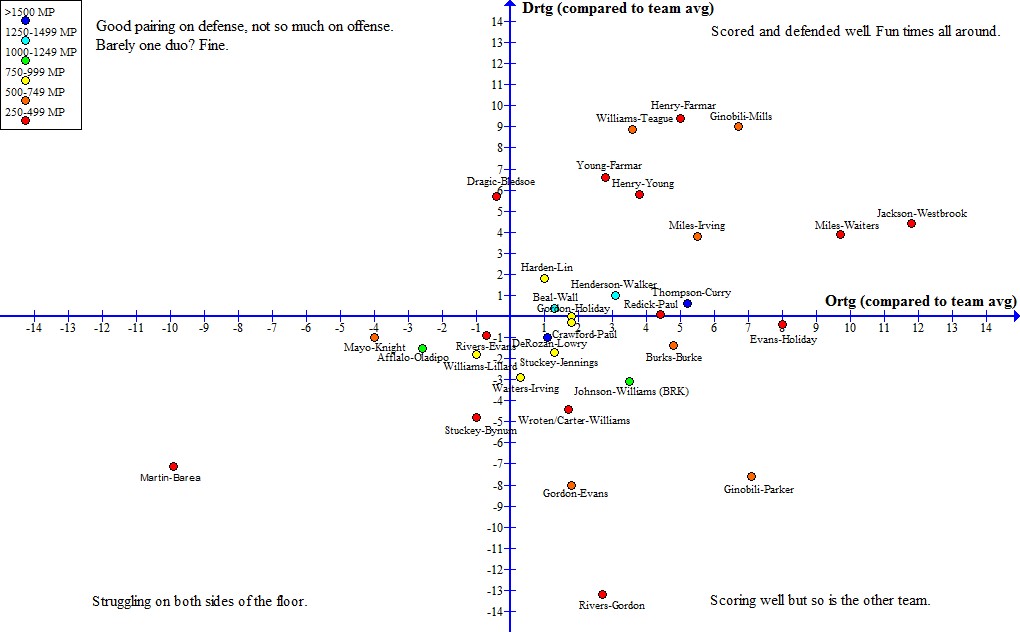
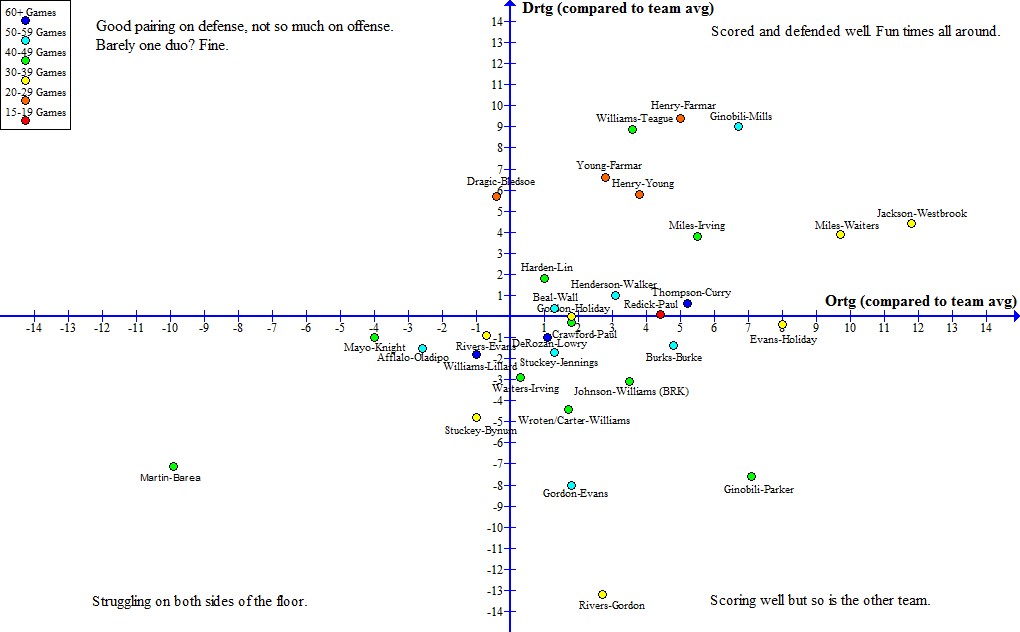
Below is a visualization of each duo’s efficiency while on the court compared to their team’s average. For example, Brooklyn has scored 3.5 more points per 100 possessions than their team average with Deron Williams and Joe Johnson playing together but they’ve allowed 3.1 more points on defense. I also added “BRK” next to that duo because of how common their last names are. Hopefully the others are self-explanatory.

The color of each duo represents the range of minutes they fall in, located in the upper left. Klay Thompson and Stephen Curry have both logged more total minutes (1,904) and averaged more minutes per game (30.7) together than any other tandem, though DeMar DeRozan and Kyle Lowry are close behind (1,803 and 30.0, respectively). Duos that are in the bottom-half of the chart have their names below their dots and the opposite for those in the upper-half.

duos Rtgs adjusted (MP)

Click to enlarge.

It doesn’t seem too surprising that no combo is stifling on defense but bad on offense. Goran Dragic and Eric Bledsoe barely make that fourth of the graph with Suns lineups scoring 0.4 points less per 100 possessions with both of them on the court. If anything, lineups would normally be the other way around which is the case for 10 of the 25 pairings that score higher than their team’s average.

It’s also not surprising that the combos that stray furthest from the average are the ones with the smallest sample sizes. The larger the minute total, the closer they should be to their team’s average. Minutes per game will be looked at further down in this post.

19 of 32 backcourts logged a positive net rating, but five of the seven with nets of +9 or higher belong to the Lakers and Cavaliers combos. Some of this is because they overlap with each other while working as a trio. Below are the three most notable teams with trios along with their minutes and efficiency splits. all according to NBA.com:

Cleveland

  • Irving-Waiters-C.J. Miles: 82 minutes, 112.7/107.2/+5.5

Los Angeles Lakers

  • Jordan Farmar-Nick Young-Xavier Henry:  133 minutes, 113.2/89.3/+23.9

New Orleans

  • Gordon-Evans-Austin Rivers: 104 minutes, 109.3/125.2/-15.8

The Thunder’s combo of Russell Westbrook and Reggie Jackson (+16.2) and the Spurs’ of Manu Ginobili and Patty Mills (+15.8) stand above the five pairings from the Cavs and Lakers as the best duos.

The biggest disaster comes from Minnesota with Kevin Martin and J.J. Barea, logging 313 minutes together over 49 games for a net of -17 points/100 possessions, at least compared to their team’s overall efficiency. Over 100 of their minutes have come with Corey Brewer, Kevin Love, and either Dante Cunningham or Nikola Pekovic. The one with Cunningham gets killed on the glass and can’t take care of the ball, altogether allowing 133 points per 100 possessions while the unit with Pek has a net of -8.3 points. There are a couple Barea-Martin lineups that have yielded good results, though they’ve totaled only 20 minutes or so. Judging by the players filling out the rest of those positive lineups (Alexey Shved, Robbie Hummel, etc.), they likely beat up an opposition’s second unit.

Overall their sample size is one of the smallest. Not nearly as big of a struggle, though still pretty bad are the Gordon-Rivers and Evans-Gordon combos in New Orleans and the Rodney Stuckey-Will Bynum duo in Detroit.

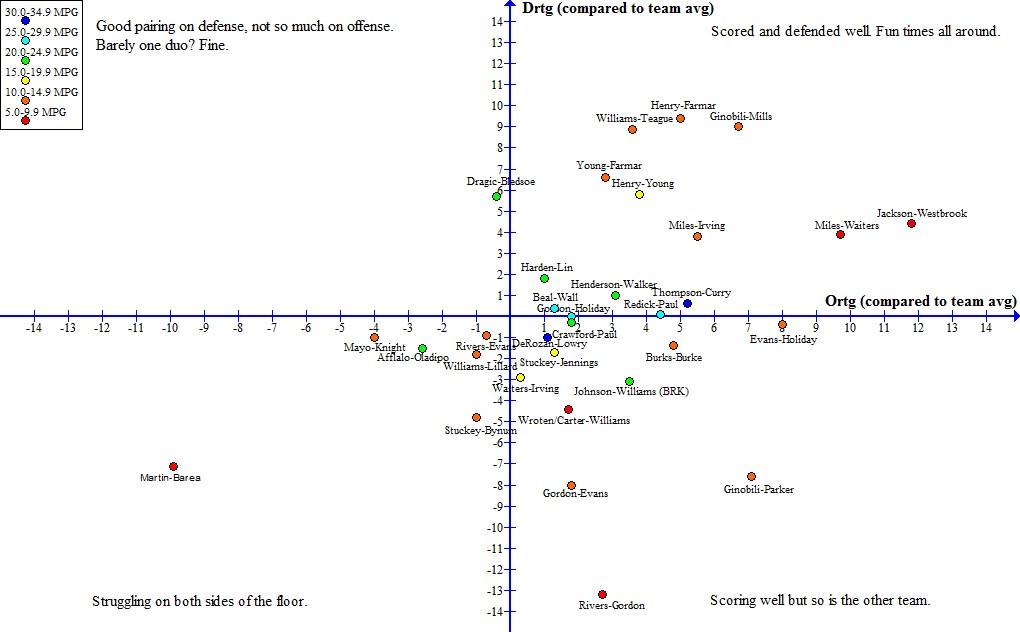
So the biggest upswings or downswings come from duos and their lineups with the smallest samples, but do they also log the least amount of minutes per game? Below are the same pairings with the color of their dots representing minutes per game instead of total minutes. As usual, click to enlarge if you’d like.

duos Rtgs adjusted (MPG)

Below is a GIF that might help look at combos that log the most minutes per game.

mp/mpg on Make A Gif

There’s a slight difference in the combos that are negatives on both sides of the floor, but probably the most noticeable change comes where other pairings score a few points more. Most play a good chunk of minutes per game. Dragic and Bledsoe fit into that category and would log hundreds of more minutes if not for the latter guard being sidelined with a right knee injury.

The last graph shows which duos play the most games:

duos Rtgs adjusted (GP)

This all isn’t to say these combos are the only reason for the collective success or failure of their lineups. Maybe they compliment each other or the rest of the lineup well (or not, in terms of negative duos), benefit from playing alongside a star forward or center (or not), or beat up a second unit as opposed to starters (or…not..). As noted before, some sample sizes are smaller than others.

Some of the duos, though, just look like they’ll give up more points than they generate over the long haul, like Tony Wroten and Michael Carter-Williams not exactly being a pairing that will stretch the defense. Others like Dragic and Bledsoe look like they’ll cause chaos no matter who they play.

Any other thoughts are certainly welcome.

All stats are according to NBA.com unless noted otherwise.