Tag Archives: NBA

NBA backcourt tandems with the highest usage rates

3097581672_1303674524_o

Photos by Keith Allison, via Flickr

Going off my last post, I decided to list the other starting backcourts with usage ratings (possessions when a player takes a field goal, gets fouled or turns the ball over) of over 25 percent each. There were some guidelines, though:

  • They couldn’t be formed after a mid-season trade. (Allen Iverson played only three games for Denver before being traded to Detroit, so I included the ’09 Pistons.)
  • Both players had to start together, not just each starting whenever the other missed a few games.
  • I sorted through the Lottery Era up to last season.

There were quite a few cases where tandems interfered with the first two guidelines, but it made it easier to narrow down the list of qualified candidates and then calculate their effective field goal percentages, compare it to the team they played for, and then see how it matches up with the league average. 

Free throw attempts per game will be missing from the table as well as some other notable stats. I had to narrow it down to a doable list otherwise it wouldn’t format correctly. Here’s what’s left of it, sorting each duo by the season. The stats are according to Basketball-Reference.

Backcourt duos with >25% usage rate each

Player Year Team MinPG FG% 3PT% PTSPG Usage DuoEFG TmEFG LgEFG W/L
Jerry Stackhouse 1996 PHI 37.5 .414 .318 19.2 26.0 .458 .474 .499 18-64
Vernon Maxwell 32.9 .390 .317 16.2 25.6
Allen Iverson 1997 PHI 40.1 .416 .341 23.5 28.9 .458 .470 .493 22-60
Jerry Stackhouse 39.1 .407 .298 20.7 25.6
Ray Allen 2000 MIL 37.4 .466 .423 22.1 25.6 .498 .494 .478 42-40
Sam Cassell 35.8 .455 .289 18.6 25.0
Latrell Sprewell 2001 NYK 39.2 .430 .381 17.7 25.8 .467 .476 .473 48-34
Allan Houston 36.6 .449 .304 18.7 25.7
Sam Cassell 2002 MIL 35.2 .463 .348 19.7 27.3 .526 .507 .477 41-41
Ray Allen 36.6 .462 .434 21.8 26.2
Allan Houston 2002 NYK 37.8 .437 .393 20.4 25.9 .471 .468 .477 30-52
Latrell Sprewell 41.1 .404 .360 19.4 25.1
Michael Jordan 2002 WAS 34.9 .416 .189 22.9 36.0 .430 .464 .477 37-45
Richard Hamilton 35.0 .435 .381 20.0 28.6
Michael Jordan 2003 WAS 37.0 .445 .291 20.0 28.7 .444 .460 .474 37-45
Jerry Stackhouse 39.2 .409 .290 21.5 27.9
Larry Hughes 2004 WAS 33.8 .397 .341 18.8 28.1 .447 .454 .471 25-57
Gilbert Arenas 37.6 .392 .375 19.6 27.4
Gilbert Arenas 2005 WAS 40.9 .431 .365 25.5 27.3 .481 .474 .482 45-37
Larry Hughes 38.7 .430 .282 22.0 26.6
Jason Richardson 2006 GSW 38.4 .446 .384 23.2 27.6 .486 .479 .490 34-48
Baron Davis 36.5 .389 .315 17.9 25.9
Allen Iverson 2009 DET 36.5 .416 .286 17.5 25.9 .459 .483 .500 39-43
Richard Hamilton 34.0 .447 .368 18.3 27.0
Devin Harris 2009 NJN 36.1 .438 .291 21.3 28.4 .482 .497 .500 34-48
Vince Carter 36.8 .437 .385 20.8 26.8
Richard Hamilton 2010 DET 33.7 .409 .228 18.1 27.9 .438 .474 .501 27-55
Rodney Stuckey 34.2 .405 .297 16.6 26.4
Manu Ginobili 2011 SAS 30.3 .433 .349 17.4 26.0 .520 .491 .498 61-21
Tony Parker 32.4 .519 .357 17.5 25.5
Kyrie Irving 2013 CLE 34.7 .452 .391 22.5 30.2 .485 .473 .473 24-58
Dion Waiters 28.8 .412 .310 14.7 26.1

You can pick and choose what stands out here, if anything. Here are a few thoughts:

Backcourts who carry the load of an offense can be risky, but that’s not to say they often struggle. They can succeed when implemented with the right group of complimentary players and system. For example, I’m pretty comfortable letting Tony Parker and Manu Ginobili carry the offense, though I can’t say the same for two guys who couldn’t stretch the floor like Jerry Stackhouse and Michael Jordan.

I DON’T know how often some duo’s minutes were staggered because lineup data on NBA.com is only available from 2008 and on. Some backcourts, like Sixers of ’97, just look like they played a ton of time together. That couldn’t have been a good thing. Here are the minutes the previously-listed backcourt tandems logged together over the last six seasons, though:

  • Allen Iverson and Richard Hamilton: 23.2
  • Devin Harris and Vince Carter: 27.7
  • Richard Hamilton and Rodney Stuckey: 25.0
  • Tony Parker and Manu Ginobili: 19.6
  • Kyrie Irving and Dion Waiters: 21.4

The combo of Jordan and Stackhouse/Hamilton made the list when neither were point guards. Looking back, there wasn’t a whole ton of talent at that position for Washington. It speaks for itself when, in 2003, 70 percent of Larry Hughes’ minutes came at the point, according to Basketball-Reference. It’s kind of amazing that he, a 39-year-old Michael Jordan, and Jerry Stackhouse won even 37 games with their shooting, but that’s the power of MJ, I guess. It’s also impressive that Jordan used up 36 percent of the Wiz’s possessions in 2002. Overall, Washington had high-usage backcourt combos for four straight seasons until Cleveland splurged on Hughes.

Another oddity was Allan Houston and Latrell Sprewell making the list too. Basketball-Reference has them listed as a shooting guard during their careers at one point or another, though. I chose not to remove them from the list. Shooting guard and small forward tandems, or teams with three starting wings who used a ton of possessions (the early-2000s Bucks, for example) might be something I’ll look into in the near-future.

Again, this post isn’t meant to say high-usage backcourts often lead teams into mediocrity. Point guard-shooting guard duos (or in some cases, two shooting guards with one as a small forward) are just something I find interesting and worth looking at. It made me think, though, that if those backcourts used up a ton of possessions, then the team is more often than not sorely lacking talent in one other position.

It’s also pretty obvious that teams with two players taking a combined ~30 or more shots per game with inefficient stats (and one of them being the point guard) just won’t perform well. They might not frequently get to the line, take (and miss) several jumpshots, play lackluster defense in order to save energy on O, or some combination of the three. To repeat what I mentioned earlier, some (not all) of that can be helped by staggering minutes.

Going forward, I wonder how often we’ll see two guards with similar high usage rates, and how well their teams perform. Right now, Philadelphia and Washington have duos that would join the list but neither squad is doing all that well this season.

Anything else worth mentioning? Feel free to leave a comment.
‘Twas the West’s 20 wins before Christmas

Richard Masoner | Flickr

Holiday spirit? (Richard Masoner | Flickr)

Quite a few teams have jumped out to unexpectedly hot starts before the Christmas games, arguably the most surprising being the Portland Trail Blazers. They have tall tasks coming up against the Clippers, Heat and Thunder, but for now they’re 23-5 and first in the West, just barely ahead of Oklahoma City and San Antonio.

For Portland to get to 20 wins before Christmas is quite an accomplishment and a sign of success across the entire regular season. From 2000 to 2013, 30 teams out West have reached 20 wins before December 25, which averages out to about 2.3 teams per season. 2014 surpassed that mark with four total.

Below is a table showing each team in the West’s 20-win club over the last 14 years:

20 wins before Christmas

Season Team W-L by 12/25 82-game record West rank Finish
1999-00 Los Angeles Lakers 22-5 67-15 1 Won Finals
Portland Trail Blazers 20-7 59-23 3 Lost Conf. Finals
2000-01 Utah Jazz 20-8 53-29 4 Lost First Round
Los Angeles Lakers 20-10 56-26 2 Won Finals
2001-02 San Antonio Spurs 20-5 58-24 2 Lost Conf. Semifinals
Sacramento Kings 20-9 61-21 1 Lost Conf. Finals
2002-03 Dallas Mavericks 23-4 60-22 3 Lost Conf. Finals
Sacramento Kings 22-8 59-23 2 Lost Conf. Semifinals
2003-04 Los Angeles Lakers 20-6 56-26 2 Lost Finals
Sacramento Kings 20-6 55-27 4 Lost Conf. Semifinals
San Antonio Spurs 20-10 57-25 3 Lost Conf. Semifinals
2004-05 Phoenix Suns 23-3 62-20 1 Lost Conf. Finals
San Antonio Spurs 21-6 59-23 2 Won Finals
2005-06 San Antonio Spurs 21-6 63-19 1 Lost Conf. Semifinals
Dallas Mavericks 20-7 60-22 4 Lost Finals
2006-07 San Antonio Spurs 21-7 58-24 3 Won Finals
Dallas Mavericks 20-7 67-15 1 Lost First Round
Utah Jazz 20-8 51-31 4 Lost Conf. Semifinals
2007-08
2008-09 Los Angeles Lakers 23-5 65-17 1 Won Finals
2009-10 Los Angeles Lakers 23-4 57-25 1 Won Finals
Dallas Mavericks 20-9 55-27 2 Lost First Round
Denver Nuggets 20-9 53-29 4 Lost First Round
2010-11 San Antonio Spurs 25-4 61-21 1 Lost First Round
Dallas Mavericks 23-5 57-25 3 Won Finals
Utah Jazz 21-9 39-43 11 Missed Playoffs
Los Angeles Lakers 21-8 57-25 2 Lost Conf. Semifinals
Oklahoma City Thunder 20-10 55-27 4 Lost Conf. Finals
2011-12
2012-13 Oklahoma City Thunder 21-5 60-22 1 Lost Conf. Semifinals
Los Angeles Clippers 21-6 56-26 4 Lost First Round
San Antonio Spurs 21-8 58-24 2 Lost Finals
2013-14 Portland Trail Blazers 23-5
Oklahoma City Thunder 22-5
San Antonio Spurs 22-6
Los Angeles Clippers 20-9
34 teams   57.8-24.2

So average regular season records those teams finish with are often quite good. Only one team finished with less than 50 wins and the average 82-game record is just under 58-24. It wouldn’t be all that surprising to see all four teams this year finish with 58 wins before the playoffs, fattening up in non-conference matchups in the process. No team with over nine losses by Christmas, however, has won over 58 or more games since Chris Webber and the 2002 Kings. The Clippers are probably out of luck, at least until they get J.J. Redick back.

Only one team missed the playoffs on that list: The Utah Jazz of 2011 who had a mess of a season. They’d lost Carlos Boozer the summer prior and replaced him with Al Jefferson, who is now in Charlotte. Utah now has Richard Jefferson and his expiring contract. Will Utah replace him next summer by drafting another Jefferson? The Jazz also ended the season without Jerry Sloan and Deron Williams while prolonging a total rebuild. None of the four 20-win teams this year match what Utah went through. Portland did have an active off-season, but to match Utah’s they’d have to ship LaMarcus Aldridge for, say, David Lee, then have Damian Lillard request a trade down the road. Hmm…

Some other notables from the 20-wins-before-Christmas Club:

  • Of the 29 20-wins-before-Christmas teams that made the playoffs, six lost in the first round.
  • 15 teams made at least the Conference Finals. It’s basically a lock that one of the four this year makes it unless we have a Houston-Golden State matchup. Not likely, but nonetheless possible.
  • 10 of the 13 seasons have featured a 20-wins-before-Christmas team represent the West in the NBA Finals.

Portland, Oklahoma City, San Antonio, and the Los Angeles Clippers are in a club that often entails success down the road, but a few stumbled despite a hot start. Let’s see which starts were more on the fluky side and ones that were the real deal.

Until then, happy holidays. I need to wrap my presents. Where’s the duct tape?

Eastern Conference ends six-week drought, finishes last week over .500 against the West

via Wikipedia

via Wikipedia

We all know the Eastern Conference has been weaker this season than it usually is. Every night, a few games out in the west coast will make us excited about a future playoff matchup like last night’s back-and-forth between the Clippers and Timberwolves. Meanwhile, it seems like the Bobcats and the Bucks are playing against each other every night out east. Please, let Indiana and Miami be at full strength come May!

It doesn’t help when the matchups in non-conference play have been historically lopsided this season, though last week finally provided some relief for the East. It was the first time since November 4 to November 10 that they went over .500 against the West. Here’s a week by week breakdown:

Week Weekly West wins-East wins West-East wins through listed week Winning % through listed week
October 29 to November 3 7-2  7-2 77.8%
November 4 to November 10 7-8 14-10 58.3%
November 11 to November 17 17-6 31-16 66.0%
November 18 to November 24 13-1 44-17 72.1%
November 25 to December 1 13-6 57-23 71.3%
December 2 to December 8 10-8 67-31 67.0%
December 9 to December 15 16-2 83-33 71.6
December 16 to December 22 8-10 91-43 67.9

As you can see, the West started laying the smackdown on Week 3. That’s pretty much when the jokes about the East started to surface. It only got worse as the West went 26-7 over the following two weeks against its “toothless Eastern cousin”, as netw3rk dubbed them. Last night, they needed Toronto to beat Kevin Durant and Oklahoma City AT OKLAHOMA CITY, WHERE THE THUNDER WERE UNDEFEATED, just to finish over .500 against the West. Somehow, Toronto came through.

Who knows what the All-Star Game will be like? Hopefully five years from now we won’t look back on a Jamaal Magloire or Mo Williams kind of all-star, but is Jordan Crawford that bad of a fit alongside LeBron James and Paul George

Maybe the conference won’t be so bad by mid-February. Up until last week, it couldn’t have been much worse. 

Weeks in this post were defined as Monday through Sunday, instead of Sunday through Saturday. 

Shot charts of the week: December 16-22

Last week, I started a weekly series built around unusual shot charts from teams. I really haven’t heard opposition or compliments about them, so I decided to make another post and proceed from there. I looked at which teams took advantage of the corner three, took a ton of shots from one side or the other, bombed away from three, or had a shot chart that was symmetrical.

FUN STUFF.

Here are last week’s shot charts that stood out to me, from December to 16 to 22. All shot charts are from ESPN.com:

The Clips bomb away from the corners (December 16 versus San Antonio)

right corner three SASLAC 121613

The Clippers gave San Antonio a taste of their own medicine after they beat the Timberwolves with the right corner three.

Los Angeles 10 attempted corner threes total, mostly thanks to Willie Green and Jared DudleyJamal Crawford also made a 34-footer as time wound down at the end of the game. Classy.

The Clips won, 115-92.

New York gets really weird (December 18 at Milwaukee)

knicks

Players from the ’60s are throwing up at that shot chart. So many threes, so many long twos.

I already went into detail about this game here, but it’s still worth mentioning that the Knicks chucked 41 threes with J.R. Smith accountable for 17 of them.

New York won this Toilet Bowl, 107-101 in double overtime.

Kyle Korver has a field day from the corners (December 18 versus Sacramento)

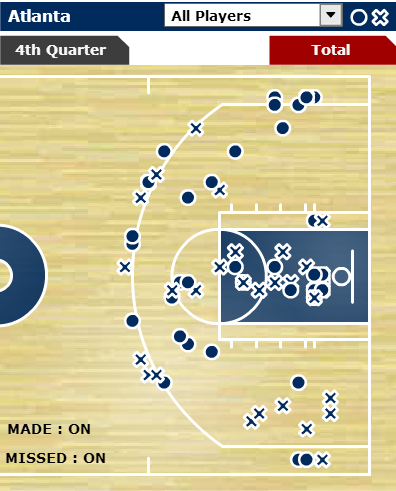
Atlanta bombs away SACATL 121813

More corner three talk!

Paul Millsap also joined in on the fun from the corners, making two of his own. The main beneficiary was Kyle Korver, though. For the night, he drained eight threes. As a team, the Hawks were 15-for-25 from behind the line. It’s an easy game.

Atlanta won 124-107.

Portland chucks (December 18 at Minnesota)

POR-MIN 121813 GAME

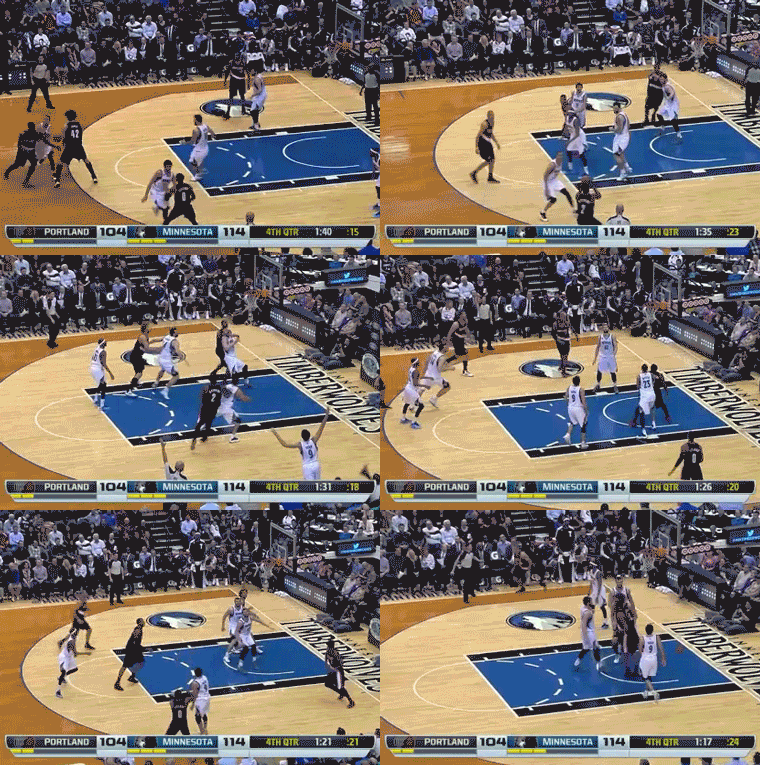
Portland took 40 threes for the night, 17 coming in the 4th quarter. It felt like every one of those happened in this sequence:

ibwRprEqKFjfar

Minnesota took advantage of a team on their fourth game in five nights, jumping out to a 30-point lead (!!!) in the first half and scoring 98 points through three quarters.

Damian Lillard nearly led a comeback from 30 down, but it was too big of a hole to climb out of. Shocking, I know.

Minnesota won, 120-109.

Memphis pounds the paint (December 18 at Dallas)

MEmphis paint 121813
54 points came in the paint for Memphis, 18 more than the Mavs. They even made their threes, shooting eight-for-18 from beyond the arc. It’s not every day that happens. Memphis has made only five threes per 100 possessions, according to NBA.com. That’s second-worst in the NBA only to the Charlotte Bobcats.

Overall, Memphis took 20 more shots than Dallas, but it wasn’t enough. They were 29-for-75 inside the three-point line, which amounts to a Ricky Rubio-like 38.7 percent. The Grizzlies kind of really miss Marc Gasol, and their 2015 first round pick they owe Cleveland is starting to look juicy with every loss.

Memphis lost this game, 105-91.

Minnesota teeters towards the left side (December 20 at the Lakers)

predominantly lefty minlal 122013

It’s not all that surprising when no Timberwolf consistently in the rotation is left-hand, but nonetheless it’s a shot chart worth looking at. It’s like having a batting lineup predominantly right-handed with 95 percent of the balls in play going to left field. It happens, I guess. 

If Kevin Love was a baseball player, he would definitely be that righty causing a defensive shift to the left side. He takes a ton of his shots from that area, but tonight the entire team jumped in.

The results were miserable. The Lakers won 104-91. It was one of the worst losses I’ve witnessed this season.

The Jazz make their threes (December 21 at Charlotte)

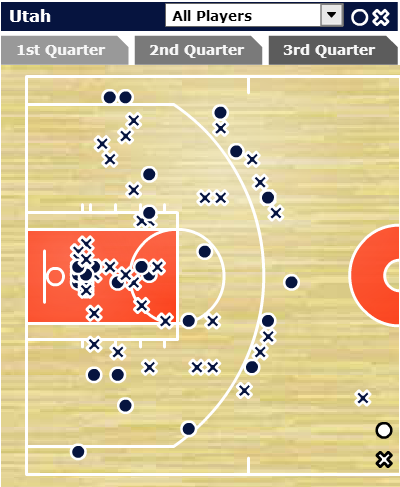
utah jazz

Early in the season I wrote about the Jazz’s embarrassing struggles from the arc, specifically in the corners. They’re up to 29.3 percent from that area of the three-point line. Lots and lots of progress, considering they were below 10 percent to start the season.

Four of their 10 made threes came from Trey Burke, who seems like a very nice building block alongside Derrick Favors, Enes Kanter, and Gordon Hayward. Good times all around, and the draft pick Golden State owes them might have better value than expected.

The Jazz won 88-85. It’s a pretty bad loss for Charlotte who has a chance to possibly finish over .500 this season.

Symmetry by Golden State (at home versus the Lakers, December 21)

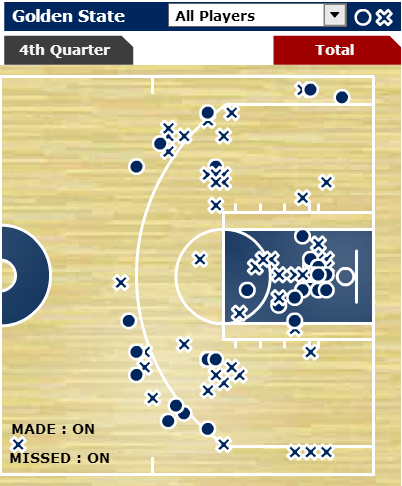
symmetry LAL-GS 122113

Cut the Warriors’ shot chart in half and it’ll look eerily similar. You might have to make every shot an X or an O, since the Warriors made a couple threes from the left corner and none from the right, but it looks pretty cool nonetheless.

Eight of their 12 threes came from Stephen Curry and Klay Thompson. Not seen in that shot chart was Andrew Bogut‘s 20 rebounds.

Golden State beat the Lakers, 102-83.

Until next week, I’ll be looking for the shot chart from this heavyweight battle:

Danny Granger gives Indiana new possibilities, but also tough decisions (Part 2)

This is the second of a two-part series about the return of Danny Granger. For part one, click here.

In an hour or so the Celtics will tip off against the Pacers, who recently got back Danny Granger after he missed the first 25 games with a calf strain. Indiana seemed just fine without their small forward who started 423 of 510 games from 2006 to 2012, but he can provide a major boost off the bench and allow Frank Vogel to experiment with some new lineups.

Granger looked better on Friday night than his numbers might indicate. He shot 1-for-7 from the field but the attempts were open and in rhythm, ones that will fall in time. There were also five turnovers, but a few of them were typical of a player in their first game of the season, turnovers everyone else (hopefully) got out of their system in the pre-season. It seemed like he has yet to get his legs fully under him, which is understandable. He blocked Dwight Howard from behind but there were also times when he didn’t elevate well. Overall, it seemed like a typical night for someone playing in their very first game of the season.

If he can stay healthy and work out the kinks, Granger can bolster an already improved bench. Their offensive efficiency is still in the bottom-10 among NBA benches, according to NBA.com, scoring 96.7 points per 100 possessions, but the shooting is much improved, up from 39.4 percent last year to 43.8. The bench’s defensive rating has remained top notch too, going from 97.2 points allowed per 100 possessions to 96.6. Granger’s a solid defender when healthy, so the Pacers shouldn’t take a hit on that end of the court.

Offensively, Granger’s certainly an upgrade over someone like Orlando Johnson, and the second unit already features key cogs with the likes of C.J. Watson, Luis Scola, Ian Mahimni, and sometimes Lance Stephenson. Without Granger, that’s still miles ahead of what the Pacers had to work with last year with D.J. Augustin, Sam Young, and Gerald Green, among others. With Granger as the sixth man, Indiana shouldn’t miss a beat when the most of the starters get their breathers.

Note: I should add that I’m expecting Granger to come off the bench because their starting lineup has a plus-minus differential of +5.3 per game. Don’t fix what isn’t broken.

Aside from being a sixth man, Granger could provide for some interesting lineups. This is especially when he’s paired with Paul George, who at times can run the point or move to shooting guard where he started his first two seasons. Vogel has already experimented with that super tall wing duo, pairing Granger and George with Hill, Scola, and Roy Hibbert for a few minutes as well as using the same starting lineup from 2012. Granger and George logged six minutes together on Friday night, according to NBA.com. The plus-minus differential was zero.

Along with going tall, a healthy Granger also makes for some small ball units. In 2012, Vogel used 17 of those lineups that placed George and Granger with only one power forward or center, according to NBA.com. The results were hot and cold, posting a plus-minus differential of plus-22 in just 59 minutes but shooting just 40 percent from the field. Of the time Granger was on the floor in 2012, three percent of it was at power forward, according to Basketball-Reference.

Houston, with the likes of Terrence Jones and Omri Casspi at power forward, provided an opportunity for Vogel to go small on Friday night, but only Granger played with those kinds of lineups when the game was well out of hand. Going forward, small lineups against New York and Miami, for example (especially when Carmelo Anthony or LeBron James play power forward), could be possible. Miami’s crunch time lineups often consist of consist of LeBron with Mario Chalmers, Dwyane Wade, Ray Allen, and Chris Bosh, but it’s unlikely Vogel would show that kind of card to Miami during the regular season.

Besides, going big is why Indiana does so well against Miami, among other teams. It’s obvious, but experimenting with Granger at power forward with the starters would mean sitting one of David West and Roy Hibbert. West would seem like the odd man out, unless Indiana wanted to gamble without one of the best rim protectors in the league. In that case, going small with George and Granger at small forward and power forward, respectively, might be better with the second unit and Ian Mahinmi at center.

Regardless, Miami’s preparing Greg Oden for the playoffs but Indiana has their own ace up their sleeve in Danny Granger. If he doesn’t get traded Frank Vogel has four months to find the best situations for him, and as long as he can stay healthy he could make an already great Pacers team even better.

For part one of this series about the cloud hanging over Danny Granger’s expiring contract, click here.