Tag Archives: NBA

J.R. Smith’s shooting spree in charts

"<strong

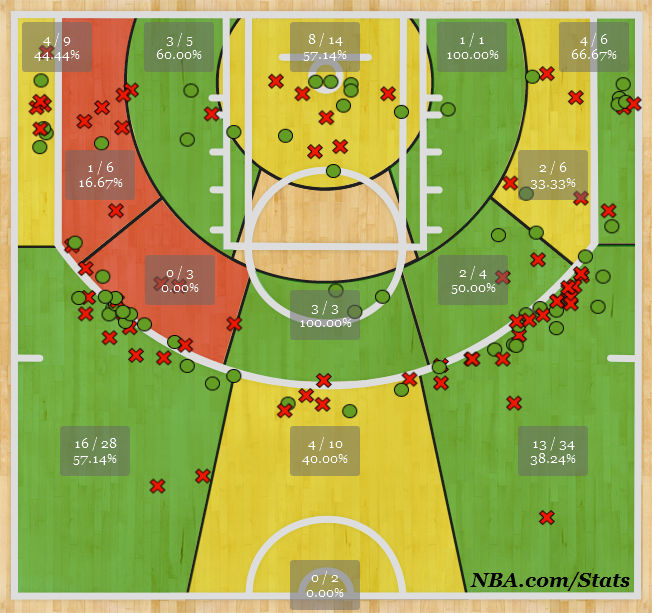
J.R. Smith’s shooting chart over his last seven games.

While the Knicks’ season is veering off a cliff, J.R. Smith has come out with guns blazing in each of his last seven games, for better or for worse. He’s been one of the league’s leading scorers during that stretch at 23.7 per, much of it thanks to emptying the clip from beyond the arc by attempting 12.7 threes per game (!!!) and doubling his total attempts for the season in just two weeks. This was all capped yesterday afternoon when he set the record for attempted threes in a game with 22, a decent summary of the Knicks’ season and something only believable if it happened to, well, Smith himself.

But while some of those attempted threes have been cringe-worthy, Smith’s shooting over the last seven games has averaged out to decent efficiency: Nearly 24 points per game on about 18 shots and shooting splits of 48.5/46.3/100. Beyond the arc is where Smith’s done most of his damage, and by fooling around with similar charts I’ve used to visualize point distribution for teams we can see the shift in Smith’s scoring from his first 63 games to his last seven and even last three where he’s averaging 29.3 points. (If only that kind of scoring were sustainable, for NBA Twitter’s sake.)

The first chart we’ll look at is point per location from the normal six areas of the floor: restricted area, in the paint (non-restricted area), mid-range, corner three, above the break three, and free throws. As an example, below is Smith’s point distribution per game through his first 63 outings:

jr smith ppl england

Smith’s scoring weighed heavily toward the above the break three, for better or for worse, with nearly six points (5.62 to be exact) coming from that area of the floor. No other area gets as many as three points, with mid-range being the second most frequent scoring area at 2.86 points per.

Now, below features the graph previously mentioned along with his scoring distribution per game over his last seven outings and last three:
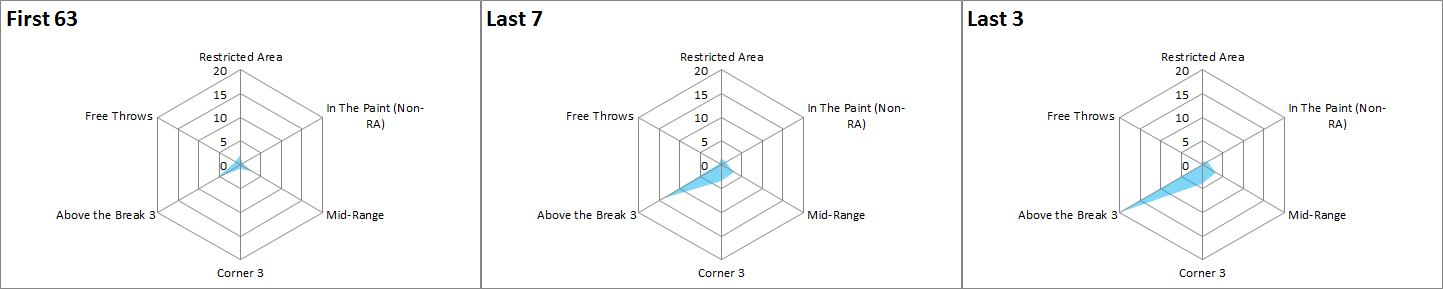
Smiff PPL

Click to enlarge. Quite helpful!

The very first chart provided shrinks considerably thanks to the max values provided to fit in Smith’s recent, unreal three-point barrage, and for the most part that’s all where he’s scored from. About three-fifths of his points coming from that scoring zone over his last seven games and two-thirds over his last three. The corner three and mid-range areas get some attention as well, but anywhere inside the paint and at the stripe has been mostly neglected.

Lastly, here’s a GIF of the increase:

smiff ppl on Make A Gif

While Smith’s upped his three-point attempts, the uptick in usage from 20.8 in his first 63 games to 25.9 over his last seven hasn’t hurt his overall efficiency. In fact, during the recent stretch, Smith’s effective field goal percentage is 62.2 compared to a pedestrian 48.6 during his first 63 games.

Below hopefully shows that increase from five spots on the floor, minus free throw shooting. A reminder should be given that Smith’s shots recently have largely come from the perimeter. He’s only taken a combined two shots per game from the two areas inside the paint.
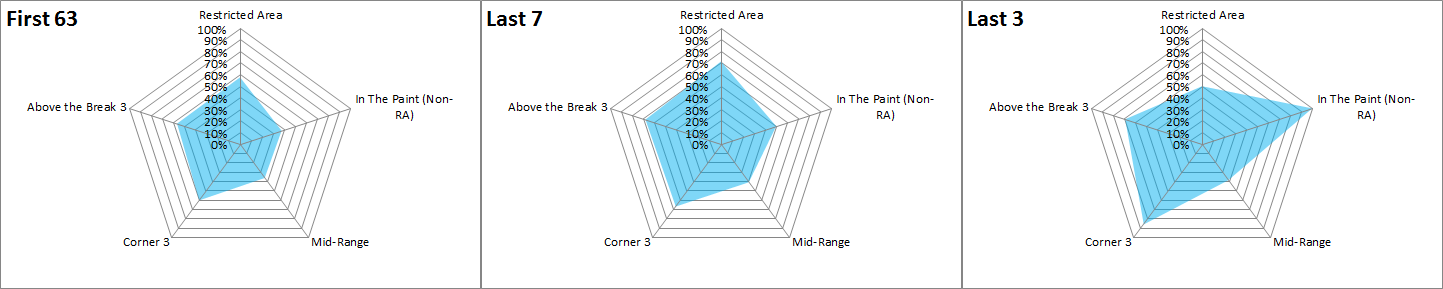
Click to enlarge.

Click to enlarge.

And like with points per location, below is a GIF of the increase in EFG% across the three stretches of games:

smiff EFG% on Make A Gif

Surely this isn’t sustainable, though there’s only four games left for the Knicks so we might see Smith lock and load until season’s end. New York doesn’t play another game until Friday anyway, giving him plenty of time to rest his shooting hand.

Edit: Previously, I mentioned that Smith holds the record for games with 10+ 3PA with four, but according to Basketball-Reference there’s actually a tie between multiple players for seven straight games of 10+ attempts. There’s still time for Smith to join that group as his streak is still alive, but for now he has a few games to go.

All stats are according to NBA.com.

East vs. West Week 23: Counting down to the last of the 450 games

Another week, another updated week-by-week breakdown:

The most exciting non-conference game of the week had to go to Minnesota traveling to Miami and winning in double overtime, much of it thanks to Kevin Love’s ridiculous shot making and Ricky Rubio carving up a hyper Heat defense. LeBron James and Chris Bosh weren’t too bad for the Heat, though, among other players. Dwyane Wade didn’t play because of a lingering hamstring injury.

Houston also lost their last two non-conference games, falling to the Nets and Raptors. Aside from all but guaranteeing the Rockets the fourth seed in the West, it also meant that San Antonio clinches the best record against the East at 24-6 while the Lakers and Kings are tied for the worst at 12-18 each. Neither hold a candle to Milwaukee’s 3-27 record in non-conference play, however, and the Bucks, 76ers, Magic, Celtics, and Pistons are collectively 100 games under .500 against the West, a combined record of 24-124 with the 76ers and Pistons finishing up the season with Memphis and Oklahoma City, respectively.

Maybe that’ll lead to an uptick in the West’s point differential, which I also updated from last week’s post. It hardly changed, but probably worth noting where it ranks in non-conference play since 1997 anyway:

Lastly, here’s the 212,749,834,9a8,943,f92th reminder about the West’s possible record-breaking winning percentage: They’d have to finish their last five games 4-1 to tie 2004’s 63.3 winning percentage and win all five to break it.

Below are those final non-conference games this season:

The last three games look very winnable for the West while the first two are something of a toss-up. Maybe they’ll split? Miami and Minnesota will be playing the tail-end of back-to-backs, however, with the first games against Brooklyn and San Antonio, respectively. Not the easiest two consecutive games for either team, especially when Minnesota has been without Nikola Pekovic, Kevin Martin, and about half the roster recently.

Updated point distributions in graphs

About a month ago, I fiddled around with graphs visualizing how many points a team scores from specific shot locations. While it was something I enjoyed working on, there wasn’t a whole lot of space to include both GIFs and pictures while looking at the difference between a squad’s offense and defense. Back then, I went with GIFs but now I’ll include some photos of the graphs with updated percentages.

I also left off effective field goal percentage this time around so I wouldn’t flood a post with a ton of huge pictures. What’s left is a percentage of points a team scores at six areas on the floor: restricted area, in the paint (non-RA), mid-range, corner three, above the break three, and free throws.

In the future I’ll experiment more with these types of graphs, but for now these are the ones for each team over the entire season, both on offense and defense. They’ll probably appear blurry but clicking on the picture, then zooming in helps a ton.

Also, below the picture are links to team graphs for offense only and defense only. Enjoy, hopefully:

offense-defense

Offense-only graphs.

Defense-only graphs.

Similar to what I mentioned in the first post, the graphs for the best and worst offenses and defenses just aren’t the same as one another. Take the Heat, Clippers, and Mavericks as the top three offenses, for example. Thanks to LeBron James, Dwyane Wade and Chris Bosh, Miami scores a ton of their points in the restricted area — 36.5 percent, to be exact and fourth-highest in the league. Meanwhile, the Clippers are near the middle in point distribution from a few locations, but with the help of Blake Griffin they get just under one-fifth of their points from the free throw line. Dallas, with a nightmare of a scorer to gameplan for in Dirk Nowitzki, is weirdly balanced in all locations as they don’t appear too high or low in any of them.

Defenses are more similar as Indiana and Chicago both concede a bunch of points from mid-range. The Spurs and Warriors, in third and fourth place in defensive efficiency, respectively, have similar mid-range portions of the graph but allow more points in the paint (non-RA) region than the top two teams. Overall, it would seem like offenses would want their offenses to shift as far to the left side of the graph as possible and the opposite for defense.

I’ll actually admit these graphs are slightly misleading, one reason being that corner threes don’t jump out in them but are nonetheless important to team success. Attempts per location looked about the same and points per location was slightly different when comparing offense to defense. In the future, though, I’ll sort by the latter stat but I had a really weird time calculating it last night and this morning and ran out of time to put those graphs together.

Lastly, below are two tables of the top and bottom five teams in point distribution for each shot location. One table is for offense and the other for defense, starting with the former:

All stats, including ones used for tables and graphs, are according to NBA.com. 

East vs. West Week 22: Comparing the West’s dominance with point differential

With another week of non-conference play in  the books, it was the same soup just reheated for the West as they went 12-7, a win rate similar to the season overall.

Every one of their playoff teams now has 20 wins against the East, something I brought up in previous posts about never being done before. Four teams out West are still in contention for the best non-conference record, but Milwaukee clinched the worst at 3-27. Two of those wins come from a sweep of the Los Angeles Lakers. Also worth noting is half the league finishing up non-conference play for the season. Gone are the West’s chances to build winning streaks against the middle and bottom of the East, which could mean movement in lottery balls.

Below is the updated week-by-week breakdown. I also included point differential for each week which I’ll then expand on by looking at how it stacks up against every other season since 1997. That’s as far back as NBA.com goes and, as far as I can tell, Basketball-Reference doesn’t yet have those splits to sort through. 1997 is a decent stopping point, though, because of expansion the season prior.

The West’s margin of victory month-by-month can be found here, for anyone curious.

Winning percentage shouldn’t be the only measuring stick for how dominant the West has been against the East. In fact, 2014 currently tops 2004 – the season with the West’s highest non-conference win rate ever – in average margin of victory:

That record-breaking point differential isn’t going to change much since there are only 11 non-conference games left. Neither are the complaints that Minnesota and one of Phoenix, Dallas, Memphis, and Golden State will miss the playoffs all while Atlanta is limping to the finish line.

I’ll have another blog post today regarding home/road, east/west splits. It’s actually something I kind of, sort of looked at six weeks ago but this time will be much more simple, hopefully less complicated and hopefully less ridiculous.

Edit: Maybe not, since Google Sheets doesn’t seem to be working for me.

All stats are according to NBA.com.

Casper Ware’s half-court shot sets league record for made heaves in a season

At a time when efficiency is as important as ever, taking a half-court shot is like a fork in the road for NBA players. It’s an opportunity for a team to score a free three points since the opposition is never getting the ball back, and that amount is more than the difference between Miami’s league-leading offensive rating and eighth-place Phoenix’s, according to NBA.com. (The drop-off is about the same anywhere in that statistic, save for one of the worst offenses ever in Philadelphia. More on them in a bit.)

The drawback to the heave is that it also counts in the box score whether or not it goes through the net, and as I’ve used as an example in previous posts about those shots, it affected how Kevin Durant and others of the Oklahoma City Thunder approached those end-of-quarter situations last season.

But to the advantage of teams and the entertainment of fans, this season’s attempts from beyond half-court (currently 331) are on pace to top 2013’s total of 361. It’s a positive sign since heaves rarely ever affect individual stats by a season’s end and never accounted for more than one percent of all attempted threes anyway.

And last night added a little extra to the uptick thanks to none other than, um, Casper Ware?

The 76ers guard, in just the second game of his career, scored the league’s 13th shot from beyond half-court this season, surpassing the record for made heaves previously set in 2010 according to Basketball-Reference.

Below is a season-by-season breakdown of shots from beyond half-court:

Before Ware, no player made a heave since March 1 when Marc Gasol dialed one up from deep, and as you might guess from the total made shots in the table above, that drought for multiple weeks is quite common. The longest came in 2005 when the first of only two made heaves was scored on January 26. 2010 and 2012 are the only seasons when two were made on the same night.

And if those field goals were ever worth more than three points, they should be way higher than the four discussed earlier this season. Very similar to what I’ve included in previous posts about half-court shots, to reach an effective field goal percentage of .500 we’d need either 1,598 of those 4,794 total heaves to go in or the 115 already made to be worth about 42 points each. If the latter were the case, even a casual NBA fan would surpass Wilt Chamberlains 100-point game in no time.

Lastly, below is the company Ware joins this season with his made heave last night:

It’s probably unnecessary given Tony Wroten‘s out with a high ankle sprain, but he’s more accurate near the opposition’s arc than his own.

But at least he has a contract guaranteeing him money next season. The same can’t be said for a few players who’ve suited up for the 76ers, including Casper Ware. If the former guard for Long Beach State never plays a minute after this season, his name will at least have some lasting power with NBA fans.

When reaching for other reasons to remember Ware, though, hopefully sinking a record-breaking half-court shot all while Philadelphia lost a record-tying 26th game will come to mind. He still has a couple games left on his 10-day contract to add to his resume, but that heave currently stands as one of the few bright spots for the post-trade deadline 76ers.

All stats are according to Basketball-Reference unless noted otherwise.

Edit: According to Basketball-Reference’s shot finder, Ware’s shot was made from 46 feet, a foot across half-court even though his player page lists the attempt from beyond that point. ESPN’s shot chart and NBA.com also marks his shot from behind the line and video confirms that. Going forward, however, maybe I’ll have to dial back the filtered shots to beyond 45 feet, but maybe it’s just an error in the Shot Finder that will be fixed in time.