Category Archives: Shot Charts

Shot charts of the week: December 16-22

Last week, I started a weekly series built around unusual shot charts from teams. I really haven’t heard opposition or compliments about them, so I decided to make another post and proceed from there. I looked at which teams took advantage of the corner three, took a ton of shots from one side or the other, bombed away from three, or had a shot chart that was symmetrical.

FUN STUFF.

Here are last week’s shot charts that stood out to me, from December to 16 to 22. All shot charts are from ESPN.com:

The Clips bomb away from the corners (December 16 versus San Antonio)

right corner three SASLAC 121613

The Clippers gave San Antonio a taste of their own medicine after they beat the Timberwolves with the right corner three.

Los Angeles 10 attempted corner threes total, mostly thanks to Willie Green and Jared DudleyJamal Crawford also made a 34-footer as time wound down at the end of the game. Classy.

The Clips won, 115-92.

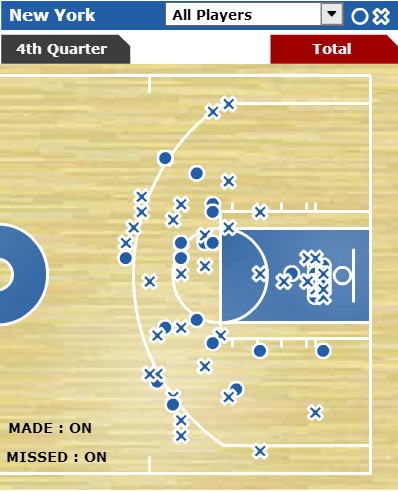
New York gets really weird (December 18 at Milwaukee)

knicks

Players from the ’60s are throwing up at that shot chart. So many threes, so many long twos.

I already went into detail about this game here, but it’s still worth mentioning that the Knicks chucked 41 threes with J.R. Smith accountable for 17 of them.

New York won this Toilet Bowl, 107-101 in double overtime.

Kyle Korver has a field day from the corners (December 18 versus Sacramento)
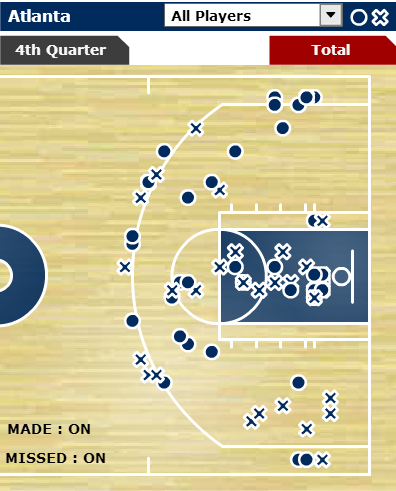
Atlanta bombs away SACATL 121813

More corner three talk!

Paul Millsap also joined in on the fun from the corners, making two of his own. The main beneficiary was Kyle Korver, though. For the night, he drained eight threes. As a team, the Hawks were 15-for-25 from behind the line. It’s an easy game.

Atlanta won 124-107.

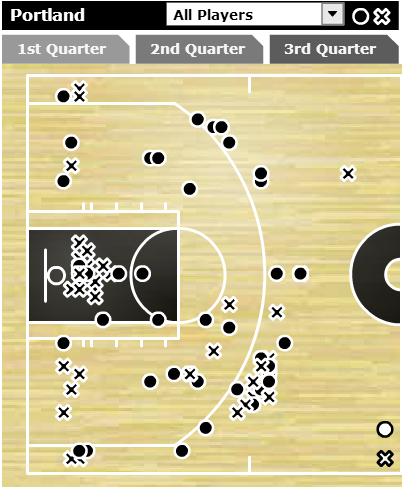
Portland chucks (December 18 at Minnesota)

POR-MIN 121813 GAME

Portland took 40 threes for the night, 17 coming in the 4th quarter. It felt like every one of those happened in this sequence:
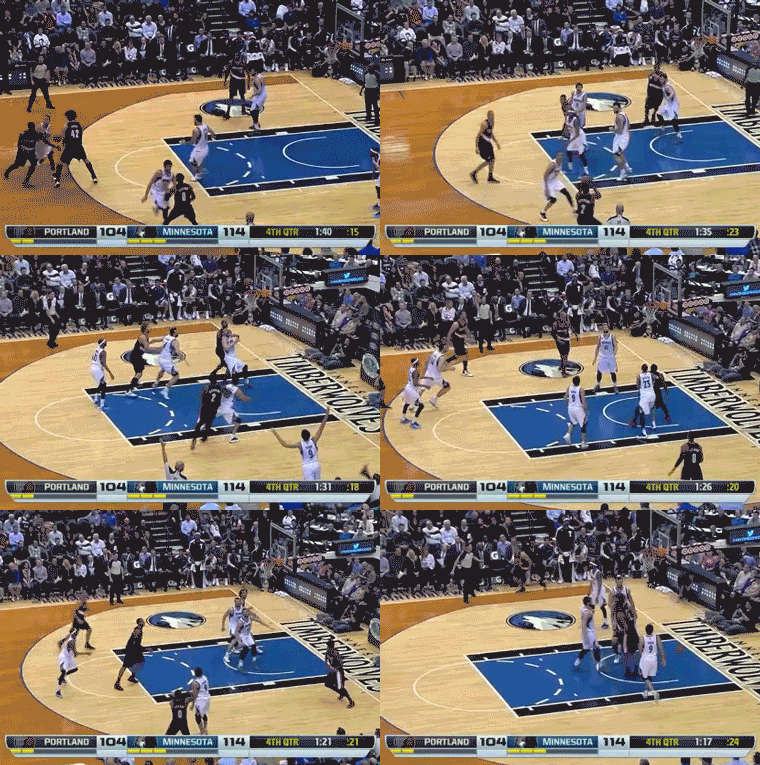
ibwRprEqKFjfar

Minnesota took advantage of a team on their fourth game in five nights, jumping out to a 30-point lead (!!!) in the first half and scoring 98 points through three quarters.

Damian Lillard nearly led a comeback from 30 down, but it was too big of a hole to climb out of. Shocking, I know.

Minnesota won, 120-109.

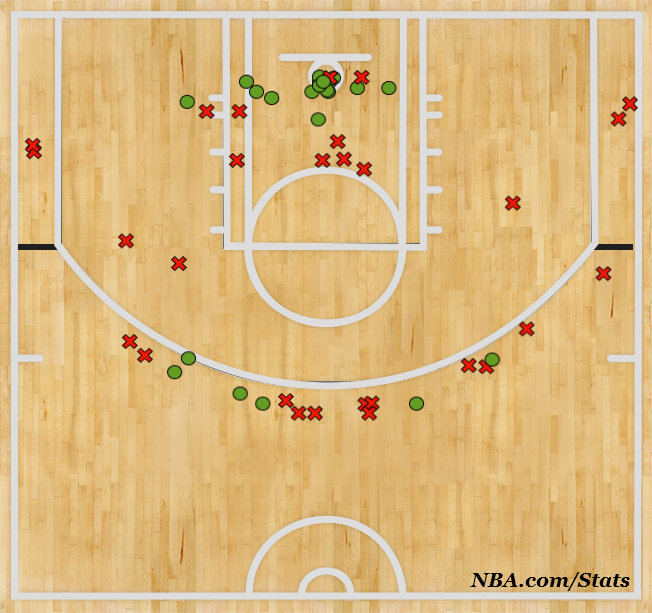
Memphis pounds the paint (December 18 at Dallas)

MEmphis paint 121813
54 points came in the paint for Memphis, 18 more than the Mavs. They even made their threes, shooting eight-for-18 from beyond the arc. It’s not every day that happens. Memphis has made only five threes per 100 possessions, according to NBA.com. That’s second-worst in the NBA only to the Charlotte Bobcats.

Overall, Memphis took 20 more shots than Dallas, but it wasn’t enough. They were 29-for-75 inside the three-point line, which amounts to a Ricky Rubio-like 38.7 percent. The Grizzlies kind of really miss Marc Gasol, and their 2015 first round pick they owe Cleveland is starting to look juicy with every loss.

Memphis lost this game, 105-91.

Minnesota teeters towards the left side (December 20 at the Lakers)

predominantly lefty minlal 122013

It’s not all that surprising when no Timberwolf consistently in the rotation is left-hand, but nonetheless it’s a shot chart worth looking at. It’s like having a batting lineup predominantly right-handed with 95 percent of the balls in play going to left field. It happens, I guess. 

If Kevin Love was a baseball player, he would definitely be that righty causing a defensive shift to the left side. He takes a ton of his shots from that area, but tonight the entire team jumped in.

The results were miserable. The Lakers won 104-91. It was one of the worst losses I’ve witnessed this season.

The Jazz make their threes (December 21 at Charlotte)
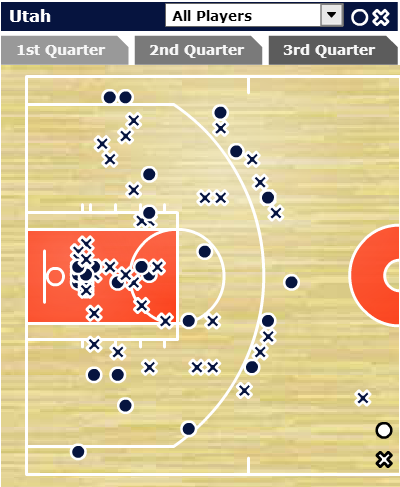
utah jazz

Early in the season I wrote about the Jazz’s embarrassing struggles from the arc, specifically in the corners. They’re up to 29.3 percent from that area of the three-point line. Lots and lots of progress, considering they were below 10 percent to start the season.

Four of their 10 made threes came from Trey Burke, who seems like a very nice building block alongside Derrick Favors, Enes Kanter, and Gordon Hayward. Good times all around, and the draft pick Golden State owes them might have better value than expected.

The Jazz won 88-85. It’s a pretty bad loss for Charlotte who has a chance to possibly finish over .500 this season.

Symmetry by Golden State (at home versus the Lakers, December 21)
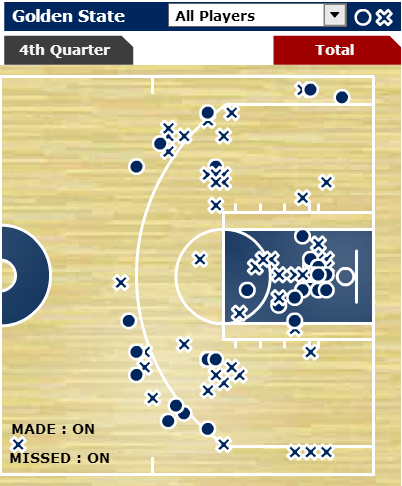
symmetry LAL-GS 122113

Cut the Warriors’ shot chart in half and it’ll look eerily similar. You might have to make every shot an X or an O, since the Warriors made a couple threes from the left corner and none from the right, but it looks pretty cool nonetheless.

Eight of their 12 threes came from Stephen Curry and Klay Thompson. Not seen in that shot chart was Andrew Bogut‘s 20 rebounds.

Golden State beat the Lakers, 102-83.

Until next week, I’ll be looking for the shot chart from this heavyweight battle:

Shot charts of the week

This is an attempt to start a weekly series where I look at unusual shot charts and post them here. They balance out over a season to what a team wants to do, like Houston straying away from mid-range shots, but unusual shot locations can emerge each game. It’s why I wanted to start a weekly series as long as it doesn’t turn out messy or jumbled.

In the future, I could also go into more depth than I did for this post or look at individual players instead of teams. For now, though, check this out:

Miami Heat and Detroit Pistons, December 8

1 MiaDet 12813

Detroit’s allowed the second-most attempted corner threes per game, 7.3 according to NBA.com, and that’s where Miami teed off from last Sunday. Detroit either over-helped or fell asleep, some of that being expected when LeBron James bends defenses until they break. There was one instance, though, where James directed every Heat player on the floor to the left side, save for Ray Allen, and Detroit didn’t adjust. It was one of the easiest corner threes of Allen’s career.

As for Detroit’s offense, they bricked all but one mid-range shot. Give credit to Miami for the bad offense on a ton of possessions, though. They forced more than a few difficult passes, ones off course just enough to where shooters spotting up for three had to take a couple steps inside the arc to catch the ball. The Pistons are actually in the bottom-five in attempts from both the 10-14 foot areas and 15-19, according to NBA.com. That’s a little surprising when Josh Smith is on the team, but not so much when Greg Monroe and Andre Drummond start at power forward and center, respectively.

Miami bagged the win, 110-95.

Phoenix Suns, December 10 at Los Angeles Lakers

2 PhxLal 121013

The Suns missed all of their attempts from the left side while hot from the right side, at least from the elbow down. The Morris twins were responsible for most of the mid-rangers in that hot patch on the right side, while Goran Dragic made two of the corner threes.

The Suns won 114-108 and continued a start to the season that was hardly expected.

New York Knicks, December 11 versus Chicago

3 ChiNY 121113

This was perhaps the ugliest game I’ve watched all season. The Knicks took a ton of mid-range shots, especially from above the elbow, and shot only two corner threes. For the season, they’re in the top-10 in both mid-range shots attempted and above the break threes, but in the bottom-10 everywhere else.

Gross.

The Knicks won, though, 83-78.

Houston Rockets and Portland Trail Blazers, December 12

4 HouPor 121213

Perhaps my favorite game of the season and definitely one that put Portland on the national spotlight if they weren’t already there. It was a contrast in styles. Both teams like to tee off from the arc, but Portland takes three times as many mid-range shots per game than Houston. In fact, every other team takes at least twice as many as the Morey Ball-Rockets.

LaMarcus Aldridge didn’t care, draining a of those mid-rangers in the chart above. Portland won, 111-104.

San Antonio Spurs, December 13 versus Minnesota

5 SaMin 121313 (2)

The Spurs really enjoyed that right corner three, a total of seven shots made from there. It’s just too hard to win games when your opponent scores over 20 points from the corner like that. Three of those corner threes came in the fourth quarter when the Spurs outscored the Timberwolves 37-21. It was quite the answer to Minnesota outscoring them 35-18 in the third, thanks to Kevin Love’s three-point barrage.

The Spurs won, 117-110.

Atlanta Hawks, December 14 at New York

atlantaNY121413 - Copy

Another Morey Ball shot chart. Barely any mid-range shots were taken, with a ton of those shots instead going towards threes, including a bunch from the corners. Atlanta took 32 attempts from the arc that night, making 15. 10 of those came from Louis Williams and Kyle Korver.

The Knicks still won, though, 111-106. Maybe they’ll trade for Kyle Lowry after all.

Portland Trail Blazers, December 14 at Philadelphia

PorPhi 121413 - Copy

So. Many. Threes.

Portland had a night reminiscent of when my rosters on NBA 2K6 had ratings of 99. They couldn’t miss (21 threes), they dished (41 assists), and they won in a blowout (139-105). Had the Trail Blazers scored one more point, they would’ve been the 11th team in league history to score 140 points while taking less than 20 free throw attempts.

Regardless, they set a franchise record with their made threes. It’s just not fair when a team takes nearly 40 shots from the arc and makes over half.

All shot charts from ESPN.com

Andre Iguodala’s shot chart resembes a putting green (with a sand trap too)

Everything’s sunny for Andre Iguodala, who gave the Golden State Warriors a game-winning bucket last night only after Russell Westbrook did all he could for Oklahoma City.

But this isn’t about just last night. Iguodala, widely known for his great defense, has turned in a terrific season offensively as well. In fact, his shot chart seems like one normally reserved for Stephen Curry, Klay Thompson, or Kevin Durant, but it also brings back memories of golfing in the summer. Introducing, the putting green that is Iguodala’s shot chart:

Shotchart_1384502833329

The rectangular sand trap in the right corner is a bit awkward since I doubt such bunkers exist, but it’s hard to complain when it could cover the entire court should Iguodala, for some reason, go on a horrific shooting slump.

Let’s not mix basketball and golf any more than we should though. Charles Barkley has shown what could go wrong when we take it too far:

Looking at the corner 3, where the Utah Jazz are shooting nine percent

Shotchart_1384330671093

Utah’s shot chart. So much blood.

It might be overkill to look at the Utah Jazz’s struggles when I wrote about Toronto’s shooting yesterday. That, and Zach Lowe touched on the cramped spacing for Utah at the end of his latest column. But I’ll also look at a few more things about the corner three, including which team was once so good from that special area that it was silly.

But to start, as you can see in the Jazz’s shot chart, there are a lot of areas where the Jazz are struggling to convert offense from. None of it is worse than the corner three though, where they’ve shot a whopping 9.1 percent (3 for 33). It’s obviously a small sample size and a few other teams have been brutal from the area that usually produces the most efficient shot outside of a layup, but it’s difficult imagining the Jazz not being one of the five worst shooting teams from that area by season’s end. Who’s going to make those shots? Can Richard Jefferson catch fire for like one game? Where’s Brandon Rush? It might be up to Gordon Hayward, who was at least 45 percent from the right corner last year.

Again, it’s only been eight games, but hopefully they don’t break the record for worst shooting ever from the corners. That record belongs to Grant Hill, Jerry Stackhouse and the 1998 Detroit Pistons who shot a record-worst 25.2 percent, according to NBA.com. To stay above that mark, Utah, if they keep taking the same amount of shots from the corner as they previously have, will have to make at least 28 percent from here on out.

Hopefully that’s manageable, and it should be. No team has made less than 30 percent of their corner threes since the Jazz of 2007. If it’s not, then starting 0-8 may only be the beginning of a long, frustrating season in Salt Lake City. (At least there’s college basketball to look forward to.)

It’s weird though. Utah used to traditionally be at or near the bottom in corner threes attempted but were very good at making them. And since they were good at making them (they shot 50.7 percent in 1999, which is nowhere near the best and soon you’ll see who is) then why didn’t they shoot more? Why didn’t every team shoot more from the corner? No team neglected corner threes as much as Portland did in 1997 though, according to NBA.com, setting the record for the least corner threes attempted in a season with 86. Last year, 12 teams surpassed that many attempts before December.

But in 1997, another record involving corner threes was set–and this one is way better! The Charlotte Hornets, featuring Dell Curry and Glen Rice in his career year, set the record for the most accurate shooting from the corners by making 108 of their 175 attempts for a blistering 61.7 percent. Most teams today don’t even shoot that well around the rim. (Edit: Glen Rice was 45 for 68 from the corner three — 66.2 percent) 

There are a ton of good shooters from the corner today but picturing a team breaking that mark, combined with the total number of shots taken there? That would surely be a team for the ages. Hopefully the Utah Jazz don’t end up on the opposite end of that discussion.

Overreaction of Week 1: Josh Smith’s shot selection

overreaction

This post was initially devoted to all sorts of weird happenings over the first week of the NBA’s season. Michael Carter-Williams and the 76ers tanked so hard they ran over every team with their tank (until the Warriors ran them out of their own building), Boston was in pole position for the 2014 Draft as a result of the 76ers’ (and Suns’) unexpected starts, there were struggles from Derrick Rose and John Wall, and Milwaukee’s bench (21.5 points per game per-48-minutes) was the third-stingiest in the league and gave the incredibly average Bucks some hope for the postseason again.

But screw it. Of all the storylines to discuss, I wanted to write about what could possibly be this decade’s Rasheed Wallace in Detroit: Josh Smith. We’ll take a look at his offense through three measly games.

Last season, Smith took 363 shots (!) between ten feet and the arc which were good for just 30.5 percent. He also made only 29.9 percent of the 221 threes he hoisted. Overall, he was only a 30 percent shooter when he took jump shots. That’s just not acceptable for anyone, let alone a player where well over half of his field goal attempts were came from them.

What’s actually most frustrating though is how good he was around the rim at 77.1 percent, yet only about a third of his shots came from that area. His PER of 17.7 was his lowest since 2009, his three-point attempt rate of .170 was the highest of his career, and he recorded -0.3 offensive win shares. (All the stats listed so far are according to Basketball-Reference.)

It triggers the same reaction I had about Wallace, who’s now on the sidelines for the Pistons: Just get in the paint! Wallace was a much better three-point shooter than Smith has ever been, but the Pistons of the mid-2000s could’ve used more of a paint presence alongside the barrage of mid-range jumpers they were known for taking (but at least they made a respectable percentage of them).

Fast forward to this season as Smith enters the first year of his four-year, $54 million contract with the Detroit Pistons. The paint, where Smith is so good yet often neglects, is even more crowded with Andre Drummond and Greg Monroe starting alongside Smith, who’s now playing small forward. 25.6 of Smith’s 40 minutes per game have been spent with Drummond and Monroe with respectable results so far. Detroit’s outscored their opponents by 1.4 points per 100 possessions when all three are on the court.

But Smith’s shot selection has been controversial as usual. He’s averaging 7.3 three-point attempts per game — including an 11-attempt outing in a three-point loss at Memphis — and making only two on average. That’s good for 27.3 percent and he’s shooting only 20 percent on jump shots overall. Smith’s more than doubled his three-point rate from 2013, with 44 percent of his shots coming from beyond the arc. If anything, the frequency of his three-pointers could turn into a drinking game.

As a result, his free throw rate has been sliced by more than half. Smith’s typically been below average from the line, shooting a career-worst 51.3 percent last season, so there could be a correlation between that percentage and the decline in free throw attempts overall. But it could also be the result of a feeling out process now that Smith is playing with two frontcourt players who also work around the painted area.

There’s good news, though. Check out his shot chart through three games:

Shotchart_1383690868809

He hasn’t hugged the dead zones (at least so far) like in previous seasons. Only five of his first 50 shots have come between ten feet and the arc while eight have been attempted from five to nine feet where Smith has also typically struggled (and continues to do so, making just two shots from that area so far).

The rest of his shots (15) have come within five feet where Smith’s been terrific, making 13 of them for an 86.7 percent mark. It would be nice to see more of his shots taken there—as well as his three-point rate dropping back to a less-ridiculous level for his skill set—but Smith would be viewed differently so far if a couple more of those threes dropped.

If anything, his shot chart actually looks promising even if all the X’s from the arc say otherwise. If he’s going to chuck the long-range jumpers — and there’s barely a difference in accuracy between his 18-footers and three-pointers — wouldn’t you rather have Smith chuck from behind the arc? If both go in at a 30 percent clip, it’s an extra 0.3 points per attempt when Smith shoots from three. Whether that cures the headaches of fans of Detroit though is anyone’s guess.

There’s plenty of time to bring Smith’s game to the paint more frequently—and whether Pistons head coach Mo Cheeks wants it there—and for his jump shot to be a little less brick-worthy. Here’s the most Josh Smith three pointer of them all, by the way, unfortunately happening in the preseason:

We’ll see if his offense improves as the season goes on or if dedicating a post to his shot selection, with a tiny, tiny sample size, was just a waste.