Josh Smith nearly goes documentary, barely misses out on 30-for-30 performance

Erik Drost | Flickr

Erik Drost | Flickr

What if I told you two days ago the Detroit Pistons had a 13-point fourth quarter lead against the 20-win Blazers, only to blow it and lose on a buzzer-beater by Damian Lillard? Not only that, but Josh Smith scored 31 points on only 17 shots.

We’ll probably never see that efficient of a performance again by Smith, who Detroit should’ve kept feeding the ball to while they had a double-digit lead. Unfortunately, he only took one shot in the fourth quarter and overtime combined. Detroit wouldn’t let that happen twice in a row, not even against the best defense in the league in Indiana.

For better or for worse, Smith was chucking all game last night against the Pacers, nearly mimicking the ESPN documentary series by finishing with 29 shots and 30 points. There were moments of brilliance that were overshadowed by frustrating shot selection: fade away jumpers, long twos with 12 seconds on the shot clock, isolations leading to more long twos. All three of those kind of shots by Smith resulted in barely grazing the rim when they didn’t go through the net. When the first long two swished, Indiana must’ve had an evil grin knowing Smith would continue flirting outside the paint.

And for the most part, he did:

Shotchart_1387306921333

Josh Smith’s shot chart versus Indiana

As you can see from the shot chart above, long jumpers accounted for over half (!!!) his attempts, bringing back memories of Rudy Gay‘s performance against Houston. Though Smith was effective from those spots percentage-wise, he was at his best when he scored by moving off the ball. Twice he took advantage of miscommunication between Paul George and whoever was guarding Greg Monroe.

Rather than showing Smith’s baskets from moving without the ball by pasting screenshots that take up a ton of space, I put them in a short video with captions up top:

Smith could’ve easily sat around the perimeter, hoping Brandon Jennings would feed him for, you know, a jumper he only makes 25 percent of the time on over 200 attempts, according to NBA.com. He produces just 0.68 points per spot-up shot, according to Synergy, ranking 205th in the league. That’s not good when 20 percent of his shots come from that situation. 

Good thing Smith cut to the rim instead, an area where he shoots nearly 67 percent from and produces 1.24 points per attempt (35th-best). He also showed off a lefty jump hook last night, one he doesn’t take anywhere near as often probably because of the cramped spacing between him, Monroe, and Andre Drummond. Not a lot of those hook shots dropped versus Luis Scola, Paul George or David West, but for the season he’s 24-of-44. Efficiency!

But those efficient shots were scattered between the long jumpers Smith chucked to varying degrees of success. Maybe he took more of them than usual because of Mount Hibbert lurking in the paint, but they’ve become a daily occurrence regardless of the opponent. It puts an earlier blog post praising his shot selection to waste, though it does make Detroit handing Indiana their first home loss of the season that much more impressive.

Shot charts of the week

This is an attempt to start a weekly series where I look at unusual shot charts and post them here. They balance out over a season to what a team wants to do, like Houston straying away from mid-range shots, but unusual shot locations can emerge each game. It’s why I wanted to start a weekly series as long as it doesn’t turn out messy or jumbled.

In the future, I could also go into more depth than I did for this post or look at individual players instead of teams. For now, though, check this out:

Miami Heat and Detroit Pistons, December 8

1 MiaDet 12813

Detroit’s allowed the second-most attempted corner threes per game, 7.3 according to NBA.com, and that’s where Miami teed off from last Sunday. Detroit either over-helped or fell asleep, some of that being expected when LeBron James bends defenses until they break. There was one instance, though, where James directed every Heat player on the floor to the left side, save for Ray Allen, and Detroit didn’t adjust. It was one of the easiest corner threes of Allen’s career.

As for Detroit’s offense, they bricked all but one mid-range shot. Give credit to Miami for the bad offense on a ton of possessions, though. They forced more than a few difficult passes, ones off course just enough to where shooters spotting up for three had to take a couple steps inside the arc to catch the ball. The Pistons are actually in the bottom-five in attempts from both the 10-14 foot areas and 15-19, according to NBA.com. That’s a little surprising when Josh Smith is on the team, but not so much when Greg Monroe and Andre Drummond start at power forward and center, respectively.

Miami bagged the win, 110-95.

Phoenix Suns, December 10 at Los Angeles Lakers

2 PhxLal 121013

The Suns missed all of their attempts from the left side while hot from the right side, at least from the elbow down. The Morris twins were responsible for most of the mid-rangers in that hot patch on the right side, while Goran Dragic made two of the corner threes.

The Suns won 114-108 and continued a start to the season that was hardly expected.

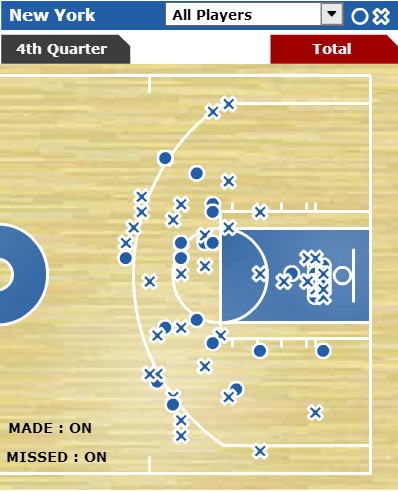
New York Knicks, December 11 versus Chicago

3 ChiNY 121113

This was perhaps the ugliest game I’ve watched all season. The Knicks took a ton of mid-range shots, especially from above the elbow, and shot only two corner threes. For the season, they’re in the top-10 in both mid-range shots attempted and above the break threes, but in the bottom-10 everywhere else.

Gross.

The Knicks won, though, 83-78.

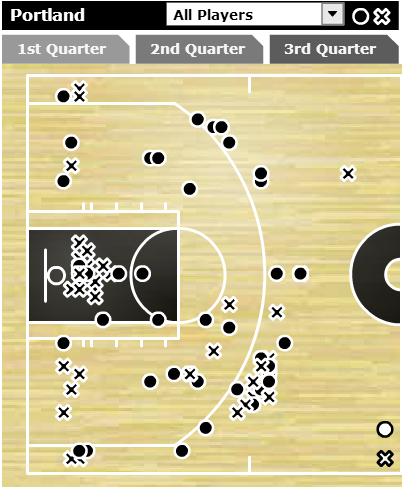
Houston Rockets and Portland Trail Blazers, December 12

4 HouPor 121213

Perhaps my favorite game of the season and definitely one that put Portland on the national spotlight if they weren’t already there. It was a contrast in styles. Both teams like to tee off from the arc, but Portland takes three times as many mid-range shots per game than Houston. In fact, every other team takes at least twice as many as the Morey Ball-Rockets.

LaMarcus Aldridge didn’t care, draining a of those mid-rangers in the chart above. Portland won, 111-104.

San Antonio Spurs, December 13 versus Minnesota

5 SaMin 121313 (2)

The Spurs really enjoyed that right corner three, a total of seven shots made from there. It’s just too hard to win games when your opponent scores over 20 points from the corner like that. Three of those corner threes came in the fourth quarter when the Spurs outscored the Timberwolves 37-21. It was quite the answer to Minnesota outscoring them 35-18 in the third, thanks to Kevin Love’s three-point barrage.

The Spurs won, 117-110.

Atlanta Hawks, December 14 at New York

atlantaNY121413 - Copy

Another Morey Ball shot chart. Barely any mid-range shots were taken, with a ton of those shots instead going towards threes, including a bunch from the corners. Atlanta took 32 attempts from the arc that night, making 15. 10 of those came from Louis Williams and Kyle Korver.

The Knicks still won, though, 111-106. Maybe they’ll trade for Kyle Lowry after all.

Portland Trail Blazers, December 14 at Philadelphia

PorPhi 121413 - Copy

So. Many. Threes.

Portland had a night reminiscent of when my rosters on NBA 2K6 had ratings of 99. They couldn’t miss (21 threes), they dished (41 assists), and they won in a blowout (139-105). Had the Trail Blazers scored one more point, they would’ve been the 11th team in league history to score 140 points while taking less than 20 free throw attempts.

Regardless, they set a franchise record with their made threes. It’s just not fair when a team takes nearly 40 shots from the arc and makes over half.

All shot charts from ESPN.com

A look at the Atlanta Hawks’ schedule amid trade rumors

3770284350_56a8905fce_o

via Flickr

We’re now past December 15, the date free agents become eligible to be traded. Paul Millsap, for example, goes from off limits to a very nice trade piece the Hawks can bait other teams with, specifically Houston for Omer Asik. Atlanta also has plenty of other friendly contracts at their disposal.

The schedule for the rest of the month might make it difficult for the Hawks to make immediate moves, however, or at least ones meant to help get in the lottery. Check out how soft the rest of December is for them:

Date Team Home/Away Record
Tonight Los Angeles Lakers Home 11-12
Wed, Dec 18 Sacramento Home 7-15
Fri, Dec 20 Utah Home 6-20
Mon, Dec 23 Miami Away 17-6
Thu, Dec 26 Cleveland Away 9-14
Sat, Dec 28 Charlotte Home 10-14
Sun, Dec 29 Orlando Away 7-17
Tue, Dec 31 Boston Away 11-14
Totals   4-4 78-112

It’s an interesting predicament when Atlanta can swap their first round pick with Brooklyn, who’s (sadly) less than two games away from the eighth seed and faces a favorable schedule this week: versus Philadelphia, versus Washington, then at Philadelphia on Monday, Wednesday and Friday, respectively.

Several teams out East are lurking under .500 anyway, a winning streak away from looking like a contender for the playoffs or a losing streak away from hopping into the abundance of tanks waiting for them. Even Chicago, injury-plagued for the second straight season, might choose to rebuild by putting Luol Deng and Carlos Boozer on the trading block. That makes it tempting for Atlanta to make a clear run at the third seed in the East when so many others are a potential step or two ahead in regards to accumulating lottery balls.

But at best, there’s a very small chance the Hawks go further than the second round of the playoffs. Atlanta’s schedule in January looks brutal anyway, playing Golden State, Chicago, Brooklyn, Indiana, Houston, Memphis, Brooklyn again, and Miami over the first three weeks and in that order. San Antonio and Oklahoma City lurk in the final week, topping off what could be a decent pile of losses.

This isn’t meant to say Atlanta would base any season-altering move just by looking at who’s on the schedule, but going possibly 18-14 through December or finishing January a few games under .500, for example, could help dictate how the Hawks finish in April and what their roster looks like by then. They could move some pieces before 2014 and use their January schedule to slowly but surely make their way into the lottery, or they could just as likely rack up wins the rest of December, tread water through January, and sell a round or two of playoff tickets in the spring.

Atlanta could always make a trade later in the season too, though a rim protector like Asik likely won’t be up for grabs by then. Regardless, the Hawks are set up as a landing spot for a valuable asset should another one become available.

LaMarcus Aldridge’s rebounding compared to Rasheed Wallace’s

Tiago Hammil | Flickr

Tiago Hammil | Flickr

Over the last decade or so, a few of the NBA’s premier forwards have been with the Portland Trail Blazers. Rasheed Wallace was traded when Zach Randolph‘s career was just getting started, then Randolph was traded just when LaMarcus Aldridge became (and remains) a building block for Portland. Of the three forwards, Aldridge is the only one who’s kept his head on straight through the first half of his career. Let’s hope that doesn’t change.

And last night against Houston, Aldridge became the only one of the three to accomplish the statistical feat of 30+ points and 25 rebounds as a Blazer. No player in the franchise’s history had accomplished that. One particular offensive rebound — leading to a bucket and a foul — triggered memories of Wallace a decade ago. Where was this when ‘Sheed was in his prime? He’s one of my favorite players ever, but I can’t get past him never averaging 20 points and 10 rebounds (let alone nine) for a single year. More on his rebounding in a bit.

Aldridge has been on an absolute tear recently, averaging 13 rebounds in his last 10 games along with 25.9 points, 2.9 assists, just 1.3 turnovers, and 1.5 fouls. The rebounding numbers are a little misleading since Aldridge is the only rebounder in the top 25 to grab less than 30 percent of contested boards, according to SportVU, but it’s nonetheless impressive.

We know now that Wallace never became elite on the glass, but Aldridge had only been an average rebounder going into this season, similar to ‘Sheed at the same stage of his career. Because of that, I wanted to look at the two forwards who came to Portland ten years apart and their rebounding, specifically between the ages of 25 to 28 when both came into their own as players. 

We’ll start with their rebounding stats per-36 minutes:

Player Season ORB DRB TRB PTS
Rasheed Wallace 2000-03 1.7 5.8 7.4 17.8
LaMarcus Aldridge 2011-14 2.7 5.7 8.4 20.6

Adding field goal attempts, free throws, etc. was tempting, but those stats don’t necessarily make rebounding much worse if at all. (You’ll see in the next graph that ‘Sheed’s rebounding actually improved when he started taking threes.) From the per-36 numbers, though, neither player’s rebounding stats are all that impressive. Wallace’s look quite terrible.

We can see if those numbers by either player deceive or confirm how they look in a table showing the percentage of rebounds they grab while on the court:

Player  Season Age G PER 3PAr ORB% DRB% TRB% USG%
Rasheed Wallace 1999-00 25 81 18.1 0.048 5.6% 17.2% 11.7% 21.9%
Rasheed Wallace 2000-01 26 77 20.9 0.138 6.2% 17.9% 12.2% 23.4%
Rasheed Wallace 2001-02 27 79 19.3 0.246 5.3% 20.4% 12.8% 23.7%
Rasheed Wallace 2002-03 28 74 18.5 0.281 5.1% 19.6% 12.3% 23.3%
Total 2000-03   311 19.2 0.182 5.6% 18.8% 12.3% 23.1%
LaMarcus Aldridge
2010-11 25 81 21.5 0.016 10.1% 17.2% 13.5% 25.7%
LaMarcus Aldridge
2011-12 26 55 22.7 0.012 8.6% 17.5% 12.9% 27.0%
LaMarcus Aldridge 2012-13 27 74 20.4 0.011 7.2% 20.9% 14.0% 26.5%
LaMarcus Aldridge 2013-14 28 23 23.8 0.004 6.7% 24.7% 15.8 28.7%
Total 2011-14   233 21.6 0.012 8.5% 19.1% 13.7% 26.5%

Worth noting: Last night, Aldridge nearly doubled his percentages coming into the game, getting 12.2 percent of available offensive rebounds, 45 percent of defensive ones, and 29.2 percent total.

Neither player’s total rebounding percentage over a four-year span lights up the league, though. Among the 290 forwards and centers from 2011 to 2014 (minimum 40 games played), Aldridge is ranked 119th. As for Wallace, from 2000 to 2003 (minimum 50 games), he was 163rd out of 279. Aldridge sits between the top-third and top-half of the league, Wallace lies between the bottom-half and bottom-third with a percentage less than Eddy Curry‘s, post-surgery Tom Gugliotta‘s, Keith Van Horn‘s, and Dirk Nowitzki‘s, among other players not known for their rebounding either.

What separates Aldridge from Wallace a decade ago is the offensive glass, even if Aldridge’s seems to be declining each season. Like mentioned earlier, Wallace’s rebounding percentages increased when he started taking threes, but the offensive rebounding dipped slightly. He was 226th out of 279 forwards and centers in offensive rebounding percentage while Aldridge is currently 125th out of 290, a clear difference between terrible and average.

Rasheed  Wallace in Detroit. (Keith Allison via Flickr)

Rasheed Wallace as a Piston in 2008. (Keith Allison via Flickr)

Personnel also affects rebounding totals. There’s just not as many rebounds available when playing alongside Marcus Camby and Gerald Wallace, which Aldridge occasionally did during 2011 and 2012. His rebounding improved when playing alongside J.J. Hickson and Nicholas Batum, the former replaced by Robin Lopez this season. 

It’s a similar case for Wallace, who played with Brian Grant (traded after ’00) and Arvydas Sabonis in through ’01 before improving in defensive rebounding with Dale Davis at center. Sabonis came back in ’03 to play a limited role.

Regardless, Portland was a top-10 team in total rebound percentage from ’00 to ’03, according to NBA.com. They were also in the top-eight each year in offensive rebounding and no worse than 12th in defensive boards.  The Blazers from ’11 to ’14 were hot and cold on the glass, though. In their seasons as a playoff team — ’11 and likely ’14 — they’ve been both the best offensive rebounding teams and at stopping the fast break. In their lottery-bound seasons of ’12 and ’13, however, they were a bottom-10 team in each category. Defensive rebounding percentage over those four seasons has been consistently below average, never above 18th.

In the years following ‘Sheed’s stint with Portland, his rebounding percentages fluctuated. They were often higher in Detroit but dipping in Boston. (Bill Simmons was especially not happy with his performance as a Celtic.) As for his cup of coffee with New York, I pretend it doesn’t really exist.

Meanwhile, Aldridge’s rebounding used to be something that neither jumped out nor was worth getting too frustrated about. Through one-fourth of this season, it’s helped him become an MVP candidate.

Can he keep it up?

All statistics via Basketball-Reference unless noted otherwise.
Rudy Gay’s $19.3 million player option

9163148927_7c092524b4_o

via Flickr

Before looking at Rudy Gay, let’s take a moment to remember the December 9, 2013 Sacramento Kings who blew out Dallas, mostly thanks to the combined 87 points from DeMarcus Cousins, Isaiah Thomas, and Derrick Williams. Basketball-Reference should commemorate them by giving them their own team page.

You can do a simple Google search about the trade sending Gay to Sacramento and discover just how many people wanted to chime in on it. While the trade is certainly worthy of discussion, I’ll look at what I find most interesting about it: the $19.3 million player option Gay can exercise next season.

By trading for Gay, the Kings hope he doesn’t take the last year of an $82 million contract he signed with Memphis back in 2010. If he indeed doesn’t and the Kings let him walk this summer, the trade is a salary dump both ways. Each team sheds the salaries of players not in their long-term future and spends it more wisely elsewhere. Sacramento needs some of that money Gay would turn down in order to re-sign Isaiah Thomas, one of the best reserves in the NBA before the trade. They’ll have to work around the luxury tax if Gay chooses the $19.3 million, the tax being an embarrassing obstacle for a team that’s shown signs of hope but is not yet a playoff contender.

And at this point, taking the player option would be Gay’s best move. Sure, players generally prefer more years of guaranteed money, even if the annual salary is cheaper than their player option since injuries, among other things, can derail future earnings. However, Zach Lowe at Grantland made a good point. Players like Andrei Kirilenko have opted out of the final year of their contracts, but they didn’t turn down anything close to the $19 million and change that Gay can take.

Gay’s value is also at its all-time lowest. He’s 27 and about to enter his prime, yet Toronto only got John Salmons, Greivis Vazquez, Chuck Hayes, and Patrick Patterson in return. Three of those players are decent pieces on a good team, but that’s not even close to the haul you’d expect in exchange for someone paid like a superstar, save for Amar’e Stoudemire’s uninsured knees. In the same column by Lowe, he writes that some GMs wouldn’t even want Gay for the midlevel exception, an amount only a fraction of what the player option would pay out.

But Sacramento was interested in the small forward, and there’s a chance it could work out better for them than it did for Toronto. For one, the Raptors already had a high volume-shooting wing in DeMar DeRozan while Sacramento has Derrick Williams and Ben McLemore, two likely starters who play much better off the ball at this point in their careers. Gay’s also replacing one of the worst starting small forwards in the league in John Salmons, whose PER so far is nearly half of Gay’s.

The problem lies in how he works with DeMarcus Cousins and Isaiah Thomas, who have usage rates of 35 and 28 percent, respectively. Both will now be in the starting lineup with Gay, thanks to the trade, and both need the ball. They’ve certainly been more efficient with it than Gay has, and if the former Raptor continues using possessions at his current rate (about 30 percent), this makes the trade a potential disaster. Bad times all around, both on the court and in the checkbook.

Neither result bodes all that well for Sacramento anyway. If Gay fits in well and the Kings win a few more games than expected, they lessen the value of their first round pick in the upcoming draft. Even more confusing is if it brings Gay’s value up to the point he tests free agency, meaning Sacramento may get nothing in return for him and, in the process, worsen their No. 1 pick in a loaded draft.

If Gay doesn’t work out in Sacramento and his current value somehow continues to decline, then he’s better suited to exercise his player option, which also sets the franchise back yet another season. Sacramento could avoid the $19.3 million and end the paranoia altogether by offering a salary at about half the price but with long-term security for Gay, say $46 million for four years, but that only creates more problems down the road.

All of this is the cost of acquiring Rudy Gay, whose stock continues to drop but price tag only gets more expensive. That’s no longer Toronto’s problem, but Sacramento’s.

For more Rudy Gay-related postings, check this out.