Tag Archives: LeBron James

Game-by-game shot locations for each team

About two months ago, I wrote a few things about the Knicks and their excessive shooting from the perimeter. Part of what was looked at were game-by-game shot locations for teams from NBA.com, but ever since writing that post there wasn’t a whole lot of usefulness with a season’s worth of shot location logging when it came to presenting it.

With the season concluding last night, however, I decided to release the entire document in this post. Along with that, I made three tables to highlight some of the best and worst performances by teams from each of the five spots on the floor: restricted area, paint non-restricted area, mid-range, corner three, and the above the break three. Unfortunately, I never tracked free throws. Maybe next season.

The three separate tables include the top 10 games with the most and least field goals made from each spot, most and least field goals attempted, and the hottest and coldest performances from each shot location. (Scroll a little further down in each table for the least/coldest shooting games.) For some categories with ties, I included a few extra games just because.

Some teams will dominate certain categories, for better or for worse, like how some may expect Houston to make a joke of the least mid-range field goals attempted. For every table I’ll also include some notes, something like a tl;dr section.

Anyway, the first table is the most/least field goals made from each location. You can toggle through each location with links to them at the bottom of each table. Again, for the entire document, this link should do the trick along with sheets detailing percentage of attempts outside the paint and percentage of attempts in high-efficiency spots versus dead zones.

Restricted Area: Not surprisingly, the Los Angeles Lakers got fried around the rim while the opposite can be said for the Pacers. All of the latter’s appearances in the least attempts around the rim came before the all-star break, but it shows just how suffocating they’ve been when clicking 100 percent.

Paint Non-RA: A good mix of teams and opponents for the most makes. Another not-so-surprising stat is how many games played out where a team was scoreless from this location: well over 40.

Mid-Range: The teams that shoot a ton from this location (Portland, New York, Orlando) make the list for most field goals made, Portland being at the top thanks to a 26-for-49 outing against non other than a team like Indiana. Houston and Detroit, the former neglecting this location while the other can’t space the floor all that well, fill up over half the slots for the least field goals made.

Corner 3: A mix of teams and opponents for both categories. A lot of struggling defenses gave up the most threes from the corner, however. Washington is the only team to make 10 in one game with Milwaukee being the casualty.

Above the break 3: Another variety of teams. Minnesota, one of the most frustrating teams from beyond the arc (in my opinion), actually makes the top 10 twice. More of the typical struggling teams from the perimeter crack the bottom 10: Memphis, Philadelphia, Detroit, Utah. Memphis is the only team to make no above the break threes in a game. Their opponent? Chicago.

Onto most and least field goals attempted:

Restricted Area: Detroit, a team that feasts around the rim, naturally is featured here. Philadelphia and Houston unsurprisingly crack the top 10 as well. The results for the bottom 10 may or may not be expected as well. Teams like Brooklyn, Boston, and New York make that list. Sacramento has the lowest attempts with 8. Crazy. That’s 45 less attempts than the leading Detroit.

Paint-Non RA: A mix of good defenses allowing the most attempts and bad ones allowing the least from this location. The Kings are a surprise in the top 10, however, making the list as an opponent three times. Some good and struggling offenses make the bottom 10 in attempts with Miami and New York each making it twice and Chicago once.

Mid-Range: Houston makes a joke of the bottom 10 attempts in a game. There’s a wider variety in the top 10 but Portland, Boston, and Washington unsurprisingly are featured. Indiana and Chicago account for half the opponents in that top 10.

Corner 3: Some brutal defenses make up the opponents in the top 10 with a mix of solid offenses as the ones teeing off from the corners. The opposite can be said for the bottom 10. Yeesh. 14 times has a team attempted no threes from the corner. Some good defenses and ones that struggle but do take away the corner (Portland) are the opponents during those games.

Above the break 3: A bunch of games that went into overtime make up the top along with a lot of solid teams and…Philadelphia. At the bottom, New Orleans and Memphis make up 2/3 of it with the latter shooting the least amount of threes from above the break with 3. Sigh.

Lastly, hottest and coldest shooting:

Restricted Area: Oklahoma City makes the top 10 multiple times, but Miami is absent despite their trio of LeBron James, Dwyane Wade, and Chris Bosh all feasting from that location. A few of the struggling offenses make up the bottom, as usual. No team missed 75 percent of their attempts, however, so there’s that.

Paint Non-RA: Tons of scoreless outings from this spot on the floor with the hottest shooting coming from less than 10 attempts. Dallas, Chicago, and New York are the only ones to shoot perfectly.

Mid-Range: Quite a few brutal nights, with New York’s Knicksy performance at Milwaukee probably being the worst. Brooklyn, with all the decent shooting they have, holds the worst park percentage-wise, however, at 19 percent on 4-for-21 shooting. Ouchies!

Corner 3: Lots of perfection here with New York’s KNICKSY game at Milwaukee topping all others. The worst outings come against a mix of both good and bad defenses. Not surprising, though, with how only a handful attempts or so available each game.

Above the Break 3: Indiana and Chicago each allowed a couple of the best shooting nights, though against respectable teams in the Suns and Clippers, respectively. There have sadly been 13 scoreless games from this location with the usual struggling teams from the arc being featured. Utah holds the worst performance at 0-for-14 against Dallas from just over a week ago.

But that’s it! A brief summary of each location. To explore the entire document and some other sheets I fooled around with from earlier posts, click here. Unfortunately, as someone not too experienced with Google Sheets, I can’t figure out a way to sort through columns. Any help would be appreciated since it’d be nice to let others sort their way through the document.

Other than that, enjoy the break until the playoffs.

As a reminder, all stats are according to NBA.com.
Point distribution charts of the top 10 scorers

After experimenting with point distribution charts for teams and with J.R. Smith’s shooting explosion, I thought it’d be fun to apply the same ones for the top 10 players in points per game this season.

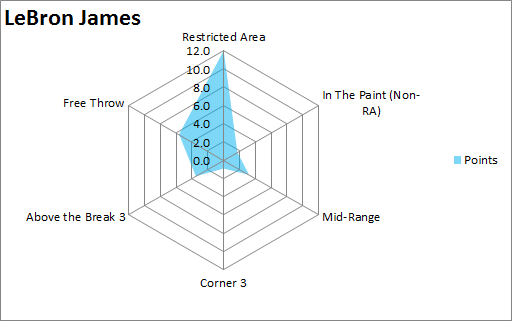
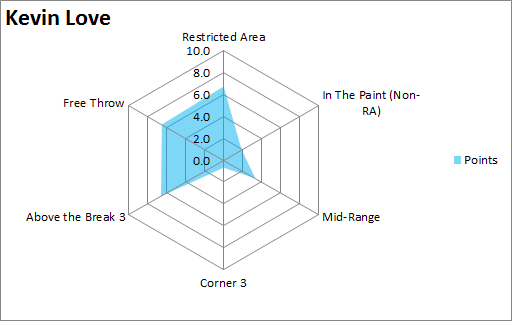
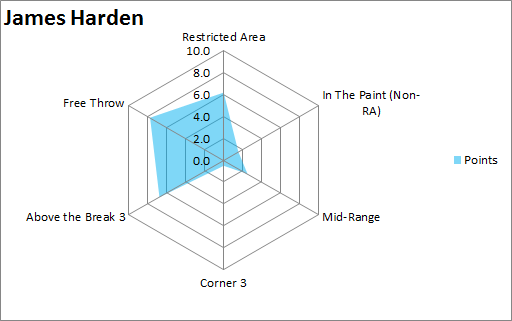
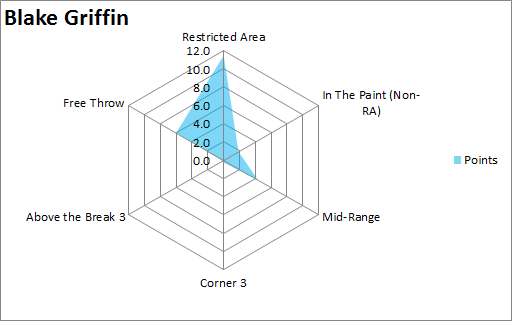
As usual, these graphs visualize points per game across six different locations on the floor: restricted area, in the paint (non-RA), mid-range, corner three, above the break three, and three throws. This time however, those graphs of the 10 players will also include the exact points per location below them and where that production ranks among the 480 players to log playing time this season. All of that is according to NBA.com.

Also, the axis for the 10 players will vary depending on the player, but at the very end of the post I’ll make a common one to show each of the 10 charts in a single GIF, sorted from the highest scorer to the lowest.

With all that said, here are the point distribution charts of those at or near the top in points per game:

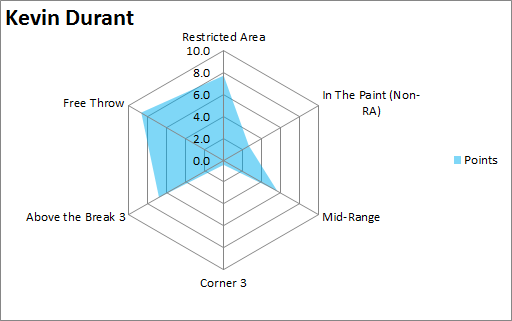
1. Kevin Durant – 32.0 points per game

Kevin  Durant 10 axis

Points per location:

  • Restricted area: 7.71 (14th)
  • Paint (non-RA):  2.65 (21st)
  • Mid-range: 5.66 (8th)
  • Corner 3: 0.43 (209th)
  • Above the Break 3: 6.82 (4th)
  • Free throw: 8.69 (1st)

To get a feel for just how large Kevin Durant’s graph and others on this list really are, we can compare the league’s leading scorer to Kendrick Perkins’ graph because PERK:

durant perk

Click to enlarge.

Perk’s looks minuscule compared to Durant’s, who’s just an offensive shark and in the top 25 in every category except corner threes. It might also be worth noting that just behind Durant in points around the rim per game is none other than Tony Wroten, somehow at 7.62 points per game and good for 17th-best.

As for three-pointers, I’m not sure how common this is and how often it’s been noted before, but Durant shoots better on pull-up attempts (42 percent) than catch and shoot ones (38.7), according to SportVU. Weird, maybe?

Onto number two in points per game:

2. Carmelo Anthony – 27.5 points per game

Carmelo  Anthony 10 axis

Points per location:

  • Restricted area: 5.04 (76th)
  • Paint non-RA:  1.20 (tied-108th)
  • Mid-range:  8.77 (3rd)
  • Corner 3: 0.52 (182nd)
  • Above the Break 3: 6.08 (9th)
  • Free throw: 5.92 (7th)

One of the more unusual charts I’ve looked at, Anthony gets a respectable share of points around the rim but he’s in the middle of the pack when compared with the top 10 in points per game. Ahead of him across the league are the likes of Timofey Mozgod, Alec Burks, and Tobias Harris. Melo also gets very little points from the corner three, but that’s common for high scorers with range.

As for the above the break threes, Anthony’s one of five on this list to crack the top 10 in points from that area of the floor. He also feasts at the line, another common theme with the top scorers.

What makes Anthony’s chart so odd is the mid-range game. This is the first chart where I’ve noticed both a great deal of points in the high-efficiency zones of the floor and the dead zones. Durant’s is like that, but not to the extent of Melo’s.

3. LeBron James – 27.0 points per game

LeBron  James PPL

Points per location:

  • Restricted area: 12.00 (1st)
  • Paint (non-RA): 1.73 (60th)
  • Mid-range: 3.20 (68th)
  • Corner 3: 0.92 (108th)
  • Above the Break 3: 3.52 (57th)
  • Free throw: 5.64 (8th)

Confirmed: LeBron James feasts around the rim. He made me change the range on his chart to a max of 12 points per location, though a couple other players eventually did the same thing so whatever. His graph is a good example of an efficient one, though, and how it should show quite a few points on the left side. In fact, out of the top 10 scorers, James is the second-most Moreyball-like of the top 10 scorers in that 81.75 percent of his points come around the rim, from three, or from the stripe.

You might be able to guess who’s in first place on that list. Third place in that mentioned stat is…

4. Kevin Love – 25.8 points per game

Kevin  Love PPL 10 axis

Points per location:

  • Restricted area: 6.73 (26th)
  • Paint (non-RA): 1.89 (47th)
  • Mid-range:  3.35 (59th)
  • Corner 3: 0.69 (144th)
  • Above the Break 3: 6.61 (6th)
  • Free throw: 6.51 (3rd)

Love’s the first player on this list to not lead or be near the top in averages from one of the first three shot locations. In terms of non-point guards in this list (eight players), he averages the least amount of points from those first few spots but still gets a decent amount from around the rim.

Love’s graph is the prototypical efficient kind anyway, confirming how he scores nearly 80 percent of his points either around the rim, from three, or from the stripe. The king of efficiency among this group goes to the league’s fifth-leading scorer, however:

5. James Harden – 25.3 points per game

James  Harden PPL 10 axis

Points per location:

  • Restricted area: 6.17 (37th)
  • Paint (non-RA): 1.54 (tied-70th)
  • Mid-range: 2.51 (89th)
  • Corner 3: 0.51 (185th)
  • Above the Break 3: 6.77 (5th)
  • Free throw: 7.76 (2nd)

Nearly 85 percent of Harden’s points come from the spots that generate the most points per attempt, though he’s still in the top 100 in each of the least-efficient locations. He’s also the only player besides Durant to be in the top five in points from both above the break threes and free throws per game, though Kevin Love narrowly misses out on joining that club too.

6. Blake Griffin – 24.1 points per game

Blake  Griffin 12 axis

Points per location:

  • Restricted area: 11.46 (2nd)
  • Paint (non-RA): 1.87 (tied-49th)
  • Mid-range: 4.33 (23rd)
  • Corner 3: 0.27 (240th)
  • Above the Break 3: 0.15 (tied-301st)
  • Free throw:  6.00 (6th)

Just how many of Griffin’s points from the non-restricted area part of the paint are from either dunks or near-dunks that turned into double-pump layups? Regardless, we have our first near-triangular chart and the second player to score over 10 points per game from a single shot location. There’s also a smidge of blue crossing over the three-point areas thanks to whatever plays were drawn up to get Griffin a score from there.

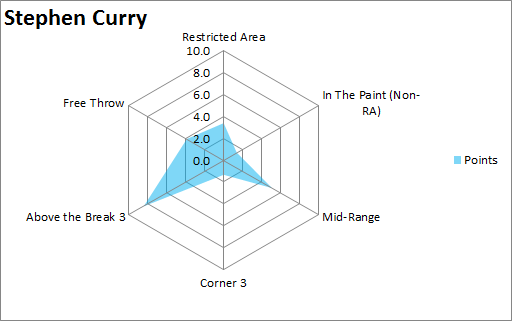
7. Stephen Curry – 23.5 points per game

Stephen  Curry 10 axis

Points per location:

  • Restricted area: 3.38 (137th)
  • Paint (non-RA):  1.38 (86th)
  • Mid-range:  5.11 (13th)
  • Corner 3: 1.34 (63rd)
  • Above the Break 3: 8.43 (1st)
  • Free throw: 3.88 (31st)

Arguably the most unusual chart, in my opinion. Curry feasts from outside the paint, one of the stats worth noting being that he averages over one more point per game from the above the break three than third-place Damian LillardRyan Anderson is in second-place at 7.8 but…sigh.

8. LaMarcus Aldridge – 23.3 points per game

LaMarcus  Aldridge 12 axis

Points per location:

  • Restricted area: 5.70 (53rd)
  • Paint (non-RA):  2.15 (36th)
  • Mid-range:  10.96 (1st)
  • Corner 3: 0.00 (Meh, tied for last)
  • Above the Break 3: 0.13 (308th)
  • Free throw: 4.33 (21st)

Maybe worth noting, maybe not: It took until Aldridge to get to a player who hasn’t made a corner three this season.

And that mid-range game. Aldridge looks like the least-efficient of this bunch as over half of his points come from the dead zones of the floor. In fact, while he scores a whole two more points from mid-range than second-place Dirk Nowitki, he averages nearly six more possible points (25.94 total for LMA) from that area than second-place Carmelo Anthony (20.00) in that stat. Unfortunately, he can’t make every one of those attempts and average nearly 40 points per game. Shucks.

9. DeMar DeRozan – 22.7 points per game.

DeMar  DeRozan 10 axis

Points per location:

  • Restricted area: 4.29 (97th)
  • Paint (non-RA):  2.13 (tied-37th)
  • Mid-range:  7.42 (4th)
  • Corner 3: 1.46 (51st)
  • Above the Break 3: 0.91 (233rd)
  • Free throw: 6.50 (4th)

Among this list, DeRozan’s chart is my favorite just from the shape his points form.

But, like Aldridge, it’s a bit of a weird one. DeRozan sits comfortably in fourth place in mid-range points, but he only makes a shade under 40 percent of his attempts. He does score the most points per game from the corner three among this group, however, and gets a decent chunk from the free throw line as well, more than the likes of Melo, LeBron, and Paul George, among others.

10. DeMarcus Cousins – 22.4 points per game

DeMarcus  Cousins 10 axis

Points per location:

  • Restricted area: 9.62 (6th)
  • Paint (non-RA):  2.75 (16th)
  • Mid-range:  4.03 (36th)
  • Corner 3: 0.00 (somewhere in last place)
  • Above the Break 3: 0.00 (take more threes, Boogie!)
  • Free throw: 6.01 (5th)

The most triangular chart of the top 10 scorers, Boogie feasts in the paint, at the line and, um, sometimes from mid-range where me makes 41 percent of his attempts.

That triangle, though. It’s pretty neat, so there’s that.

Lastly, below is a GIF comparing each chart at once. It goes in the order of highest-scoring to the lowest:

Top 10 scorers on Make A Gif

All but Aldridge score at least half their points on locations in the center or left side of the graph. Harden’s chart seems to be the most efficient, though LeBron is just too effective around the rim. Regardless, it’s nice to see a variety of charts, especially the triangles. Don’t forget the triangles.

Any other thoughts are certainly welcome.

When a prospect slips in the draft, how much salary do they lose?

This post has been revised after noticing a mistake in salaries of four-year rookie contracts. My air head regrets the error. 

With top college basketball players declaring for the draft left and right save for Jabari Parker, whose decision seems very much up in the air, I looked at the contracts for first round picks and how much money is really lost when top prospects slide in the draft. There are also cases when a player like Anthony Bennett gets drafted, when a team either reaches for a draftee or takes a player that might not have been on the radar for that draft slot.

But to start, contracts for first round picks are scaled ahead of time (up to the year 2020 can be found here) with teams having the option to offer as little as 80 percent of the fixed price or as high as 120 percent, according to Larry Coon’s cbafaq.com. Players often have that slight raise with Anthony Davis as just one example, but taking less than the slot scale has happened before thanks to Andre Roberson. Those contracts can last up to four years, but teams have options after the first two seasons to either release their once-first rounders or hold onto them at what’s likely a bargain price.

Below is a table looking at the scaled salaries for first rounders in the 2014 NBA Draft, sorted by draft slots. The first sheet is the combined salary, year after year, of the first four years. That’s assuming they all play through their rookie contracts and take the slight raise that teams can offer. The second sheet is the salary each season with the raise percentage they could get in their fourth.

But the first sheet is most important as it’ll be applied to a second batch of tables comparing how much money could be lost between draft slots. Take a look at the most money each slot could make through their first four seasons:

For a player like Anthony Davis, whose combined salary over four years is around that $20 million range, he makes as much over those seasons as Carmelo Anthony, Dwight Howard and LeBron James make this season alone, among others. But that’s for Davis, who was drafted first overall in 2012. The 8th pick in the 2014 NBA Draft will make just under half of the 1st overall pick’s salary over four years (unless their contract includes incentives).

It’s simply a huge get for a franchise to score a first round pick that’s not only productive and can stay in the league, but an overall positive on the court. The sooner they’re a positive contributor the better, obviously, but even if a player hangs on for three years of his contract despite producing little and then becomes a key cog in Year 4, it still seems worth it given how many contracts around the $10 million/year range end up not so terrific. Looks like fun times all around for teams with those first rounders.

As for the draft prospects projected to go in the first round, slipping in the draft may provide positives such as a chip on their shoulder and a better fit with a better team. However, depending on how far a prospect slides and how high they were slated to go, it can be quite a blow to their bank account. For example, if the first overall pick and sixth of the 2014 Draft each play out all four years of their rookie contract (and take that raise they can be offered), the difference in salary between them is over $10 million. Maybe something comes up with Joel Embiid that hurts his draft stock or teams have second thoughts on Andrew Wiggins, who knows. Crazier things have happened, for better or for worse.

Regardless, dropping in the draft means an obvious decline in the salary they can earn and below are tables hopefully showing the difference for each draft pick over the course of two, three, and four seasons under their scaled pay. Again, that includes taking the slight raise they can be offered. Salary lost is in parenthesis while salary gained — if a prospect is drafted ahead of their projected slot or range — is not.

Also, because the sheets were fairly large, I made columns of draft slots on the bottom of them and to the right side in case it becomes hard to tell which draft slot is which. Anyway, take a look if you’d like:

Jabari Parker could very well be that player who slips in the draft not because of a performance issue but the overall talent that’s at the top. Is it worth it for him to trade being a top-5, maybe top-7 pick in this year’s draft in exchange for being a top-3 pick in 2015 and Duke being a title contender next year?

Some other highly-touted prospect is bound to drop in the draft regardless, but hopefully to a team that he’ll fit right in with. Trey Burke, Gorgui Dieng, and Tim Hardaway Jr. probably weren’t the ninth, 21st, and 24th-best available players in last year’s draft but they all look like they’ll end up as solid gets for the teams that chose them.

Which players will be this season’s Burke, Dieng, or Hardaway? Better yet, will anyone be the next Anthony Bennett in terms of rising in the draft for whatever reason? I guess we’ll have to wait, um, like 76 more days for all of this, though. Ugh, but if some player drops or rises then hopefully the tables posted above can help look at the impact it’ll have in their paychecks.

Any other thoughts are certainly welcome. You can find previous years here.

East vs. West Week 23: Counting down to the last of the 450 games

Another week, another updated week-by-week breakdown:

The most exciting non-conference game of the week had to go to Minnesota traveling to Miami and winning in double overtime, much of it thanks to Kevin Love’s ridiculous shot making and Ricky Rubio carving up a hyper Heat defense. LeBron James and Chris Bosh weren’t too bad for the Heat, though, among other players. Dwyane Wade didn’t play because of a lingering hamstring injury.

Houston also lost their last two non-conference games, falling to the Nets and Raptors. Aside from all but guaranteeing the Rockets the fourth seed in the West, it also meant that San Antonio clinches the best record against the East at 24-6 while the Lakers and Kings are tied for the worst at 12-18 each. Neither hold a candle to Milwaukee’s 3-27 record in non-conference play, however, and the Bucks, 76ers, Magic, Celtics, and Pistons are collectively 100 games under .500 against the West, a combined record of 24-124 with the 76ers and Pistons finishing up the season with Memphis and Oklahoma City, respectively.

Maybe that’ll lead to an uptick in the West’s point differential, which I also updated from last week’s post. It hardly changed, but probably worth noting where it ranks in non-conference play since 1997 anyway:

Lastly, here’s the 212,749,834,9a8,943,f92th reminder about the West’s possible record-breaking winning percentage: They’d have to finish their last five games 4-1 to tie 2004’s 63.3 winning percentage and win all five to break it.

Below are those final non-conference games this season:

The last three games look very winnable for the West while the first two are something of a toss-up. Maybe they’ll split? Miami and Minnesota will be playing the tail-end of back-to-backs, however, with the first games against Brooklyn and San Antonio, respectively. Not the easiest two consecutive games for either team, especially when Minnesota has been without Nikola Pekovic, Kevin Martin, and about half the roster recently.

Updated point distributions in graphs

About a month ago, I fiddled around with graphs visualizing how many points a team scores from specific shot locations. While it was something I enjoyed working on, there wasn’t a whole lot of space to include both GIFs and pictures while looking at the difference between a squad’s offense and defense. Back then, I went with GIFs but now I’ll include some photos of the graphs with updated percentages.

I also left off effective field goal percentage this time around so I wouldn’t flood a post with a ton of huge pictures. What’s left is a percentage of points a team scores at six areas on the floor: restricted area, in the paint (non-RA), mid-range, corner three, above the break three, and free throws.

In the future I’ll experiment more with these types of graphs, but for now these are the ones for each team over the entire season, both on offense and defense. They’ll probably appear blurry but clicking on the picture, then zooming in helps a ton.

Also, below the picture are links to team graphs for offense only and defense only. Enjoy, hopefully:

offense-defense

Offense-only graphs.

Defense-only graphs.

Similar to what I mentioned in the first post, the graphs for the best and worst offenses and defenses just aren’t the same as one another. Take the Heat, Clippers, and Mavericks as the top three offenses, for example. Thanks to LeBron James, Dwyane Wade and Chris Bosh, Miami scores a ton of their points in the restricted area — 36.5 percent, to be exact and fourth-highest in the league. Meanwhile, the Clippers are near the middle in point distribution from a few locations, but with the help of Blake Griffin they get just under one-fifth of their points from the free throw line. Dallas, with a nightmare of a scorer to gameplan for in Dirk Nowitzki, is weirdly balanced in all locations as they don’t appear too high or low in any of them.

Defenses are more similar as Indiana and Chicago both concede a bunch of points from mid-range. The Spurs and Warriors, in third and fourth place in defensive efficiency, respectively, have similar mid-range portions of the graph but allow more points in the paint (non-RA) region than the top two teams. Overall, it would seem like offenses would want their offenses to shift as far to the left side of the graph as possible and the opposite for defense.

I’ll actually admit these graphs are slightly misleading, one reason being that corner threes don’t jump out in them but are nonetheless important to team success. Attempts per location looked about the same and points per location was slightly different when comparing offense to defense. In the future, though, I’ll sort by the latter stat but I had a really weird time calculating it last night and this morning and ran out of time to put those graphs together.

Lastly, below are two tables of the top and bottom five teams in point distribution for each shot location. One table is for offense and the other for defense, starting with the former:

All stats, including ones used for tables and graphs, are according to NBA.com.